Home & Garden Insecticides
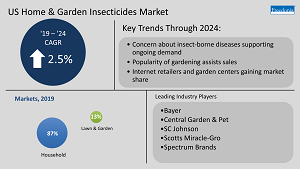
Demand for home and garden insecticides in the US is forecast to rise an average of 2.5% per year to $1.5 billion in 2024.
Free Sample Report
Request a free sample of this report and our team will email it to you.
Report Overview
Featuring 24 tables and 5 figures – now available in Excel and Powerpoint! Learn More
This report covers the US market for home and garden insecticides, which includes products used in residential settings by nonprofessional pesticide applicators. Service revenues and sales of pesticides to professional users are excluded from the scope of this study. Also excluded are alternative products such as traps, electronic repellents, and beneficial organisms.
Products include:
- household insect control products (e.g., for flying and crawling insects, fleas and ticks, other household pests such as mites and spiders)
- insect repellents (e.g., sprays intended for skin application, indoor repellents, insect repellents for use in outdoor living spaces)
- lawn and turf products, such as pyrethroids and neonicotinoids,
- garden care products
Demand is also segmented by formulation:
- liquids
- aerosols
- granules
- powders and dusts
- other formulation (e.g., gels, pastes, solid forms such as blocks and bars)
In addition, home and garden pesticide retail sales are analyzed with segments including:
- mass merchandisers
- home centers
- internet and mail order
- garden centers
- other retailers (e.g., hardware stores, feed and seed stores, drug stores, grocery stores, convenience stores)
Demand for home and garden insecticides in the US is forecast to rise an average of 2.5% per year to $1.5 billion in 2024. While sales growth will be limited by weak consumer spending in the wake of the COVID-19 pandemic, the necessity of insect control will sustain demand.
Concern About Insect-Borne Diseases Remains a Driver of Sales
Use of insect controls and insect repellents will be supported by consumer worries about insect-borne diseases, which will help to sustain an ongoing level of demand. The US is home to a variety of endemic but rare insect diseases, and periodic outbreaks of dangerous viruses tend to be highly publicized. In addition, globalization and climate change contribute to viruses from overseas occasionally gaining a foothold in the US. In recent years, the insect-borne diseases generating the most concern include West Nile virus, Lyme disease, Eastern equine encephalitis, and Jamestown Canyon virus.
Expanding Gardening Activity to Boost Demand
The US witnessed a boom in consumer gardening activity in 2020 as COVID-19 lockdowns left many consumers with increased free time to engage in home improvement projects. As a result, sales of insecticides for lawn and garden applications held up well in spite of a poor economic environment. Going forward, it is expected that the increased popularity of gardening will continue to at least some extent, sustaining relatively strong sales performance.
Non-DEET Insect Repellents Gaining Market Share
While DEET remains the most widely used active ingredient in insect repellents, DEET alternatives are rapidly gaining market share. In particular, oil of lemon eucalyptus products have performed well in recent years and are expected to continue posting fast growth. The strong health and environmental profile of oil of lemon eucalyptus repellents makes them popular for children and for backyard use. Picaridin-based products have also become increasingly common since first becoming available in 2005. These products are popular by being odorless and effective, although they tend to carry a price premium over DEET products and are less attractive than oil of lemon eucalyptus to environmentally minded customers.
- Executive Summary
- About this Report
- Report Details
- Study Scope & Product Description
- Impact of COVID-19 Pandemic
- Overview
- Historical Trends in Home & Garden Insecticide Use
- Demand by Formulation
- Insecticide Active Ingredient Trends
- Active Ingredient Prices
- Sustainability & Regulatory Trends
- Product Registration Requirements
- Conventional Pesticides
- Biopesticides
- Retail Trends
- Home & Garden Insecticide Retail Sales
- Mass Merchandisers
- Home Centers
- Internet & Mail Order
- Garden Centers
- Other Retailers
- Consumer Trends
- Consumer Pesticide Use by Demographic Group
- Why Consumers Do Not Use Home & Garden Pesticides
- Home & Garden Pesticide Feature Priorities
- Markets
- Demand by Market
- Household Insecticides
- Insect Control
- Insect Repellants
- Lawn & Garden Insecticides
- Lawn Care
- Garden Care
- Suppliers & Market Share
- Key Findings & Industry Composition
- Market Share
- Competitive Strategies
- Brand Name Recognition & Loyalty
- Product Line Extensions
- Proprietary Formulations
- Packaging & Convenience
- Marketing
- Appendix
- Scope
- Definitions
- Freedonia Methodology
- Study-Specific Methodology
- Sources
- Associations & Agencies
- Related Studies & Reports
- Macroeconomic Assumptions
- Economic Environment
- Demographic Trends
- Consumer Spending
- Housing Stock