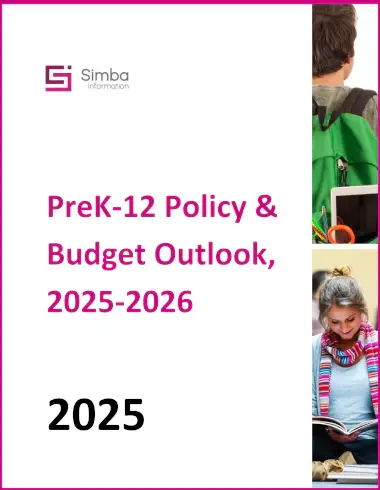
PreK-12 Policy and Budget Outlook 2025-2026 Report
The PreK-12 Policy & Budget Outlook 2025-2026 report reveals how federal cuts, shifting state priorities, and the end of ESSER funds are reshaping education budgets and decision-making. The report highlights the challenges facing instructional materials markets while identifying growth opportunities in AI, assessments, and career and technical education.
Free Sample Report
Request a free sample of this report and our team will email it to you.
Report Overview
A More Restrictive Funding Environment Requires Adaptability
Shrinking budgets, shifting legislative priorities, and heightened accountability standards are transforming the K–12 instructional materials market. This report explores how the expiration of federal relief is prompting districts to rely more heavily on core funding sources, how state-level disputes over curriculum and parental rights are influencing adoption timelines, and how financial constraints are fueling demand for affordable, high-quality learning resources.
Key Themes Covered in this Report:
- Federal & State Budget Trends: Analysis of 2025–2026 fiscal allocations across major programs including Title I, IDEA, Perkins V, and career and technical education (CTE).
- Policy Shifts: Tracking recent federal executive orders, Department of Education restructuring, and state-level moves around curriculum standards, parental rights, and diversity/DEI initiatives.
- Impact on Instructional Materials: District procurement decisions as they balance accountability mandates, digital equity initiatives, and instructional adoption processes shaped by literacy and math policy shifts.
- State Policy Case Studies: Detailed profiles highlighting how states like Texas, Florida, and California are driving adoption cycles, curriculum approvals, and budget reallocation.
- Forward-Looking Analysis: Forecasting market opportunities as districts prioritize sustainable procurement, targeted interventions, and flexible delivery formats in leaner financial environments.
PreK–12 Policy and Budget Outlook 2025–2026 offers a comprehensive examination of how funding flows and policy priorities are reshaping the K–12 instructional ecosystem. Drawing on federal budget documents, state-level appropriations, and district spending patterns, the report highlights the critical intersections between fiscal policy decisions and instructional material adoption.
Beyond examining federal program allocations and state-level legislation, the report also explores how political shifts, demographic pressures, and policy disputes over equity and accountability influence district purchasing and vendor positioning. It incorporates detailed analysis of Title I, IDEA, and Perkins V allocations; examines the impact of parental rights and DEI-related legislation at the state level; and assesses how district leaders are adjusting procurement strategies amid heightened accountability mandates. Expanded context includes case studies from states such as Texas, Florida, and California, as well as profiles of large urban districts navigating reduced discretionary budgets. The report also considers how smaller and rural districts, which often face disproportionate funding challenges, are adapting through consortia purchasing and innovative partnerships with regional service centers.
The analysis integrates proprietary forecasts, budget trend tables, and district procurement data, delivering actionable insights for market stakeholders. In addition, it places current fiscal developments within a historical continuum, comparing them to past cycles of austerity and stimulus to help stakeholders anticipate likely outcomes. It also presents scenario planning that anticipates both near-term adjustments—such as shifts in CTE and workforce development funding—and longer-term trajectories in K–12 funding and policy environments, including the implications of federal executive orders, potential realignments in Department of Education oversight, and the broader political climate that will shape education policy over the next decade.
PreK–12 Policy and Budget Outlook 2025–2026 Report Details
| Current Total Market Size | Not a revenue market but a federal/state budget environment: FY 2026 proposed U.S. Department of Education discretionary budget of $66.7B compared with $79.6B in FY 2025 (−15%). Senate drafts seek to restore DOE funding closer to FY 2025 levels. About half of proposed cuts affect K–12; Title I and IDEA remain flat, with proposed structural changes. |
| Forecast Total Market Growth Rate | No overall revenue CAGR; outlook shows constrained budgets, with only modest areas of growth in CTE, workforce development, and some assessment segments. |
| Forecast Period | 2025–2026 |
| Historical Period | 2020–2024 |
| Units Covered | U.S. dollars for federal, state, and district education budgets |
| Regions | United States |
| Grade Levels Covered | PreK–12 |
| Product Segments | Federal programs (Title I, IDEA, Perkins V/CTE), state general funds, local revenue streams (property taxes, levies), categorical grants |
| Market Applications | Instructional materials adoption, accountability compliance, equity initiatives, digital transformation, professional development funding |
| Delivery Formats | Print, digital, and hybrid instructional tools shaped by state adoption/approval policies, Science-of-Reading literacy requirements, and evolving math policy |
| Key Technologies | Policy-related technology impacts (assessment platforms, state reporting systems, digital equity infrastructure) |
| Point Where Data is Measured | Federal appropriations, state-level education budgets, district procurement and expenditures |
| Additional Elements | State case studies, federal budget tables, district procurement profiles, delayed allocation analyses, implications of proposed program transfers (e.g., CTE to Department of Labor) |
ESSER Funding Reversal
The Coronavirus Aid, Relief, and Economic Security (CARES) Act; the Coronavirus Response and Relief Supplemental Appropriations (CRRSA) Act; and the American Rescue Plan Act (ARPA) – together known as the Education Stabilization Fund – provided a total of more than $276 billion for education, from preschool through graduate school. There were four main funding streams, with the primary one for K-12 schools being the Elementary and Secondary School Emergency Relief Fund (ESSER), which infused $189.5 billion into US schools.
The three COVID-19 relief bills, enacted in 2020 and 2021, provided a huge influx of funding to help schools stay open and safe as well as addressing educational and mental health challenges spurred by the pandemic and school closures. The end of the pandemic-era ESSER program was long anticipated, and the significance to states and districts is discussed in Chapter 2 of this report.
The money was meant to be spent by January 2025, but several states had been granted extensions until March 30, 2026. The extensions took into account such factors as inflation and supply chain delays that had made it difficult for some districts to spend the funding in time for the original deadline.
All told, along with the District of Columbia and Puerto Rico, 41 states received extensions. The unspent funds (totaling $2.5 billion) – which had been designated for specific purposes, with contracts completed – ranged from a low of $2.5 million in South Dakota to a high of $331 million in Puerto Rico.
The new Administration, however, felt that states had had enough time to allocate their funds by the deadline and that allowing them to capitalize on their extensions did not align with Administration priorities. In March 2025, it reversed the ESSER extensions without notice, which affected more than $2.5 billion in unspent funding.
The reason for the termination offered by the Administration was that COVID-19 was “over” and there was allegedly rampant misuse of the funds. Extensions would still be available on a case-by-case basis if states reapplied and could prove the funding would be used to mitigate learning loss, but did not give a deadline for submissions or decision-making.
Sixteen states and DC took the DoE to court, and a federal judge ordered the department to reverse the cancellations for the 16 states that sued on May 16; the other states were still included under the original directive. However, the court also said the department could continue to make changes, which experts interpreted as further rescissions, as long as it provided at least 14 days’ notice.
In June 2025, the Department of Education went back to allowing states to request disbursement distribute funds that were preapproved for extensions. The Department said that the still-pending litigation on behalf of the 16 Democratic-leaning states creating problems in fairness and consistency as the reason for the change.
Even as it agreed to release the funds, the Department noted that all extended funding requests would be reviewed to ensure they related to pandemic recovery efforts. It said it still hoped to reinstate the earlier policy to withhold funds until states reapplied and were reapproved. That step is awaiting further court decisions, as of press time.
But the initial decision had already had ramifications, with states and districts across the country reporting effects such as delays in infrastructure repairs, cancelations of tutoring and after-school programs, stoppage of initiatives to develop content devoted to literacy and math, and cancelation of professional development and educator retention programs.
- Executive Summary
- Introduction and Methodology
- Methodology
- Federal Funding: 2025 Brings Significant Cuts
- Fiscal 2025 Continuing Resolution Maintains 2024 Priorities
- Table | 2024 Federal Elementary and Secondary Education Budget by Program Area (in millions)
- Table | 2025 Special Education and Rehabilitation Services Budget by Program Area (in millions)
- Table | 2025 Career and Technical Education Budget by Program Area (in millions)
- A New Administration: Cuts and Chaos
- 2025 Allocation Delays
- ESSER Funding Reversal
- Immediate Cuts to Education
- FY 2026 Budget Proposal Confirms Priorities
- Some Programs Escape Cuts
- Budget Negotiations Underway
- Fiscal 2025 Continuing Resolution Maintains 2024 Priorities
- States and Districts Face New Funding Realities
- Districts Deal with ESSER’s End
- Labor Expenditures Are Difficult to Replace
- Effectiveness of the Funding
- The Educator’s Perspective
- More Power to the States, But....
- State Expenses Outpace Revenues
- Table | Public School Revenue Receipts Per Student in Fall Enrollment by State, 2022-2023 and 2023-2024
- Table | Public School Current Expenditures Per Student in Fall Enrollment by State, 2022 - 2023 and 2023 - 2
- Table | Annual Percentage Change In General Fund Spending by Number of States in Each Tier
- Ramifications of Federal Cuts
- Table | How School Districts Use Medicaid Reimbursement Funds
- State and Local Budget Pressures
- Table | Growth in State Revenues, Fiscal Year 2024-2025
- Population, Budget Woes Lead To Layoffs, School Closures
- Table | Big School Districts Having Highest Concentrations of Schools with Plummeting Enrollment, 2019-2020
- Changes to State Funding Formulas
- State Funding Priorities
- Districts Deal with ESSER’s End
- Policy Changes Galore
- Changes in Policy From the Get-Go
- The Future of Research
- Diversity, Equity, and Inclusion
- OCR Actions
- State and District DEI Trends
- Immigration
- School Choice
- Table | States with School Choice Programs, by Type, 2024
- Impacts of the “One Big, Beautiful Bill”
- Changes in Policy From the Get-Go
- Academic Policies and Priorities in Flux
- Protests, Opt-Outs, and Bans of Books and Curriculum
- State and District Trends
- Table | School Book Bans, 2021-2022 through 2023-2024 School Years
- Legal Action
- Freedom-to-Read Laws
- State and District Trends
- Focus on Core Subjects: Literacy and Math
- Table | Policy, Guidance, and Practices Supporting the Science of Reading by State, As of Mid-2025
- Early Education
- Career and Technical Education
- Table | Top 10 Policy Areas Affecting CTE, 2024
- Technology Takes a Front Seat
- Integration of Artificial Intelligence
- Table | District Tech Leaders’ Views on AI’s Potential for Positive Impact in Education
- Table | Districts’ Generative AI Usage, 2024 and 2025
- Table | K-12 Teachers’ Views of AI in the Classroom, 2023
- Table | How Educators Rank the Benefits of AI in the Classroom
- Media Literacy, Coding, and Computational Thinking
- Computer Science
- Privacy and Infrastructure Trends
- Other Tech Priorities
- Table | District EdTech Initiatives, 2024
- Integration of Artificial Intelligence
- Assessments
- Extended-Day Programs
- Religion in Public School Instruction
- Special Education
- Competency-Based Education
- Table | Competency-Based Education Policy by State, March 2025
- Protests, Opt-Outs, and Bans of Books and Curriculum
- Non-Academic Policies Impact School Culture and Learning
- Teacher Shortages and Dissatisfaction
- Table | Average Salaries of Public School Instructional Staff by State, 2022-2023 and 2023-2024
- States Are Taking Action
- Changing View of Uncertified Teachers
- Reduction in Federal Support
- Absenteeism and Population Shifts
- Immigration Policies
- Table | Share and Number of School-Aged Children in Immigrant Families by State, April 2025
- Homelessness
- Immigration Policies
- Health, Behavior, and Safety
- Social-Emotional Learning
- School Shootings
- Cell Phones and Social Media Use
- Table | Percentage of US Adults Supporting Middle and High School Cell Phone Bans
- State Action
- Table | Statewide Policies on Cellphone Usage in K-12 Public School Classrooms, June 2025
- Social Media Usage
- Cybersecurity and Privacy
- Federal Policy
- State and Local Policy
- Infrastructure
- DEI Policies’ Impact on the Ground: Transgender Students
- Transgender Students and Sports
- Use of Gender Pronouns and Bathrooms
- Teacher Shortages and Dissatisfaction
- What’s Ahead for Vendors of Instructional Materials?
This report covers changes to the existing 2025 federal education budget following the start of the Trump administration, and examines the likely outlook for the 2026 federal education budget.
States are re-assessing their education funding priorities and adjusting their funding formulas to balance their educational priorities with available funding streams.
Beyond state and federal education policies and budgets, this report also looks at factors such as teacher shortages and salaries, immigration policies, school safety, and artificial intelligence.