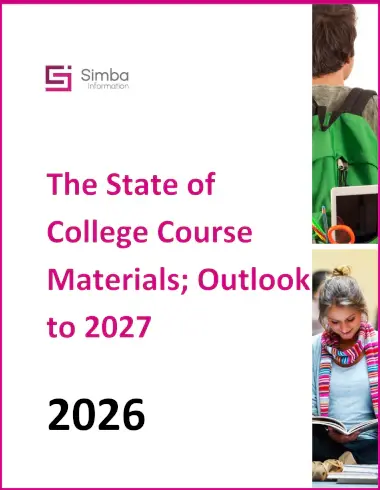
The State of College Course Materials; Outlook to 2027 Report
The US college course materials market is being reshaped by affordability pressure, digital substitution, federal policy change, and shifting enrollment patterns. This report explains where revenue is holding, where it is slipping, and how major publishers are repositioning around digital, AI, and institutional delivery models.
Free Sample Report
Request a free sample of this report and our team will email it to you.
Report Overview
Shrinking Revenues, Selective Demand: Where Course Materials Still Win
The textbook market is shrinking. Demand is shifting, not disappearing.
Affordability pressure, enrollment redistribution, OER adoption, student loan reform, and AI-enabled delivery models are changing the structure of the US college course materials market. Demand is also becoming more concentrated in workforce-aligned programs and institution types with stronger enrollment stability. This report shows where demand is weakening, where it is holding, and how major publishers are adapting their platforms, pricing, and product strategies.
Key Themes Covered in this Report
- How falling student spending, OER growth, and lower-cost sourcing behaviors are changing the economics of course materials
- How student loan reform, Workforce Pell, and low-ROI program scrutiny could redirect enrollment and alter demand by field and institution type
- Why digital subscriptions, Inclusive Access, analytics, and AI-enabled platforms are becoming the central competitive battleground
Key Questions Answered in the Report
- Which institution types, student segments, and academic fields still support stronger demand for commercial course materials?
- How will federal loan caps, Graduate PLUS elimination, Workforce Pell, and program accountability rules affect publisher revenue opportunities?
- How are Pearson, Cengage, McGraw Hill, and Wiley repositioning around digital delivery, recurring revenue, AI, and institutional partnerships?
Slower Growth Gave Way to a More Pressured Market
The State of College Course Materials, 2025-2027 shows a market moving out of short-term stabilization and into a more selective, pressured environment. Postsecondary enrollment rose 1.0% in Fall 2025, led by community colleges and public four-year institutions, but freshmen enrollment was essentially flat overall and fell sharply at private for-profit institutions. Students are also concentrating more heavily in engineering, health professions, and public administration while computer and information science and several humanities fields posted declines. These shifts matter because they affect where commercial demand for course materials is likely to hold and where it is likely to weaken.
Student Spending Keeps Falling, Even as Usage Holds
Average student spending on course materials fell to $341 in the 2024-2025 academic year, roughly half the 2007-08 level. Yet students still took an average of 8.7 courses and purchased 8.2 materials, showing that the spending decline is not simply a matter of lighter course loads. It reflects a structural shift toward used books, rentals, unauthorized free access, digital alternatives, institutionally negotiated access models, and rising OER adoption. Students remain highly cost sensitive, and that behavior continues to pressure traditional textbook sales.
Digital Dominates, but the Market Is Not Stable
Digital media represented 88.3% of the college course materials market in 2025 and is expected to reach 91.1% by 2027. That does not mean the market is healthy across the board. Simba estimates that total market sales will fall from $3.24 billion in 2025 to $3.11 billion in 2026 and $2.98 billion in 2027. Print is projected to decline from $378.4 million in 2025 to $273.2 million in 2027, while digital media is also expected to soften, though at a much slower pace. Inclusive Access, subscriptions, and digitally embedded institutional models are helping publishers defend revenue, but they are not fully offsetting weaker demand and lower student spending.
Policy and Funding Are Now Direct Market Variables
The report details how Graduate PLUS elimination, loan caps, repayment changes, Pell Grant pressure, Workforce Pell expansion, and low-ROI program accountability could reshape the economics of higher education and redirect demand for course materials. Programs aligned with workforce priorities, including healthcare, engineering, business, and selected trades, may remain more resilient than lower-ROI or shrinking disciplines. These policy shifts are no longer background conditions. They are becoming direct market variables for publishers, platforms, and investors.
Competitive Strength Is Concentrated, Not Broadly Shared
Major publishers are responding through digital platforms, AI-enabled tools, institutional partnerships, and recurring revenue models. The report assesses the positioning of Pearson, Cengage, McGraw Hill, and Wiley, along with broader market activity in acquisitions, divestitures, and platform strategy. The strongest players are shifting toward analytics, subscription access, AI-supported learning, and institutionally embedded delivery rather than relying on traditional one-time textbook sales.
The State of College Course Materials; Outlook to 2027 Report Details
| Current Total Market Size | $3.24 billion in 2025 |
| Forecast Total Market Growth Rate | Market projected to decline 4.1% in 2026 and 4.5% in 2027 |
| Historical Period | Current market analysis focuses on 2024 and 2025, with longer historical context for selected measures |
| Forecast Period | 2026-2027 |
| Units Covered | US dollars |
| Regions | United States |
| Countries Individually Covered | United States |
| Products | New course materials, print, digital media |
| Markets | Higher education institutions, student spending behavior, course materials sourcing, digital access models, OER adoption, AI in teaching and learning |
| Materials | Print textbooks, digital media, digital courseware, subscriptions, eTextbooks |
| Point Where Data is Measured | Publisher sales and market-level demand estimates |
| Additional Elements | Enrollment analysis, student affordability, state and federal policy, competitive performance, publisher strategy, mergers and acquisitions |
Leading Companies Driving Trends in the The State of College Course Materials; Outlook to 2027
| Cengage Group | Wolters Kluwer Health |
| Pearson | MIT Press |
| McGraw Hill | Coursera |
| Wiley | Udemy |
Why the Market Is Changing
The college course materials market is no longer being shaped by textbook format alone. Student affordability pressure, new federal policy, enrollment redistribution, and institutional budget stress are now having direct effects on publisher revenue. Students are spending less, more faculty are assigning free or low-cost materials, and institutions are under pressure to justify the price and performance of every required resource.
Student Spending Has Fallen Faster Than Usage
Average student spending on course materials dropped to $341 in the 2024-2025 academic year, but students still took 8.7 courses and purchased 8.2 materials on average. That matters because it shows the market is not weakening simply because students need fewer materials. Instead, it is being reshaped by lower-cost sourcing behavior, rentals, unauthorized free access, used books, and rising OER use. The report also shows that 97% of students take active steps to avoid buying new textbooks, making affordability one of the most important structural forces in the market.
Digital Is Dominant, but Not Problem-Free
Digital media accounted for 88.3% of market sales in 2025 and is projected to reach 91.1% by 2027. Digital now dominates the market, but it is no longer a sufficient growth engine on its own. Yet even digital growth is not enough to prevent overall market contraction. Simba estimates total sales of new course materials will fall from $3.24 billion in 2025 to $3.11 billion in 2026 and $2.98 billion in 2027. Publishers are leaning harder on subscriptions, Inclusive Access, and institutionally embedded models to stabilize revenue, but student resistance to bundled costs and ongoing institutional budget pressure remain important constraints.
Policy Is Now a Demand Variable
Graduate PLUS elimination, loan caps, repayment changes, Pell pressure, Workforce Pell expansion, and low-ROI program scrutiny all have implications for course materials demand. Fields tied more closely to employment outcomes, including healthcare, engineering, business, and selected trades, are likely to remain more resilient than lower-ROI or shrinking academic areas. This makes policy tracking essential for publishers, platforms, investors, and institutional strategy teams.
The State of College Course Materials, 2025-2027 Report Scope
This report covers the US market for course materials used in higher education settings, including both print and digital products sold or licensed for instructional use. It analyzes market size and forecast trends for new course materials and examines the institutional, student, and policy conditions shaping demand.
Coverage includes student spending, course materials sourcing, funding sources, OER adoption, digital access programs, faculty preferences, AI-related developments, and the strategic responses of major higher education publishers. The report also places course materials demand in the broader context of postsecondary enrollment, freshmen trends, workforce-aligned program growth, federal student aid policy, state higher education funding, and institutional financial pressure.
- Executive Summary
- Key Highlights from the Report
- Methodology
- Market Size and Enrollment
- Institution Types and Numbers
- Table | Number of US Title IV Postsecondary Institutions, 2024-2025 vs. 2023-2024
- For-Profit Private Institutions Outnumber Non-Profit Schools
- Higher Education Under Pressure: Closures, Mergers, and Acquisitions
- Table | College Closures: Completed in 2025 and Forthcoming
- Table | College Mergers: Completed in 2025 and Forthcoming
- Undergraduate and Graduate Enrollment Stable
- Table | Enrollment Changes by Award Level and Institution Type, Fall 2024 vs. Fall 2025
- For Profit Enrollment
- Table | Selected For-Profit Colleges Enrollment, 2023 and 2024
- Freshmen Numbers Stagnant
- Table | Freshmen Enrollment, Fall 2025 vs. Fall 2024
- Interest in Undergraduate Certificates Remains Strong
- International Students Enrollment Rose
- Enrollment by Major Field Study
- Table | National Undergraduate 4-Year Enrollment in Top 20 Major Field Families, Fall 2024 vs. Fall 2025
- Table | National Graduate 4-Year Enrollment in Top 20 Major Field Families, Fall 2024 vs. Fall 2025
- Table | National Undergraduate 2-Year Enrollment in Top 20 Major Field Families, Fall 2024 vs. Fall 2025
- Distance Education Enrollment Remains Strong
- Table | Number and Percentage Distribution of Students Enrolled at Distance Education Title IV Institutions,
- Higher Education Outlook for 2026 Negative
- Enrollment Outlook
- Institution Types and Numbers
- Policy and Funding
- Cost of Attending College in 2025-2026
- Table | Undergraduate Tuition and Fees, 2024-2025 vs. 2025-2026
- Cost of Attending College in 2026-2028
- Table | Cost of Attending College Estimates, 2026 - 2028
- Federal Funding for Higher Education
- Table | Select Education Program Funding in President Trump's Budget Request vs. the Final Appropriation Bil
- Looming Pell Grant Shortage
- Student Loans
- Table | Average Cumulative Debt Levels in 2024 Dollars: Bachelor's Degree Recipients at Public and Private N
- Table | Distribution of Outstanding Federal Borrowers by Age, Fourth Quarter FY2018, FY2021, and 2025
- Table | Distribution of Outstanding Federal Loan Dollars by Borrowers Age, Fourth Quarter FY2018, FY 2021, a
- Federal Student Loan Repayment System Overhaul
- Grad PLUS Loans Ending
- Table | Federal Student Loan Limits Under OBBB vs. Previous Law
- New Graduate PLUS and Parent PLUS Loan Caps
- Table | Number of PLUS Loans Borrowers, 2009-2010 to 2024-2025, Selected Years (in thousands)
- Curbing Federal Funding for Low ROI Programs
- Impact on College Materials Publishers
- State Funding for Higher Education
- Table | Sources of State and Local Higher Education Funding by State, FY 2024
- Student Share
- Table | Net Tuition as a Percentage of Total Education Revenue by State (excluding net tuition revenue used
- Pell Grant Extension: Workforce Pell
- Opportunities for Publishers
- Federal Grants for Workforce Pell Courses
- Table | Strengthening Community Colleges Training Grants Program - Summary
- New America Talent Strategy
- Workforce Federal Grants Consolidation: Make America Skilled Again (MASA)
- Pay- for- Performance Incentive Payments Program (Registered Apprenticeships)
- Table | Pay-for-Performance (PfP) Incentive Payments Program Summary
- Table | YouthBuild - FOA-ETA-26-38 Summary
- Table | Career, Technical, and Education Training Budget, 2024 - 2026
- Cost of Attending College in 2025-2026
- Course Materials
- Cost of Coursebook Materials
- Table | How much do students pay for their course materials per term?
- Why Is Student Spending on Course Materials Declining?
- How Do Students Source Course Materials?
- How Students Fund Their Materials?
- Table | Funding Sources for College Education and Materials
- Course Materials Cost-Cutting Efforts
- The Impact of Textbook and Courseware Costs on Student Success
- The Share of Open Educational Resources Keeps Growing
- Table | Percentage of Faculty Using OER as Required Material, 2021 - 2025
- Federal and State Governments OER-supporting Initiatives 2025-2026
- Outlook for College Course Materials
- Table | Sales by Segment of Key College Course Materials, 2024 -2027P (million dollars)
- Cost of Coursebook Materials
- Industry Trends & Innovations
- High Value, High Cost: Americans' Views on Higher Education
- Gallup Research: Public Trust in Higher Education Rebounding
- Pew Research Center: Higher Education Heading in the Wrong Direction
- American Higher Education Barometer 2025 Reveals Cost and Free Speech Concerns
- Varying Degrees 2025: Call for a Reform
- Vanderbilt University Poll: Colleges Should Stay Out of Politics
- Students Find Degree Investment Worthwhile
- Students Trust Their Colleges and Universities
- Cost Remains a Persistent Barrier to Degree Benefits
- Beyond the Printed Page: Faculty Textbook Usage and Preferences
- Faculty Grade Curricula: Solid Scores, Price Problems
- Digital Access Programs: Market Growth Amid Student Concerns
- Table | Top Reasons for Using IA and EA Models Among Administrators
- AI In Higher Education: Students Keen, Teachers Skeptical
- Students and Generative AI: New Habits, New Expectations
- Faculty Largely Unprepared for AI in the Classroom
- Teachers Report AI Increases Their Workload
- Table | How Teachers Use GenAI
- Implications for Publishers
- Federal Crackdown on DEI Programs
- Trump Administration Conflicts with Universities
- State Rules, New Realities for Textbook Publishers
- High Value, High Cost: Americans' Views on Higher Education
- Competitive Landscape
- Acquisitions, Divestments, and Funding
- Table | Acquisitions and Divestments for Higher Education Materials Publishers and Technology and Content Pr
- From Textbooks to Environments
- Career, Credential, and Outcomes-Focused Education Is Winning
- Distressed Assets Change Hands at Deep Discounts
- AI is Infrastructure Now
- Learning Commodification Progresses
- Major Competitors
- Table | Performance of Higher Education Competitors: Total Corporate and Higher Education Segment, Current a
- Pearson
- Table | Pearson's Interactive Media Platforms
- Financial Results
- Table | Pearson's Divisional Revenue, FY 2023 and FY 2024
- Table | Pearson's Adjusted Operational Profit, FY2023 and FY2024
- Personnel Changes
- Strategic Directions
- Technological Advancements
- Table | Pearson's AI Development & Rollout Milestones - Summary
- Acquisitions, Divestitures, and Partnerships
- Cengage
- Table | Cengage's Business Segments
- Table | Cengage's Digital Platforms
- Financial Results
- Table | Cengage's Units and Total Financial Result, FY 2024 and FY2025
- Strategic Directions
- Personnel Changes
- Technological Advancements
- Acquisitions, Divestitures, &Partnerships
- McGraw Hill
- Table | McGraw Hill's Digital Platforms
- Financial Results
- Table | McGraw Hill Total and Higher Education Segment Revenue, FY2024 and FY2025
- Strategic Directions
- Personnel Changes
- Technological Advancements
- Acquisitions, Divestitures, &Partnerships
- Wiley
- Financial Results
- Table | Wiley's Divisional and Total Revenue for the FY 2024 and FY 2025
- Strategic Directions
- Personnel Changes
- Technological Advancements
- Acquisitions, Divestitures, &Partnerships
- Financial Results
- Performance
- Competitive Performance Year-to-Date
- Table | FY2026 Performance and Guidance for Higher Education Publishers
- Competitive Performance Year-to-Date
- Acquisitions, Divestments, and Funding
Demand is being reshaped by lower student spending, rising OER use, digital access models, policy-driven shifts in enrollment and borrowing, and greater concentration of demand in workforce-oriented and higher-ROI fields.
The report tracks Pearson, Cengage, McGraw Hill, and Wiley, with the strongest positioning concentrated among companies that are expanding digital, recurring, AI-enabled, and institutionally embedded delivery models.
Digital media is still growing as a share of the market, but that growth is not fully offsetting weaker per-student spending, stronger use of lower-cost alternatives, OER expansion, and broader pressure on institutional and student budgets.X