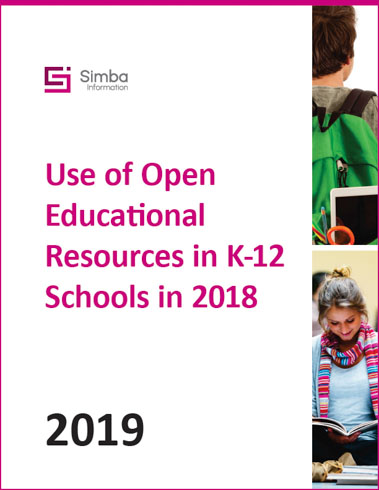
Use of Open Educational Resources in K-12 Schools in 2018
Open educational resources (OER) have been available for use in K-12 schools for two decades, but they have not taken hold in mainstream fashion until relatively recently.
Free Sample Report
Request a free sample of this report and our team will email it to you.
Report Overview
Open educational resources (OER) have been available for use in K-12 schools for two decades, but they have not taken hold in mainstream fashion until relatively recently. Progress has been much faster in the college market. That said, there has been a spike in interest and adoption in recent years, especially since the launch of the federal #GoOpen program in 2015 under the Obama administration.
Use of Open Educational Resources in K-12 Schools 2018 by Simba Information provides an overview of the K-12 landscape for open educational resources (OER). The report delves into how K-12 districts in the U.S. are using OER, analyzes the factors that are driving growth, looks into the challenges facing the market, and provides an overview of suppliers providing open resources.
Specific topics include:
- Why schools turn to OER
- Financial drivers of OER
- OER usage by district, subject, and grade level
- Spending on OER
- The impact on commercial publishers and vendors
- Challenges to OER growth
- Leading brands in the K-12 OER space
- The future of OER
- Case studies illustrating the use and implementation of OER
The insights in this report draw on both qualitative and quantitative research, including:
- In-depth interviews with district personnel and leaders at the state level responsible for OER
- An online survey on district usage and perceptions of OER
- Third-party research on various aspects of OER from respected organizations
- A review of company/organizational information distributed by leading purveyors of OER
The information provided in the report is designed to help education industry leaders stay ahead of market shifts and build effective growth initiatives.
What Are Open Educational Resources?
Open educational resources have been available for use in K-12 schools for two decades, but they have not taken hold in mainstream fashion until relatively recently. Progress has been much faster in the college market.
That said, there has been a spike in interest and adoption in recent years, especially since the launch of the federal #GoOpen program in 2015 under the Obama administration.
The Free Software Foundation is credited with creating the first OER materials back in 1985. One of the first OER collections released to the public came from MIT, which offered almost all of its courses online for free and has since launched a high school site to assist teachers in tailoring the content to that age cohort. UNESCO first used the term open educational resources in 2002.
Open educational resources are learning materials that anyone can use, adapt, and share, all under an open license. They are often free or very low cost, but this is not a requirement. In addition, even when the materials themselves are available at no cost, necessary and complementary products and services, such as printing, professional development, and ancillaries, often come at a price. There are also significant costs associated with human resources.
Open educational resources are not copyright-free or in the public domain. Nor are they marketed under a traditional closed copyright where all rights are reserved to the owner, who must grant permission for any sort of use. An open license resides between these two ends of the spectrum. While not public domain, OER materials fall under what is sometimes called a “5R permissions” umbrella: they can be retained, reused, revised, remixed, and redistributed, as long as the original is recognized and proper attribution given.
- Methodology
- Executive Summary
- Introduction & Overview
- What Are Open Educational Resources
- Table | Six Forms of Creative Commons Licenses
- What Is Driving Adoption of Open Educational Resources
- Fit with Current Educational Trends
- Table | Why Schools Turn to OER, 2018-2019
- Currency
- Federal Policies
- Table | #GoOpen Campaign States
- State Support
- Financial Drivers
- Redirection of Savings
- Improvements in Availability and Quality
- Easier Access
- Fit with Current Educational Trends
- What Are Open Educational Resources
- OER Use and Spending
- OER Usage: A Survey Approach
- Table | OER Use, A Snapshot
- Market Leaders See Growth
- Usage Varies by District
- Table | District Approaches to Using OER
- OER USE by Subject
- Grade-Level Use
- Core or Supplemental
- Adaptation and Collaboration
- OER Sits Alongside Traditional Textbooks
- OER Finding and Vetting Responsibility
- Spending on OER
- Table | Key Cost Areas with OER
- Sources of Funding
- Table | Examples of OER Funding
- Impact on Commercial Publishers and Vendors
- OER Usage: A Survey Approach
- Challenges to OER Growth
- Educator Unfamiliarity and Resistance
- Finding and Assessing Quality Materials
- Role for Commercial Publishers, Providers
- Technology and Infrastructure
- Other Challenges
- Table | Challenges Associated with OER (ranked in descending importance)
- Market Landscape
- Who Provides OER?
- Table | Examples of OER Providers
- Nonprofit Groups, Associations, and OER Specialists
- Table | Examples of OER movers in the Association/Non-Profit Segment
- Universities, States, and Districts
- Commercial Publishers
- Districts Rely on Multiple Providers
- Key Players
- Big History Project
- CK-12 Foundation
- Curriki
- EL Education
- Great Minds
- Khan Academy
- Knovation
- LearnZillion
- MIT OpenCourseWare (OCW) Project
- OER Commons/ISKME
- OpenStax
- Open Up Resources
- UnboundEd
- Who Provides OER?
- The Future of OER
- Challenges Remain
- Good Experiences, High Interest Predict Growth Ahead
- Best Practices for OER Implementation
- Develop a Plan
- Educate About Open Licensing
- A Better Path
- Professional Learning
- Collaboration
- Sufficient Infrastructure
- High Quality Materials
- Plan for the Future
- Case Studies
- States
- Washington
- Utah
- Louisiana
- Districts
- Cedar Rapids, IA
- Loudon County, VA
- Anne Arundel, MD
- Nampa, ID
- Wayland Union, MI
- OER Initiatives
- Michigan Open Book Project
- OpenSciEd
- States