Global Plastic Caps & Closures
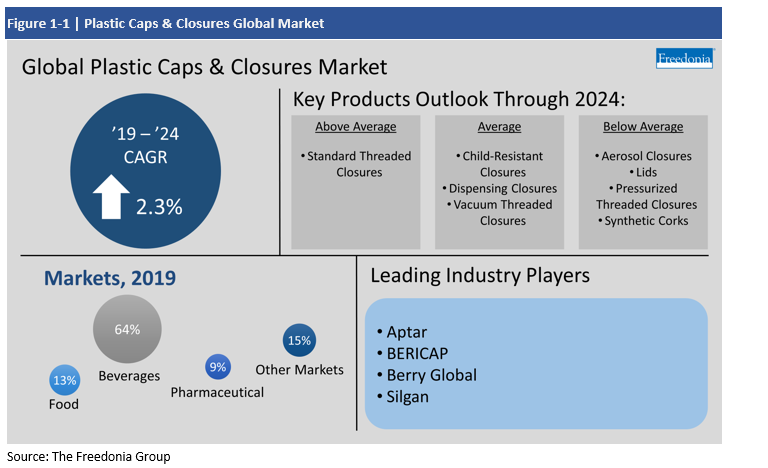
Global demand for plastic caps and closures is expected to grow 2.3% yearly to 1.9 billion units valued at $55.5 billion in 2024.

Free Sample Report
Request a free sample of this report and our team will email it to you.
Report Overview
Featuring 68 tables and 64 figures – now available in Excel and Powerpoint! Learn More
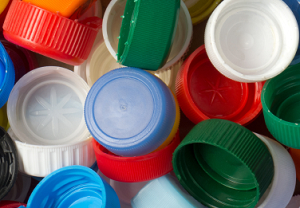 This study analyzes the global market for plastic caps and closures.
Demand by Region
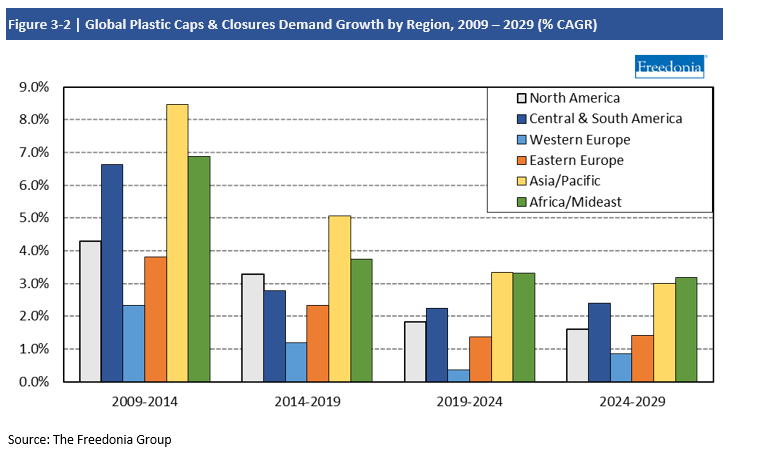
Global demand for plastic caps and closures is projected to increase 2.3% per year to just over 1.9 trillion units, valued at $55 billion in 2024:
- Over half of these increases will be in the Asia/Pacific region, already the largest regional market. Advances in the region will be fueled by healthy growth in food and beverage output, the main drivers of demand for plastic caps and closures.
- Above average increases are also anticipated in the Africa/Mideast region, though growth in that region will come from a much smaller base.
- Western Europe is projected to register growth well below the global average. Nonetheless, opportunities will exist, especially for value-added products such as tamper-evident and dispensing products.
- Growth in North America will be boosted by increases in the dominant US market, where bottled water and pharmaceuticals are expected to see healthy gains through 2024.
- Demand in the East European market will decelerate from the pace seen during the 2014-2019 period, as economic growth of countries in the region slows.
Competitive Products
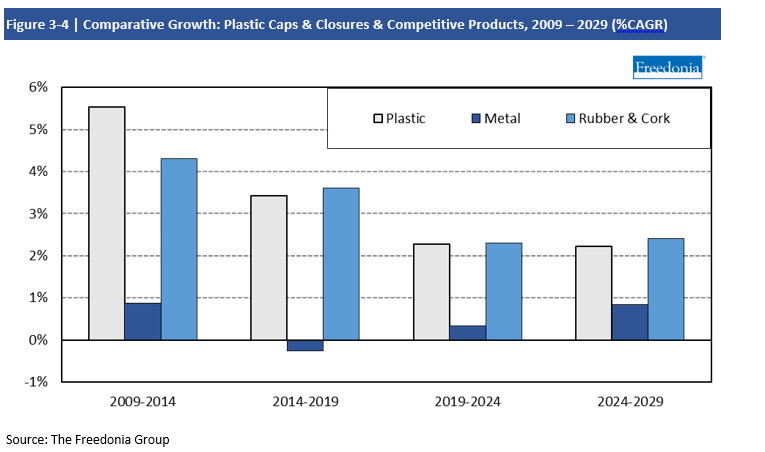
Plastic caps and closures primarily face competition from caps and closures made from other materials – metal, rubber, and cork:
- Metal caps and closures are commonly used on glass bottles, limiting plastic closure demand. However, plastic closures are increasingly being used with glass containers, most notably with upmarket bottled water.
- Cork closures are widely used in wine packaging; however, “cork taint” and cork’s relatively high cost has limited their use, particularly in value wines, allowing for the penetration of synthetic corks into the wine market. Additionally, the growing popularity of boxed wine has boosted demand for plastic dispensing closures.
- Rubber closures are primarily used in pharmaceutical applications where their resealability is important, such as pharmaceutical vials. However, plastic does face competition from rubber in closures for plastic containers.
Plastic caps and closures also face competition from packaging that does not utilize closures. For example, the growing popularity of metal cans in some beverage container markets, such as the craft beer, packaged water, and prepared cocktails markets, will limit demand for all closures, including plastic closures.
International Trade
Trade activity in plastic caps and closures does not account for a large share of the overall market. However, there is more trade of these products than of most other forms of packaging. One major reason for this is that plastic caps and closures are much smaller than other packaging products, making them more efficient to transport than larger or heavier packaging materials, such as empty bottles, cans, jars, or other containers. In addition, opening sizes on containers such as bottled water and soft drink bottles tend to be standardized, while container sizes are often not.
In regional terms, Western Europe and the Asia/Pacific region are net exporters, while the remaining regions are net importers. However, a significant share of trade activity is intraregional:
- In North America, all three countries are net importers, but most trade by those countries is within the region.
- Western Europe is a net exporting region largely because Germany and Italy are significant net exporters. However, much of those countries’ trade is with European neighbors such as France and the UK.
Overall, China has become the world’s largest net exporter. A considerable share of its export volume is bound for other Asian countries, but the US has also become a more significant destination for Chinese exports.
Demand by Market
Global demand for plastic caps and closures is projected to increase 2.3% annually to 1.9 trillion units in 2024. While beverages will remain by far the largest market, similar gains are expected in pharmaceuticals through the forecast period.
Product manufacturers will continue to seek packaging that adds value to their offerings. As a result, plastic caps and closures in some markets have trended toward the adoption of more expensive, functional closures, such as child-resistant, tamper-evident, and dispensing types. However, in higher-volume beverage applications, such as bottled water and CSDs, simpler commodity closures have retained a dominant market position.
The main categories of plastic closures include:
- threaded closures
- standard threaded closures (also known as screw caps);
- pressurized
- vacuum
- unthreaded closures
- lids
- overcaps
- aerosol closures
- synthetic cork
- dispensing closures
- child-resistant closures
A significant degree of overlap exists among product categories. For example, some trigger dispensers are outfitted with child-resistant features. For purposes of this report, a closure is categorized by the primary function of the closure. In the example here, the closure would be categorized as a child-resistant closure.
Excluded from the scope of this study are:
- caps and closures that are an integral part of the container (e.g., aerosol can valve assemblies)
- home canning and bottling closures
- closures for industrial bulk containers
- flexible closures such as twist ties or foil lidding
- caps and closures used in nonpackaging applications (e.g., valve covers, distributor caps, pen caps, food storage containers lids, liquor decanter closures)
Markets for these products include:
- beverages
- bottled water (still and sparkling)
- carbonated soft drinks
- milk (dairy milk)
- other beverages (such as wine, beer, fruit drinks, ready-to-drink coffee and tea, and sports drinks, liquor and spirits, alternative milk products)
- food
- pharmaceuticals
- other markets (e.g., personal care products, household cleaning products, automotive chemicals, paints and coatings, durable goods such as art supplies)
Historical data (2009, 2014, and 2019) and forecasts for 2024 and 2029 are presented for caps and closures demand in units and current US dollars (including inflation) by product and market on a country-by-country and region-by-region basis. The terms “shipments”, “production”, and “output” are used interchangeably in the study, as are the terms “demand”, “sales”, and “market”, which are defined as domestic shipments, plus imports, minus exports.
Global demand for plastic caps and closures is expected to grow 2.3% yearly to 1.9 billion units valued at $55.5 billion in 2024. The ongoing shift from glass and metal to plastic containers will boost demand for plastic caps and closures. The advantages of plastic caps and closures include their:
- lighter weight
- greater resiliency, which reduces loss due to breakage
- availability in a wider range of design options, including dispensing and child-resistant versions
Standard Threaded Plastic Closures Will Offer the Best Opportunities
Standard (non-pressurized and non-vacuum) threaded lids will grow at a solid rate and remain the most used type of plastic closure through 2024. Gains will benefit from:
- increasing popularity of single-serve noncarbonated beverages in bottles, including bottled water, enhanced water, and flavored water
- rising demand for aseptic cartons and spouted pouches, which use standard threaded closures
- the versatility of standard closures, which can be used with both glass and plastic containers
- their ability to effectively reseal packaging after they are opened
Both beverage and food applications for standard threaded plastic closures are expected to see healthy growth through 2024.
Pharmaceutical Market Will Experience Strong Gains in Developed Countries
Unlike in developing regions, where the beverages market – in particular bottled water – will see the fastest gains, in the developed economies of the US, Canada, and Western Europe, pharmaceutical applications for plastic caps and closures will see the fastest growth. Demand will be boosted by the high level of healthcare expenditures per capita in these countries and aging populations. An acceleration in pharmaceutical production in the US will buoy demand. Additionally, child-resistant and tamper-evident closures are expected to see healthy gains, driven by stricter regulations and standards for pharmaceutical closures.
The Asia/Pacific & Africa/Mideast Regions Will See the Fastest Gains
Over half of global demand increases for plastic caps and closures will be in the Asia/Pacific region, already the largest regional market due to the outsized Chinese market. Advances in the region will be fueled by healthy growth in beverage production and increasing personal spending power:
- Bottled water is expected to offer the best opportunities, accounting for half of all unit gains through 2024.
- Rising standards of living will benefit purchase of consumer products such as cosmetics, toiletries, household cleaners and detergents, and automotive fluids, further buoying demand for plastic caps and closures.
Above average increases are also anticipated in the Africa/Mideast region, though this growth will occur from a much more limited base.
- Executive Summary
- About This Report
- Report Details
- Study Scope & Product Description
- Impact of COVID-19 Pandemic
- Overview
- Historical Market Trends
- Demand by Region
- Leading Country Markets
- Pricing Trends
- Competitive Products
- International Trade
- Sustainability Initiatives
- Source Reduction
- Recycling & Recycled Content
- Market Share & Leading Producers
- Products
- Demand by Product
- Threaded
- Standard
- Pressurized
- Vacuum
- Unthreaded
- Lids
- Aerosol Closures
- Synthetic Cork
- Dispensing
- Child-Resistant
- Markets
- Demand by Market
- Beverages
- Bottled Water
- Carbonated Soft Drinks
- Milk
- Other Beverages
- Food
- Pharmaceuticals
- Other Markets
- North America
- Plastic Caps & Closures Market Size
- Demand by Country
- Demand by Product & Market
- United States
- Plastic Caps & Closures Market Size
- Demand by Product & Market
- Mexico
- Plastic Caps & Closures Market Size
- Demand by Product & Market
- Canada
- Plastic Caps & Closures Market Size
- Demand by Product & Market
- Central & South America
- Plastic Caps & Closures Market Size
- Demand by Country
- Demand by Product & Market
- Brazil
- Plastic Caps & Closures Market Size
- Demand by Product & Market
- Other Central & South America
- Plastic Caps & Closures Market Size
- Demand by Product & Market
- Western Europe
- Plastic Caps & Closures Market Size
- Demand by Country
- Demand by Product & Market
- Germany
- Plastic Caps & Closures Market Size
- Demand by Product & Market
- France
- Plastic Caps & Closures Market Size
- Demand by Product & Market
- Italy
- Plastic Caps & Closures Market Size
- Demand by Product & Market
- United Kingdom
- Plastic Caps & Closures Market Size
- Demand by Product & Market
- Spain
- Plastic Caps & Closures Market Size
- Demand by Product & Market
- Other Western Europe
- Other Plastic Caps & Closures Market Size
- Other Demand by Product & Market
- Eastern Europe
- Plastic Caps & Closures Market Size
- Demand by Country
- Demand by Product & Market
- Russia
- Plastic Caps & Closures Market Size
- Demand by Product & Market
- Other Eastern Europe
- Plastic Caps & Closures Market Size
- Demand by Product & Market
- Asia/Pacific
- Plastic Caps & Closures Market Size
- Demand by Country
- Demand by Product & Market
- China
- Plastic Caps & Closures Market Size
- Demand by Product & Market
- India
- Plastic Caps & Closures Market Size
- Demand by Product & Market
- Japan
- Plastic Caps & Closures Market Size
- Demand by Product & Market
- Indonesia
- Plastic Caps & Closures Market Size
- Demand by Product & Market
- South Korea
- Plastic Caps & Closures Market Size
- Demand by Product & Market
- Australia
- Plastic Caps & Closures Market Size
- Demand by Product & Market
- Other Asia/Pacific
- Plastic Caps & Closures Market Size
- Demand by Product & Market
- Africa/Mideast
- Plastic Caps & Closures Market Size
- Demand by Product & Market
- Appendix
- Scope
- Definitions
- Freedonia Methodology
- Study-Specific Methodology
- Sources
- Associations & Agencies
- Related Studies & Reports
- Country Lists by Region
- Macroeconomic Assumptions
- Global Economic Outlook
- Global Population
- Global Personal Consumption Expenditures
Global demand for plastic caps and closures is expected to grow 2.3% yearly to 1.9 billion units valued at $55.5 billion in 2024.
Pharmaceutical applications will see the fastest growth in the developed economies of the US, Canada, and Western Europe.
Standard (non-pressurized and non-vacuum) threaded lids will grow at a solid rate and remain the most used type of plastic closure through 2024.