US Residential Siding
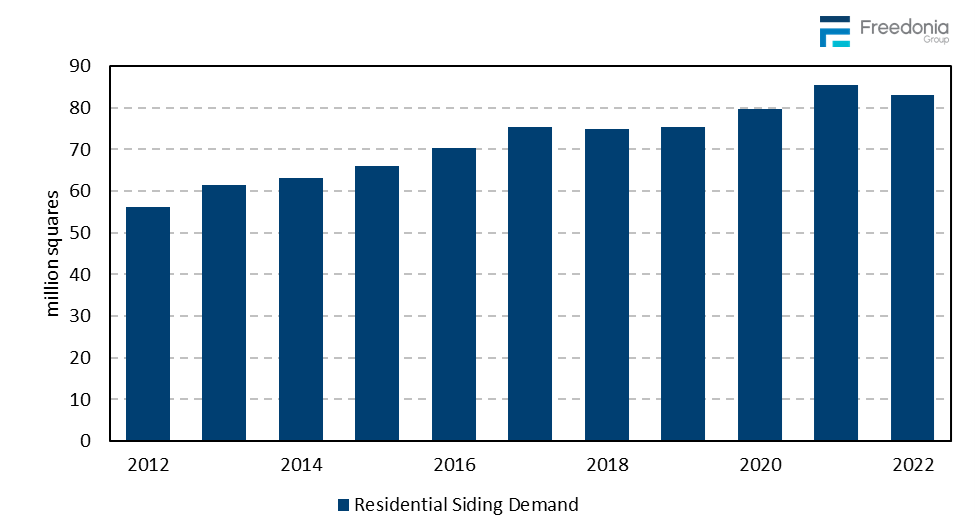
This study analyzes US demand for residential siding by material, market, and region. Historical data for 2012, 2017, and 2022 and forecasts for 2027 and 2032 are presented in millions of squares and in current dollars (which are not adjusted for inflation).
Free Sample Report
Request a free sample of this report and our team will email it to you.
Report Overview
What is the residential siding size?
- $10.6 billion in 2027
Featuring 33 tables and 13 figures
Demand for residential siding in the US is forecast to increase less than 1.0% annually to 84.7 million squares in 2027, valued at $10.6 billion. Growth in squares will be restrained primarily by a decline in conventional housing starts that began in 2022 – following significant increases in 2020 and 2021 – and is expected to continue through 2024. However, housing starts will rebound in 2025, supporting gains in the latter part of the forecast period.
Vinyl to Gain Market Share After a Decade of Declines
Vinyl siding is forecast to gain market share through 2027 at the expense of fiber cement and engineered wood due to advancements made by suppliers in the performance and appearance of vinyl siding. While fiber cement was the second most used siding material in 2022, its penetration rate will moderate through the forecast period due to the product’s growing maturity and the improving quality of competitive materials like vinyl siding. Vinyl will also take market share from engineered wood due to improvements in the material’s aesthetics, which allow vinyl to mimic the appearance of natural wood, along with the material’s greater durability and fewer maintenance requirements.
Single-Family Renovation Continues to Drive the US Siding Market
The single-family large renovation siding market provides suppliers with a relatively stable source of demand, as severe weather and general home remodeling activity generate sizable demand for these products. Going forward, the single-family renovation market will be supported by:
-
the need to replace siding that has surpassed its useful life or has been damaged by impacts or weather
-
homeowners who wish to change their siding to an alternative material type with greater durability and fewer maintenance requirements
-
the desire to re-side a home prior to sale in order to increase its value
-
purchasers of existing homes wanting to change the siding to better suit their tastes
Sustainability & Energy Efficiency Become Increasingly Important to Purchases
Environmental concerns and aesthetics are becoming increasingly important in the siding market, particularly for single-family homeowners engaging in remodeling projects. Siding materials that enhance a building’s energy efficiency are in high demand. For instance, insulated vinyl siding can lower heating and cooling expenses by offering superior thermal insulation. Sustainable products such as fiber cement and engineered wood have gained popularity in the US market over the past decade. Fiber cement has a lower environmental impact than many siding materials, and engineered wood often uses recycled materials.
Historical Market Trends
Siding demand tends to follow trends in building construction activity, especially in the residential market. For instance, siding demand is strongly correlated with new home construction because it is installed on virtually every unit.
Demand for siding also follows trends in new commercial building, though not as closely as the residential trends. The materials used on commercial structures tend to be concentrated, such that metal, concrete, and brick make up an absolute majority of demand.
Siding demand is also impacted by trends in home renovation activity, as the residential re-siding market is the leading application for siding. Homeowners looking to upgrade the appearance of their homes may do so in a number of ways that promote siding demand:
-
For example, some siding materials – namely vinyl and natural wood – will necessitate replacement over time.
-
Additionally, some homeowners may seek to increase the value of their homes by opting for higher quality siding products that have fewer maintenance requirements.
Demand by Region
Regional variations in construction activity – and thus siding demand – are influenced by demographic and economic patterns.
-
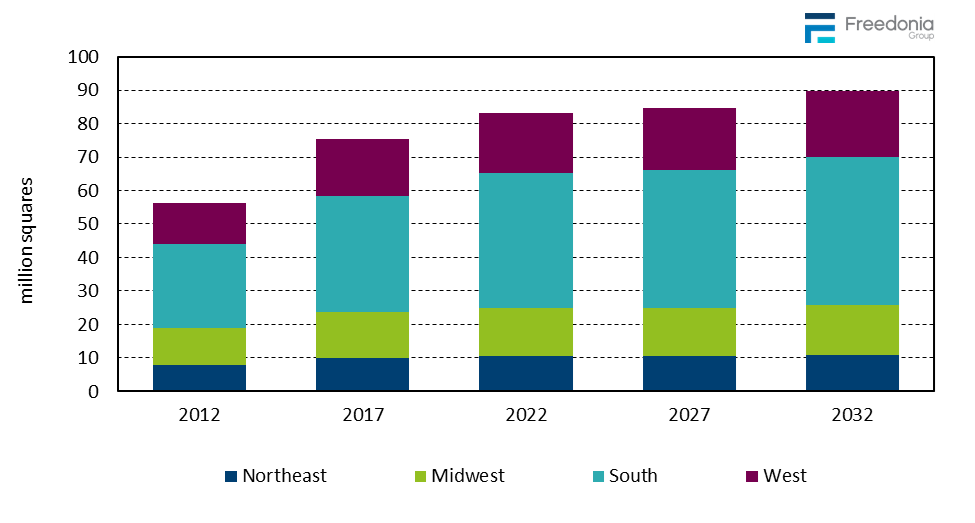
The South is the largest regional market for siding, owing to its large population and housing stock.
-
The West is the second largest siding market, accounting for 22% of demand in 2022.
-
The Midwest and Northeast account for smaller shares of demand, mostly due to their smaller populations.
Siding demand varies among the census regions for several reasons, most notably differences in residential building construction activity. Siding demand is also affected by regional material preferences.
-
Vinyl and engineered wood are the two most popular siding materials in the Northeast.
-
Fiber cement and brick are more commonly specified in the South.
Pricing Trends
In this study, prices for siding materials are measured at the manufacturers’ level, so thus exclude any distributor or retail markups. The cost of raw materials is the key determinant of siding price levels. For example, the cost of vinyl siding, which is manufactured from a petrochemical plastic resin, is affected by changes in the price of feedstocks such as crude petroleum or natural gas.
The price of siding within a given material category is also determined by its quality classification. Performance factors are often key to this classification. For example, whether vinyl siding is classified as an economy, standard, or premium product depends on its rigidity, resistance to fading, thickness, and ease of installation.
Aesthetics can also play a role in product classification; premium vinyl siding is offered in more vibrant colors because it is made with specialty coatings and treatments that make it more expensive than standard grades.
The average price of residential siding products is forecast to rise less than 1.0% per year through 2027, a significant deceleration from the 2017–2022 period. Pricing in the latter part of that span was affected by major supply chain issues that plagued numerous industries, with product shortages and higher raw material costs pitching prices upward:
-
Natural wood pricing skyrocketed in the second half of 2020 and into 2021. Many lumberyards drastically cut production at the onset of the COVID-19 pandemic, as they anticipated a steep drop in lumber demand and did not want to build up large unsellable inventories.
-
Prices for steel and aluminum products spiked in 2021 and 2022 due to increased demand and supply chain disruptions.
Residential Building Construction Industry Outlook
The most important factor to siding sales is the health of the US construction industry, and in particular the construction of buildings. Siding is a critical and necessary component of all buildings constructed in the US, although the type of siding may vary significantly depending on whether the structure is residential or commercial and whether it is new construction or renovation.
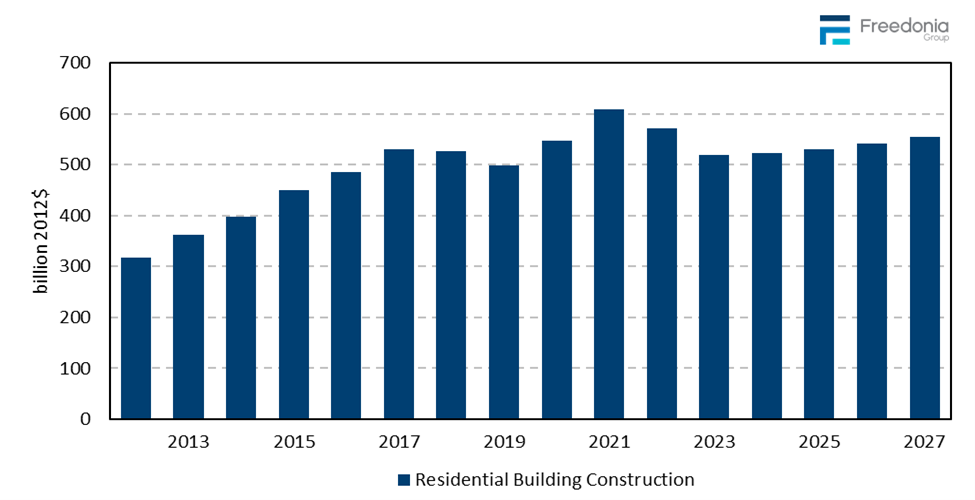
Residential building construction experienced a sharp drop in 2023 due to elevated interest rates, high material and labor costs, and existing homeowners having already invested in their residences over the previous three years. However, growth, albeit slow, is expected to return in 2024.
Scope
This study analyzes US demand for residential siding by material, market, and region. Siding is defined as exterior cladding for buildings. Excluded are such ancillary products as soffit and trim.
The siding materials are broken out by:
-
vinyl
-
fiber cement
-
stucco (e.g., three-coat, one-coat)
-
engineered wood, including oriented strand board (OSB), plywood, and hardboard
-
brick (standard and modular)
-
metal panels (excluding aluminum and steel siding with specific limited, legacy applications)
-
concrete (non-loadbearing concrete bricks and precast concrete panels)
-
small volume siding materials, including:
-
EIFS (exterior insulation and finish systems)
-
manufactured and quarried natural stone
-
natural wood
-
polypropylene
-
composites (e.g., glass-reinforced polymer and polystyrene foam; polyethylene and aluminum; fly ash, polyurethane, and glass fiber; polymer resin, inorganic materials, acrylic colorants; sawdust and HDPE; bamboo and plastic; fiberglass and natural stone)
-
steel and aluminum, other than metal panels
-
plastic and vitreous panels
-
The residential building market is segmented by housing type:
-
single-family
-
multifamily
-
manufactured housing
Excluded from the definition of residential buildings are housing units located in a structure whose primary purpose is something other than habitation. Thus, a small living space contained in a larger retail facility would be classified as part of a retail building and not a residential building.
Historical data for 2012, 2017, and 2022 and forecasts for 2027 and 2032 are presented in millions of squares and in current dollars (which are not adjusted for inflation).
- Executive Summary
- Figure 1-1. US Residential Siding Market Outlook
- About This Report
- Report Details
- Market Scope & Product Description
- Figure 2-1. Siding: Product Examples
- Short-Term Residential Siding Trends
- Table | Residential Siding Demand by Application, 2020 – 2024
- Figure 2-2. Residential Siding Demand, 2020 – 2024
- Overview
- Historical Market Trends
- Table | Residential Siding Demand, 2012 – 2022
- Figure 3-1. Residential Siding Demand, 2012 – 2022
- New vs. Renovation
- Table | Residential Siding Demand: New vs. Renovation, 2012, 2017, 2022, 2027, &2032
- New Construction
- Table | New Residential Siding Demand by Material, 2012, 2017, 2022, 2027, &2032
- Figure 3-2. New Residential Siding Volume Demand by Material, 2012, 2017, 2022, 2028, &2032
- Residential Renovation
- Table | Residential Renovation Siding Demand by Material, 2012, 2017, 2022, 2027, &2032
- Figure 3-3. Residential Renovation Siding Volume Demand by Material, 2012, 2017, 2022, 2028, &2032
- Demand by Region
- Table | Residential Siding Demand by Region, 2012, 2017, 2022, 2027, &2032
- Figure 3-4. Residential Siding Demand by Region, 2012, 2017, 2022, 2027, &2032
- Pricing Trends
- Table | Average Residential Siding Prices, 2012, 2017, 2022, 2027, &2032
- Historical Market Trends
- Factors Impacting Residential Siding Demand
- Residential Building Construction Industry Outlook
- Figure 4-1. Residential Building Construction Expenditures, 2012 – 2027
- Regulations & Standards
- Environmental Issues
- Building Codes
- Health & Safety
- Green Building Standards
- Industry Standards
- Sustainability Initiatives
- Recycling & Recycled Content
- Energy Efficient Production & Transportation
- Product Trends
- Improved Product Performance
- Products That Mimic Other Materials
- Style Trends & Curb Appeal
- Labor Shortages
- Tariffs
- Residential Building Construction Industry Outlook
- Siding Materials
- Demand by Material
- Area Demand (Squares)
- Table | Residential Siding Demand by Material, 2012, 2017, 2022, 2027, &2032
- Value Demand
- Table | Residential Siding Demand by Material, 2012, 2017, 2022, 2027, &2032
- Area Demand (Squares)
- Vinyl Siding
- Table | Residential Vinyl Siding Demand by Application & Housing Type, 2012, 2017, 2022, 2027, &2032
- Fiber Cement Siding
- Table | Residential Fiber Cement Siding Demand by Application & Housing Type, 2012, 2017, 2022, 2027, &2032
- Stucco Siding
- Table | Residential Stucco Siding Demand by Application & Housing Type, 2012, 2017, 2022, 2027, &2032
- Engineered Wood Siding
- Table | Residential Engineered Wood Siding Demand by Application & Housing Type, 2012, 2017, 2022, 2027, &20
- Brick Siding
- Table | Residential Brick Siding Demand by Application & Housing Type, 2012, 2017, 2022, 2027, &2032
- Concrete Siding
- Table | Residential Concrete Siding Demand by Application & Housing Type, 2012, 2017, 2022, 2027, &2032
- Metal Panels
- Table | Residential Metal Panel Siding Demand by Application & Housing Type, 2012, 2017, 2022, 2027, &2032
- Small Volume Siding Materials
- Table | Residential Small Volume Siding Material Demand by Application & Housing Type, 2012, 2017, 2022, 202
- Demand by Material
- Housing Types
- Demand by Housing Type
- Table | Residential Siding Demand by Housing Type, 2012, 2017, 2022, 2027, &2032
- Single-Family Housing
- Table | Single-Family Housing Siding Demand by Material, 2012, 2017, 2022, 2027, &2032
- Figure 6-1. Single-Family Housing Siding Demand by Material, 2012, 2017, 2022, 2027, &2032
- Multifamily Housing
- Table | Multifamily Housing Siding Demand by Material, 2012, 2017, 2022, 2027, &2032
- Figure 6-2. Multifamily Housing Siding Demand by Material, 2012, 2017, 2022, 2027, &2032
- Manufactured Housing
- Table | Manufactured Housing Siding Demand by Material, 2012, 2017, 2022, 2027, &2032
- Figure 6-3. Manufactured Housing Siding Demand by Material, 2012, 2017, 2022, 2027, &2032
- Demand by Housing Type
- Key Suppliers & Industry Structure
- Industry Composition
- Market Share
- Figure 7-1. US Residential Siding Market Share, 2022
- Mergers & Acquisitions
- Table | Selected Mergers & Acquisitions
- Appendix
- Scope
- Table | Relevant Industry Codes
- Table | Relevant HS Codes
- Definitions
- Freedonia Methodology
- Study-Specific Methodology
- Sources
- Related Studies & Reports
- Macroeconomic Assumptions
- Economic Environment
- Table | Macroeconomic Indicators, 2012, 2017, 2022, 2027, &2032
- Demographic Trends
- Table | Population & Households, 2012, 2017, 2022, 2027, &2032
- Building Construction
- Table | Building Construction Expenditures, 2012, 2017, 2022, 2027, &2032
- Residential Building Construction
- Table | Residential Building Construction Expenditures, 2012, 2017, 2022, 2027, &2032
- Residential Improvements & Repairs
- Table | Residential Improvement & Repair Expenditures, 2012, 2017, 2022, 2027, &2032
- Commercial Building Construction
- Table | Commercial Building Construction Expenditures, 2012, 2017, 2022, 2027, &2032
- Commercial Building Improvements & Repairs
- Table | Commercial Building Improvement & Repair Expenditures, 2012, 2017, 2022, 2027, &2032
- Housing Completions
- Table | New Housing Indicators, 2012, 2017, 2022, 2027, &2032
- Housing Stock
- Table | Housing Stock by Type, 2012, 2017, 2022, 2027, &2032
- Figure 8-1. Housing Stock: Share by Year of Construction, 2022
- Economic Environment
- Scope
The market size for residential siding products is 83 million squares.
Residential siding demand, in value terms, is expected to increase at an annual average pace of 1.2% to $10.6 billion in 2027.
The leading siding suppliers to the US residential market are James Hardie, Louisiana-Pacific, and Saint-Gobain (CertainTeed).