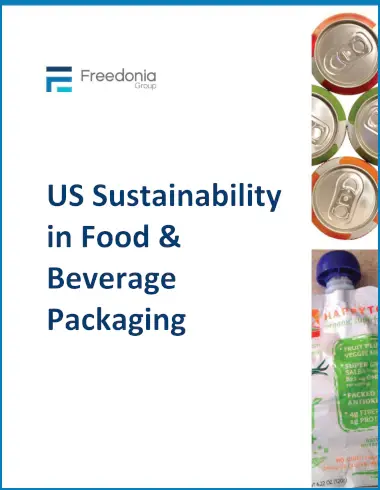
Sustainability in Food & Beverage Packaging Report
Sustainability is rapidly reshaping the food and beverage packaging industry, pushing companies to rethink materials, design, and compliance strategies. This report examines how evolving regulations, consumer expectations, and innovation in packaging technologies are transforming the market and redefining competitive advantage.
Free Sample Report
Request a free sample of this report and our team will email it to you.
Report Overview
Sustainability Goals Collide with Packaging Reality
Rising regulation, PFAS bans, and circular economy targets are reshaping what “sustainable packaging” really means for food and beverage suppliers.
Key Themes Covered in this Report:
- PFAS Bans Redefine “Safe” Packaging – Federal and state restrictions are forcing rapid reformulation of coatings and barriers across molded fiber, paper, and compostable packaging lines.
- The Circular Economy Gets Real – Brand owners are moving beyond pledges toward measurable progress in recyclability, reuse, and recycled content, reshaping supplier relationships and product design.
- Sustainability Under Cost Pressure – As inflation stabilizes, producers are balancing environmental goals with pricing, performance, and availability of sustainable materials.
Food and beverage packaging remains the largest and most dynamic segment of the US packaging industry, serving as both a growth engine and a proving ground for sustainability commitments. Producers and brand owners face mounting pressure to balance performance, cost, and environmental responsibility as expectations from consumers, regulators, and investors intensify. Competitive advantage now hinges on the ability to reduce environmental impact without sacrificing product protection, shelf life, or affordability.
Sustainability as a Defining Industry Driver
Sustainability is now the primary driver shaping packaging development, procurement, and long-term strategy. Companies are moving from aspirational pledges to measurable performance indicators centered on lower carbon intensity, renewable inputs, and validated recycled content. Innovation in coatings, mono-material structures, and lightweight formats is enabling suppliers to maintain functional requirements while improving environmental profiles.
Recyclability & Circularity
Recycling and circular design remain central to sustainable targets, yet progress is limited by low recovery rates. As a result, companies are redesigning packaging to make it easier to collect and process, simplifying structures, eliminating problematic components, and improving labeling. Lightweighting and source reduction remain key efficiency strategies for meeting corporate commitments related to recycled content and emerging state-level mandates.
Rise of Compostable & Fiber-Based Alternatives
Compostable and molded fiber packaging are gaining prominence as cost and performance barriers decline. Molded fiber – traditionally used in egg cartons and produce trays – now appears in ready-meal bowls, beverage cups, and liquid-resistant containers as PFAS-free coatings improve moisture and grease resistance. Suppliers are expanding use of renewable fibers such as bamboo, bagasse, and wheat straw, offering recyclable or compostable solutions that help brands reduce reliance on plastic and meet consumer expectations for visibly sustainable packaging.
Regulation Accelerates Change
New policies are accelerating the pace of innovation and accountability in packaging sustainability. State-level extended producer responsibility (EPR) programs, recycled-content laws, and PFAS bans are reshaping material choices and compliance frameworks across the US. These measures are compelling manufacturers to quantify their environmental impact, invest in recyclable and refillable formats, and expand domestic reprocessing capacity. As federal and state initiatives continue to evolve, regulation has become a primary catalyst – pushing sustainability from a brand initiative to an operational requirement across the entire packaging value chain.
Sustainability in Food and Beverage Packaging Report Details
| Report Focus | A global examination of food & beverage packaging innovation, covering technologies, materials, design trends, regulatory forces, and the companies driving new product development. |
| Historical Period | 2014-2024 |
| Forecast Period | 2024-2034 |
| Units Covered | Qualitative assessments, technology analysis, case studies, and product spotlights |
| Geographic Scope | Global with strong US coverage; examples span North America, Europe, and Asia. |
| Areas of Innovation | Materials development (plastic, fiber, coatings, adhesives) | Machinery innovation (automation, AI, sealing/filling tech) | Circularity & sustainability-driven design | Active & intelligent packaging | E-commerce & SIOC-ready packaging | Next-generation closures & dispensing | Consumer-focused features (convenience, experience, personalization |
| Key Challenges Addressed | Regulatory pressure (PFAS, EPR, recyclability rules) | Supply volatility & rising material costs |Retail and brand sustainability requirements | Food safety & shelf-life expectations | Infrastructure gaps for recycling & compostability | Performance limitations of emerging materials | Costs and scalability of new technologies |
| Packaging Product Overviews | Bottles, jars, and rigid containers | Flexible packaging & pouches | Cartons | Molded fiber formats | Closures, fitments, and dispensing systems | Labels, adhesives, and coatings | Smart-enabled components (RFID, sensors, digital printing) |
| Innovation Sources Covered | Material suppliers | Packaging converters | Machinery & equipment makers | Food & beverage producers | Academic & research institutions | Technology developers (AI, electronics, advanced materials) |
| Additional Elements | Regulatory and sustainability trend tracking | Near-term industry trend analysis | Case studies & product spotlights throughout | M&A activity and partnership developments | Insight into how consumer expectations are reshaping packaging |
Leading Companies Driving Trends in the Packaging Sustainability Industry
| Amcor | Pactiv Evergreen |
| Berry Global | Plastipak |
| Cascades | Printpack |
| Footprint | Smurfitt Westrock |
| Genpak | Sonoco |
| Graphic Packaging International | Tellus |
| Huhtamaki | Zume |
| Novolex |
Key Forces Reshaping Sustainable Packaging
Sustainability has become a defining influence on the US food and beverage packaging industry. Companies across the value chain now face rising expectations from consumers, regulators, and retailers to reduce waste, improve circularity, and demonstrate measurable environmental progress. These pressures are reshaping material choices, supply chain investments, and packaging design strategies. As a result, sustainable packaging has shifted from a niche category to a core requirement for long-term competitiveness.
Material Shifts & Design Innovation
Packaging producers are reevaluating the role of traditional materials and accelerating development of alternatives with lower environmental impacts. Plastic continues to dominate in many applications due to its strength, barrier performance, and cost advantages, yet it remains the focus of regulatory scrutiny and corporate reduction goals. Paper and molded fiber are expanding into new uses as barrier coatings improve, while metal and glass suppliers are emphasizing recyclability and higher post-consumer content. Across all materials, lightweighting, simplified structures, and mono-material formats are emerging as central strategies for improving recyclability and reducing resource use.
Regulation as a Market Driver
New policies at the state level—including extended producer responsibility (EPR) programs, recycled-content mandates, and PFAS restrictions—are accelerating changes in packaging design and material sourcing. These policies affect nearly every participant in the packaging ecosystem, from resin suppliers to consumer brands. Companies are responding by investing in compliant materials, redesigning packaging for easier collection and sorting, and strengthening partnerships with recovery and recycling networks.
Growing Role of Fiber-Based & Compostable Solutions
As performance and cost barriers decline, fiber-based packaging and certified compostable formats continue to gain traction. Molded fiber products, in particular, have advanced beyond traditional applications and now appear in ready-meal bowls, beverage cups, carriers, and other liquid-resistant containers. These solutions appeal to both consumers and brands seeking packaging with a strongly communicated sustainability profile.
Sustainability in Food & Beverage Packaging Report Scope
This study is focused on identifying key trends in sustainability in the food and beverage packaging industry. For purposes of this report, packaging is defined as the materials or containers used to enclose or protect products for distribution, storage, sale, and use. Packaging products not only contain and protect the items but also identify or describe the package contents and can be used to display or market the packaged goods.
Packaging is generally classified as rigid or flexible (although semi-rigid packaging straddles the line between these two categories) and can be made from a variety of materials, primarily plastic, paper and paperboard, metal, and glass, but also with other niche materials such as molded fiber or cellulose.
The main products included in the scope of this report are:
- primary and secondary packaging such as containers, clamshells, bags, pouches and wrap
- bulk packaging such as beverage rings
- corrugated and paperboard boxes
- protective packaging
- retail bags
Excluded from the scope of this report are serviceware such as straws, cutlery, and napkins, as well as nondurable goods such as garbage bags.
- Executive Summary
- Short-Term Analysis
- Recent Economic Trends
- Short-Term Food & Beverage Industry Trends
- Food Industry Trends
- Recent Trends (2022-2024)
- Outlook (2025-2026)
- Beverage Industry Trends
- Recent Trends (2022-2024)
- Outlook (2025–2027)
- Short-Term Food & Beverage Packaging Trends
- Packaging Introduction
- Study Scope & Packaging Definition
- Packaging Markets
- Sales Outlook
- Food Packaging
- Beverage Packaging
- Key Packaging Product Trends
- Corrugated & Paperboard Boxes
- Rigid Containers
- Flexible Packaging
- Materials Competition
- Key Materials & Market Trends
- Shipment Outlook
- Paper Packaging
- Plastic Packaging
- Molded Fiber Packaging
- Metal Packaging
- Glass & Other Packaging
- Glass
- Other Packaging
- What Drives Packaging Choice?
- The Challenge in Finding the Best Packaging Solution
- Pricing Trends & Packaging Cost
- Performance
- Core Performance Attributes
- Performance by Material
- Plastic Packaging
- Paper & Paperboard Packaging
- Glass & Metal Packaging
- Emerging Sustainable Materials
- Changing Package Size Preferences
- Shelf Appeal
- Regulations
- Plastic Bag & Container Bans
- PFAS in Food Packaging
- Federal Activity
- State-Level Legislation
- Outlook & Industry Implications
- Container Deposit Laws
- Purpose & Mechanics
- Current US Landscape & Recent Changes
- Recycled Plastic Content Regulations
- Federal Procurement Guidelines
- State-Level Mandates & Legislation
- Regulatory Challenges in Food Contact Applications
- FDA Approvals & Expanding Supply of Food-Grade Resin
- Extended Producer Responsibility
- Artificial Intelligence (AI)
- Consumer Attitudes & Packaging Preferences
- Packaging is Important to Grocery Shopping Consumers
- Attitudes About Eco-Friendly Packaging
- Priority of Eco-Friendly Packaging Features
- Consumer Attitudes Toward Recycling & Environmental Responsibility
- How Consumers Rate Material Sustainability
- What Is Sustainability?
- Introduction
- Total Environmental Footprint
- Key Metrics
- Corporate Goals & Progress
- Disclosures & Standards
- Key Goals
- Resource/Waste Reduction
- Energy Efficiency
- Material Impacts on Energy Use
- Design & Distribution Efficiency
- Shift Toward Flexible Formats
- Pollution & Waste Prevention
- Food Waste Reduction
- Areas of Focus
- Recycling
- Overview
- Access & Household Participation
- E-Commerce & Retailer Initiatives
- Recycling Rates by Material
- Challenges in Multi-Material Packaging
- System Constraints & Infrastructure Investment
- Corporate & Industry Initiatives
- Outlook
- Recycled Content Usage
- Paper & Paperboard
- Plastics
- Glass & Metal
- Retailer & Policy Pressure
- Biodegradability
- Compostability
- Renewable Resources
- Reusability
- Packaging Material Sustainability Comparison
- Competitive Factors
- Paper & Molded Fiber
- Plastic & Bioplastics
- Glass & Metal
- Material Recycling Rate Comparison
- Market Spotlight: Beverage Packaging
- Market Scope
- Demand Forecast
- Materials Comparison
- New Sustainable Packaging Developments
- Lightweighting & Source Reduction
- Recycling & Recycled Content Integration
- Alternative & Hybrid Material Developments
- Suppliers & Sustainability Goals
- Major Supplier Strategies
- Industry-Wide Sustainability Trends
- Recycled Content & Material Circularity
- Lightweighting & Source Reduction
- Reporting & Disclosure
- Low-Carbon Production Investments
- Material Spotlight: Mono-Materials
- Product Description
- Market Overview
- Supplier Trends
- Converters Expand Recyclable Film & Pouch Portfolios
- Material & Resin Producers Enable Next-Generation Mono-Structures
- Strategic Alignment & Certification
- Product Spotlight: Labels
- Product Description
- Demand Forecast
- Competitive Products & Technologies
- Materials Comparison
- Paper Labels
- Plastic Labels
- Other Label Materials
- New Sustainable Product Development
- Recyclability & Material Reduction
- Digital Traceability & Consumer Engagement
- Freshness & Waste Prevention
- ESG Alignment & Market Integration
- Suppliers & Sustainability Initiatives
- End User Strategies & Goals
- The Walmart Effect
- Recycled Plastic Content Targets
- Corporate Commitments & 2025 Goals
- Progress & Shortfalls
- Regulatory Drivers
- Outlook
- Shifting Away from Plastic to Paper- & Plant-Based Packaging
- Prominent Labels Can Convey Subtler Sustainability Attributes
- Expansion of Reusable Packaging Programs
- Plastic Packaging Sustainability
- Leading Packaging Products
- Key Sustainability Metrics
- Plastics Recycling Rate
- Recycled Content Usage
- Key Producer & Brand Efforts
- Challenges to Expanded Use
- Industry Goals & Progress Toward Targets
- Labeling & Bale Standards
- Consumer-Facing Labeling Initiatives
- Bale Standards & Sortation Improvements
- Captive Recycling Operations
- Source Reduction Efforts
- Lightweighting & Material Redesign
- Right-Sizing & Packaging Minimization
- Resin Efficiency & Downgauging
- Biodegradable Plastics
- Material Advances
- Food & Beverage Packaging Applications
- Compostable Plastics
- Material Advances
- Commercial Food & Beverage Packaging Applications
- Infrastructure & Certification Challenges
- Biobased Plastics
- Material Developments
- Brand & Converter Adoption
- Packaging Producer Strategies & Goals
- Leading Plastic Packaging Producers
- Pactiv Evergreen
- Plastipak Packaging
- Printpack
- New Product Development Efforts
- Recyclable Mono-Material Formats
- Compostable Plastic Formats
- Paper & Paperboard Packaging
- Leading Packaging Products
- Key Sustainability Metrics
- Paper Recycling Rate
- Recycled Content Usage
- Source Reduction Efforts
- Biodegradable & Compostable Products
- Packaging Producer Strategies & Goals
- Fiber Sourcing Initiatives
- Recycled Content Goals
- Development of Recyclable & Compostable Coatings
- Energy Efficiency & Emissions Reduction
- EPR & Circular Economy Reporting
- Collaboration & Industry Partnerships
- New Product Development Efforts
- Next-Generation Barrier & Coated Papers
Key challenges include low recovery rates, dependence on fossil-based materials, and the need to cut carbon intensity. Brands are responding with lighter-weight designs, mono-material solutions, and packaging that moves more efficiently through current recycling systems.
Efforts center on improving recyclability, reducing material use, and increasing credible recycled content. Companies are simplifying structures, upgrading barriers, and redesigning formats to align with circularity goals without sacrificing performance.
Regulatory pressure, retailer expectations, and brand commitments are forcing measurable improvements in recyclability, recycled content, and carbon performance. As a result, sustainability now shapes material choices, packaging design, and long-term market access.