US Work-From-Home Consumer Insights
This study examines consumer insights and trends in the US regarding work-from-home or remote-work activity.
Free Sample Report
Request a free sample of this report and our team will email it to you.
Report Overview
New Edition Coming Soon!
Work-From-Home remains an option for many employed respondents, as 69% are set up to do their normal work from home. Get more survey results here.
This study examines consumer insights and trends in the US regarding work-from-home or remote-work activity. Survey data capture insights starting in mid-2020 and through to the end of 2022, as well as display historical trends in consumer sentiment back to 2016. Survey responses in this study reveal consumer sentiment regarding work in general, as well as how the COVID-19 pandemic shaped and continues to shape working trends, which workers are most likely to be working at home, and future plans about work. Longer term analysis of working locations and attitudes about work are also included. Consumers opinion on the topics above is analyzed by age group, generation, urban/suburban/rural location, full- or part-time employment status, primary work location (home or office), household income, and job function. This report also includes macro-level data (2012-2027) showing the size and growth of the US resident population, civilian labor force, unemployment rates, and employment in various sectors to provide context for the potential population impacted by these trends.
Featuring 35 tables and 2 figures – available in Excel and Powerpoint! Learn More
See our blog discussing Work from Home Trends
Working from home became a major trend at onset of the COVID-19 pandemic. While some individuals – mostly in the knowledge economy – had already been working from home offices, many more shifted to remote work in March 2020. Some have stayed home since, while others have returned to their offices on a full- or part-time basis. Additionally, the workforce has changed; in some cases, workers moved from jobs that could only be done in person to those that had more remote potential.Changes in where and how we work affect many facets of the US economy, from obvious sectors like commercial real estate to the ways that commuting (or not) changes where and how workers spend their money. Consequently, an investigation into consumer trends in this area can give insight to marketing and product development opportunities.
This report contains analysis and data-based discussions of work from home trends, including a look at COVID-19 pandemic concerns and wellness impacts, attitudes about work, demographic trends, and other consumer insights.
This report includes analysis, data, trends, and customized cross tabs using two survey resources:
- Data from The Freedonia Group’s proprietary national online surveys conducted from February 2021, June 2021, August 2021, October-November 2021, November-December 2021, February 2022, May 2022, August 2022 and December 2022
- Data from syndicated national consumer survey results from MRI-Simmons’ Fall 2016-2022 Reports
Resident Population
Changes in the population can affect the number of workers available to hire. The fastest growth expected through the forecast period will be among the older age cohorts who are most likely to be either retiring or working only part-time. The decline or small growth in key working age groups will lead to greater competition for companies to attract or retain workers. One effect could be more companies offering remote work as a benefit to attract or retain workers or to be able to cast their hiring net into a wider geography beyond a reasonable commuting distance from their office or work location.Concerns About of COVID-19 Variants
Concerns about variants of COVID-19 are significant
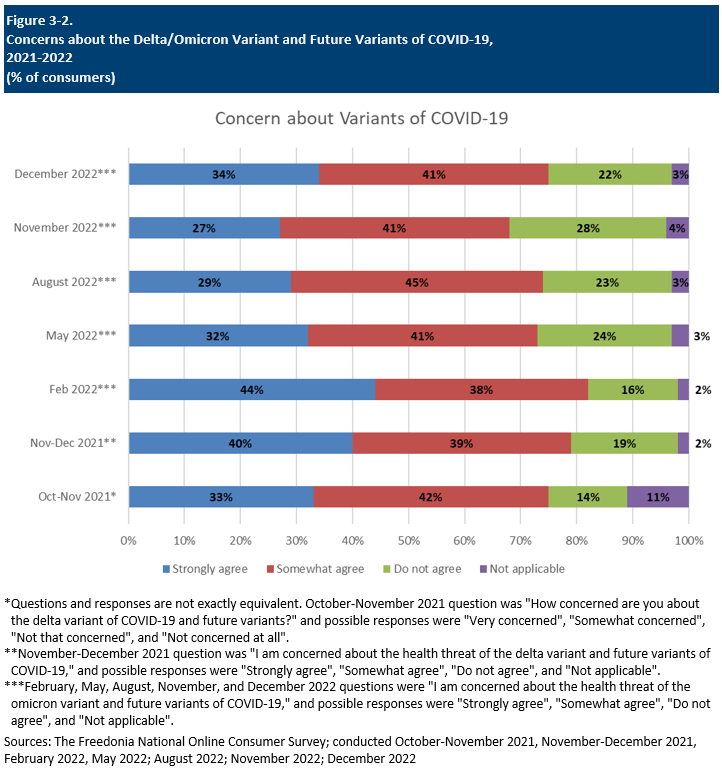
Concerns about variants of COVID-19 are significant. In The Freedonia Group’s National Online Consumer Survey conducted in October-November 2021, three-fourths of consumers expressed being at least somewhat concerned about Delta and future variants; one-third of respondents agreed strongly with that sentiment. Then in December 2021, the Omicron variant was first discovered in the US and raised new questions about the virus’ continued mutations. Thus, the survey results in November-December 2021 reflected rising fears.In February 2022, an even larger majority agreed that they were concerned about the health threats of Omicron and future variants. Concerns began to wane in May 2022, though, since caseloads were lower than during earlier parts of the year. The percentage of consumers who strongly agreed that they were concerned about variants was lowest in November 2022 after new vaccines were made available that were designed to target the newer variants. However, concerns rose again in December 2022 along with news about changes in variants and its increasing spread along with holiday gatherings.
Differences Between Full-Time & Part-Time Employees
People who are employed full-time are more likely to report that they can work from home; 70% of full-time workers say they are, at the very least, able to do so when necessary. This share had remained largely unchanged between the start of the pandemic and May 2022, but grew by December 2022.In contrast, only 62% of part-time workers are able to work from home, up from 56% in May 2022. Still, the share of part-time workers reporting that they are set up to work from home at least sometimes has been increasing since 2020.
See our blog discussing Work from Home Trends
Working from home became a major trend at onset of the COVID-19 pandemic. While some individuals – mostly in the knowledge economy – had already been working from home offices, many more shifted to remote work in March 2020. Some have stayed home since, while others have returned to their offices on a full- or part-time basis. Additionally, the workforce has changed; in some cases, workers moved from jobs that could only be done in person to those that had more remote potential.Changes in where and how we work affect many facets of the US economy, from obvious sectors like commercial real estate to the ways that commuting (or not) changes where and how workers spend their money. Consequently, an investigation into consumer trends in this area can give insight to marketing and product development opportunities.
This report contains analysis and data-based discussions of work from home trends, including a look at COVID-19 pandemic concerns and wellness impacts, attitudes about work, demographic trends, and other consumer insights.
This report includes analysis, data, trends, and customized cross tabs using two survey resources:
- Data from The Freedonia Group’s proprietary national online surveys conducted from February 2021, June 2021, August 2021, October-November 2021, November-December 2021, February 2022, May 2022, August 2022 and December 2022
- Data from syndicated national consumer survey results from MRI-Simmons’ Fall 2016-2022 Reports
Resident Population
Changes in the population can affect the number of workers available to hire. The fastest growth expected through the forecast period will be among the older age cohorts who are most likely to be either retiring or working only part-time. The decline or small growth in key working age groups will lead to greater competition for companies to attract or retain workers. One effect could be more companies offering remote work as a benefit to attract or retain workers or to be able to cast their hiring net into a wider geography beyond a reasonable commuting distance from their office or work location.Concerns About of COVID-19 Variants
Concerns about variants of COVID-19 are significant
Concerns about variants of COVID-19 are significant. In The Freedonia Group’s National Online Consumer Survey conducted in October-November 2021, three-fourths of consumers expressed being at least somewhat concerned about Delta and future variants; one-third of respondents agreed strongly with that sentiment. Then in December 2021, the Omicron variant was first discovered in the US and raised new questions about the virus’ continued mutations. Thus, the survey results in November-December 2021 reflected rising fears.In February 2022, an even larger majority agreed that they were concerned about the health threats of Omicron and future variants. Concerns began to wane in May 2022, though, since caseloads were lower than during earlier parts of the year. The percentage of consumers who strongly agreed that they were concerned about variants was lowest in November 2022 after new vaccines were made available that were designed to target the newer variants. However, concerns rose again in December 2022 along with news about changes in variants and its increasing spread along with holiday gatherings.

Differences Between Full-Time & Part-Time Employees
People who are employed full-time are more likely to report that they can work from home; 70% of full-time workers say they are, at the very least, able to do so when necessary. This share had remained largely unchanged between the start of the pandemic and May 2022, but grew by December 2022.In contrast, only 62% of part-time workers are able to work from home, up from 56% in May 2022. Still, the share of part-time workers reporting that they are set up to work from home at least sometimes has been increasing since 2020.
- Introduction
- Overview
- Resident Population
- Table | Resident Population by Age Group, 2012, 2017, 2022, 2027
- Table | Resident Population Historical Annual Data, 2017-2022
- Table | Resident Population Annual Forecast Data, 2022-2027
- Civilian Labor Force & Employment
- Table | Civilian Labor Force & Unemployment Rate, 2012, 2017, 2022, 2027
- Table | Civilian Labor Force & Unemployment Rate Historical Annual Data, 2017-2022
- Table | Civilian Labor Force & Unemployment Rate Forecast Annual Data, 2022-2027
- Types of Employment
- Table | Employed Civilian Labor Force by Type of Employment, 2012, 2017, 2022, 2027
- Table | Employed Civilian Labor Force by Type of Employment Historical Annual Data, 2017-2022
- Table | Employed Civilian Labor Force by Type of Employment Forecast Annual Data, 2022-2027
- Resident Population
- COVID-19 Insights
- Case Patterns
- Figure 3-1. COVID-19 Statistics, March 2020-March 2023
- Most Still Consider the Pandemic a Health Threat Personally or to Family/Friends
- Table | "I am concerned about the current coronavirus health threat…", 2020-2022
- Health Threat Feelings by Work From Home Status
- Table | "I am concerned about the current coronavirus health threat…", by Work From Home Status, 2022
- Heath Threat Feelings by Work From Home Frequency
- Table | "I am concerned about the current coronavirus health threat…", by Work From Home Frequency, 2022
- Health Threat Feelings by Location of Work
- Table | "The Current Coronavirus Pandemic is a Health Threat to Me, Personally" by Area of Work, 2022
- Health Threat Feelings by Age Group
- Table | "The Current Coronavirus Pandemic is a Health Threat to Me, Personally" by Age Group, 2022
- Concerns about COVID-19 Variants
- Concerns About Variants of COVID-19 are Significant
- Figure 3-2. Concerns about the Delta/Omicron Variant and Future Variants of COVID-19, 2021-2022
- Concern About Variants by Location of Work
- Table | "I Am Concerned About the Health Threat of Omicron & Future Potential Variants of COVID-19" by Locat
- Concern About Variants by Age Group
- Table | "I Am Concerned About the Health Threat of Omicron & Future Potential Variants of COVID-19" by Age G
- Concerns About Variants of COVID-19 are Significant
- Continuing Mental and Physical Health Effects
- Changes in Mental & Physical Health Effects
- Table | Changes in Mental and Physical Symptoms during the Pandemic, May, August, December 2022
- Stress, Tiredness, &Anxiety
- Table | "Please rate changes to how you currently feel in these areas (stress, tiredness, anxiety), compared
- Energy Levels & Focus
- Table | "Please rate changes to how you currently feel in these areas (energy levels, focus), compared to be
- Changes in Mental & Physical Health Effects
- Case Patterns
- Work From Home Trends
- More Than Half of Employees Are Set Up to Work From Home
- Table | "Are You Set Up to Do Your Normal Work from Home -Whether Ordinarily, Part-Time, or As-Needed?" by G
- Differences Between Full-Time & Part-Time Employees
- Table | "Are You Set Up to Do Your Normal Work from Home -Whether Ordinarily, Part-Time, or As-Needed?" by F
- Differences by Household Income
- Table | "Are You Set Up to Do Your Normal Work from Home -Whether Ordinarily, Part-Time, or As-Needed?" by H
- Differences by Location of Original Workplace
- Table | "Are You Set Up to Do Your Normal Work from Home -Whether Ordinarily, Part-Time, or As-Needed?" by L
- Changes in Work From Home
- Table | Changes in Work From Home Frequency, 2020 & 2022
- Remote Work Over Time
- Table | Remote Work Trends, 2016-2022
- Remote Work by Job Function
- Table | Remote Work Trends by Job Function, 2022
- More Than Half of Employees Are Set Up to Work From Home
- Future Plans For Work
- Convert a Room to a Home Office
- Convert a Home Office by Generation
- Table | Plan to Convert a Room to a Home Office in the Next 12 Months by Generation, 2016-2022
- Convert a Home Office by Work Location
- Table | Plan to Convert a Room to a Home Office in the Next 12 Months by Work Location, 2016-2022
- Convert a Home Office by Generation
- Retire From Full-Time Work
- Retire by Generation
- Table | Plan to Retire From Full-Time Work in the Next 12 Months by Generation, 2016-2022
- Retire by Work Location
- Table | Plan to Retire From Full-Time Work in the Next 12 Months by Work Location, 2016-2022
- Retire by Generation
- Change Jobs
- Change Jobs by Generation
- Table | Plan to Change Jobs in the Next 12 Months by Generation, 2016-2022
- Change Jobs by Work Location
- Table | Plan to Change Jobs in the Next 12 Months by Work Location, 2016-2022
- Change Jobs by Generation
- Convert a Room to a Home Office
- Attitudes About Work
- Attitudes About Work Over Time
- Table | Attitudes About Work, 2016-2022
- Attitudes by Generation
- Table | Attitudes About Work by Generations, 2022
- Attitudes by Primary Work Location
- Table | Attitudes About Work by Primary Workplace, 2022
- Attitudes About Work Over Time
- Appendix
- Related Studies
- Consumer Insights Reports
- Freedonia Group US Studies
- Freedonia Group Global Studies
- Freedonia Focus Reports
- Packaged Facts Reports
- Related Studies
Younger workers are most likely to say that they prefer working on a team than alone, making that a potential incentive to return to offices.
Work-from-home remains an option for many employed respondents, as 69% are set up to do their normal work from home.
Concern about the health threat of the pandemic remains highest in urban areas.
Those who primarily work from an office are more likely to report that they plan to change jobs in the next 12 months compared to those who primarly work remotely.