Baby Food & Formula Packaging
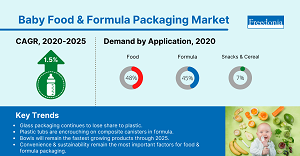
Demand for packaging used with baby food and formula is projected to grow 1.5% annually to $377 million in 2025.
Free Sample Report
Request a free sample of this report and our team will email it to you.
Report Overview
Featuring 24 tables and 22 figures – now available in Excel and Powerpoint! Learn More
 The scope of this report includes packaging for food designed and marketed for babies, including newborns, infants, and toddlers. Baby food is specifically labeled as such and generally sold in a dedicated section of retail stores.
Packaging Formats (Rigid vs. Flexible)
Demand for packaging for baby food and formula is expected to increase 1.5% per year to $377 million in 2025. Growth in baby food and formula packaging demand will be supported by:
- the convenience of packaged infant food over most home prepared foods
- the relatively high level of working mothers with infants and toddlers, for whom time and convenience is at a premium
- above average growth in organic and natural baby foods, supporting the use of higher value packaging
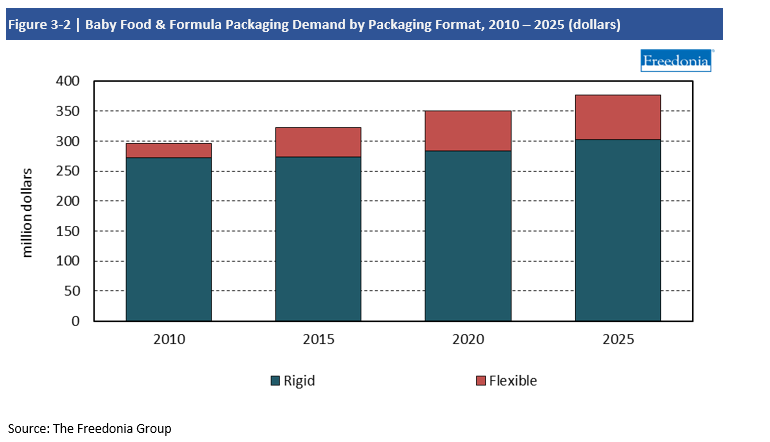
Rigid packaging dominates baby food and formula packaging demand, with 82% of total sales in 2020 – mostly in glass jars and composite cans. Other important rigid packaging products include bottles, cups, tubs, and cartons. Baby formula is packaged primarily in rigid containers due to the difficulty of packaging powdered formula in a flexible material. As such, rigid containers will remain a mainstay of formula packaging for the foreseeable future.
However, flexible packaging is expected to continue to take market share from rigid packaging in baby food and snacks due to its light weight, lower cost, and convenience.
Flexible packaging, while currently a small share of the market, is expected to see faster growth and take market share from rigid packaging in baby food and snacks. This is primarily due to advances in stand-up pouches for fruit purees, baby snacks, and cookies. Flexible lidding is often used in conjunction with cups and tubs.
Packaging Demand by Material
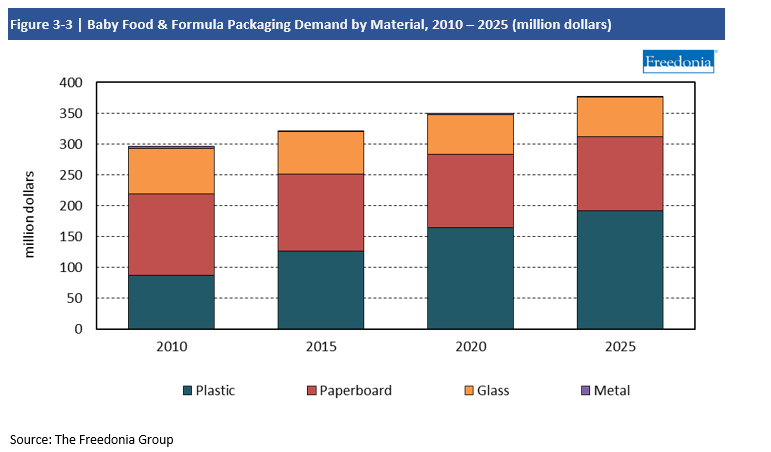
Packaged baby foods, including infant and toddler fruits, vegetables, meats, and full meals, were historically the domain of glass jars. However, plastic containers – especially tubs, cups, and pouches – have made substantial inroads into the market since Gerber (Nestlé) began transitioning to them in 2001, and plastic is now the largest material category for food and formula.
Plastic will remain the fastest growing material category, taking share from both glass and paperboard. Besides its lighter weight and lower cost compared to glass, and its structural strength compared to paperboard, plastic’s growth will be further supported by its availability in both rigid and flexible formats.
Although losing share to plastic, paperboard will remain a significant segment of baby formula and snack packaging due to the prevalent use of composite cans. Folding cartons will also remain a relatively large and stable segment of the baby food and formula packaging market due to their ubiquity as secondary packaging.
Though plastic has overtaken glass as the leading container material for baby food, glass jars will remain an important component of the container mix based on attributes including suitability for high temperature processing, resealability, and high-quality image, particularly among premium and organic brands.
Demand by Application
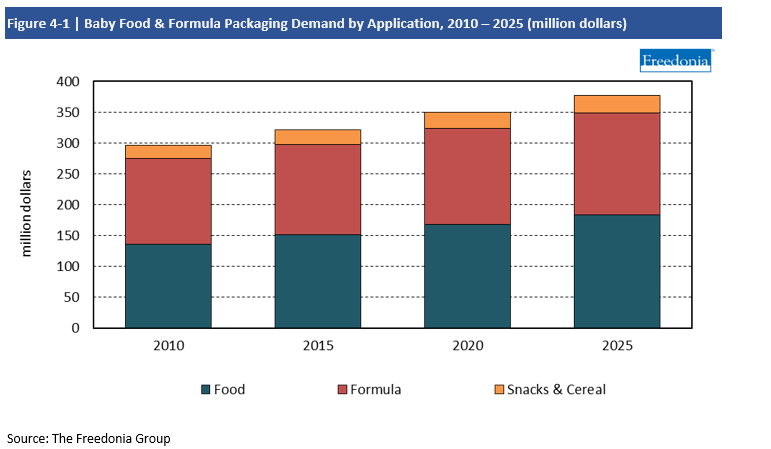
Demand for baby food and formula packaging is expected to increase 1.5% per year to $377 million in 2025, supported by:
- above average growth in organic and natural baby foods, supporting the use of higher value packaging
- innovations in baby snacks
- innovations in baby food packaging
Baby food and formula are the dominant applications for packaging, together comprising 93% of overall sales; baby snacks and infant cereal remain relatively small niches but are forecast to experience growth in line with baby food.
Specific applications covered in this report include:
- food such as entrees and dinners, meat purees, fruit and vegetable purees, and puddings
- formula, including ready-to-drink, powdered, and liquid concentrate
- cereal, such as rice, wheat, oatmeal, and multi-grain cereal
- snacks, such as puffs, crunchies, melts, teethers, yogurt pieces, and cookies
Excluded from this study are baby electrolyte drinks, such as Pedialyte, and products such as applesauce or yogurt that are not explicitly marketed toward infants and toddlers.
Specific packaging products used for baby food include:
- glass jars
- stand-up pouches
- folding cartons and sleeves
- composite cans
- plastic tubs and cups
- bowls
- aseptic cartons
- other packaging such as bag-in-box and metal cans
Excluded from the study are shipping boxes and protective packaging, such as that used with baby food subscription services.
Historical data (2010, 2015, and 2020) and forecasts for 2025 and 2030 are presented for demand for baby food and formula containers by value in current dollars (including inflation); demand data by market is presented in current dollars. Also presented are historical and forecast data for raw material usage in food containers in pounds and total dollars. “Demand” (or sales) is defined as all shipments from US plants, plus imports minus exports.
Demand for packaging used with baby food and formula is projected to grow 1.5% annually to $377 million in 2025, supported by:
- the convenience of packaged infant food over most home prepared foods
- the relatively high number of working mothers with infants and toddlers, for whom time and convenience are at a premium
- above average growth in organic and natural baby foods, supporting the use of higher value packaging
- innovations in baby food and formula packaging, such as the introduction of bowls for baby cereals
Though Still Significant, Glass Packaging Continues to Lose Share to Plastic
Baby food remains one of the few food markets to use glass packaging to a significant degree – particularly with organic and premium baby food – due to the perception of quality and purity that it imparts. Despite this, glass continues to face competition from plastic that is largely attributable to the latter’s lighter weight, shatter resistance, and lower costs of production and transportation. Some plastic packaging, such as bowls and pouches, also come equipped with added convenience features not present in glass packaging.
Furthermore, though glass is generally recyclable, its heavy weight leads to increased fuel consumption during shipping, creating both higher costs and a larger carbon footprint.
Plastic Tubs Are Taking Share from Composite Cans in Formula Packaging
Though composite cans remain the most popular form of packaging for powdered formula due to their economical nature, they will lose share to plastic tubs. Despite being more expensive, plastic tubs tend to have a variety of value-added features – built-in scoops, scoop levelers, and snap-shut lids, among others – that are becoming increasingly important to selective and busy parents. Additionally, plastic tubs convey a more premium image and have better crush resistance than composite cans.
Bowls Are Forecast to Remain the Fastest Growing Product
Introduced to the baby food category in 2017, bowls quickly became a popular alternative to cups and jars due to their resealability and ready-to-serve nature. Cereals and oatmeals, in particular, benefit from bowl packaging compared to plastic jar or composite canister packaging since they do not need to be prepared and are easy to heat, saving time for busy parents.
Convenience & Sustainability Continue To Be the Most Important Factors for Packaging
Convenience and sustainability are important in any packaging market, but especially so in baby food and formula. Parents of infants and toddlers have to balance raising their children with their work schedules; any convenience that can save them time or hassle is vital. Packaging equipped with value-added features – spouts for self-feeding, scoop holders, or snap-shut lids that ensure safety and/or freshness – are particularly valued by busy parents. Additionally, the primary consumers of baby food and formula – parents of young children – have a vested interest in the future of environmental health and, as such, tend to prioritize sustainable packaging more than the standard consumer.
Packaging Formats (Rigid vs. Flexible)
Demand for packaging for baby food and formula is expected to increase 1.5% per year to $377 million in 2025. Growth in baby food and formula packaging demand will be supported by:
- the convenience of packaged infant food over most home prepared foods
- the relatively high level of working mothers with infants and toddlers, for whom time and convenience is at a premium
- above average growth in organic and natural baby foods, supporting the use of higher value packaging
Rigid packaging dominates baby food and formula packaging demand, with 82% of total sales in 2020 – mostly in glass jars and composite cans. Other important rigid packaging products include bottles, cups, tubs, and cartons. Baby formula is packaged primarily in rigid containers due to the difficulty of packaging powdered formula in a flexible material. As such, rigid containers will remain a mainstay of formula packaging for the foreseeable future.
However, flexible packaging is expected to continue to take market share from rigid packaging in baby food and snacks due to its light weight, lower cost, and convenience.
Flexible packaging, while currently a small share of the market, is expected to see faster growth and take market share from rigid packaging in baby food and snacks. This is primarily due to advances in stand-up pouches for fruit purees, baby snacks, and cookies. Flexible lidding is often used in conjunction with cups and tubs.

Packaging Demand by Material
Packaged baby foods, including infant and toddler fruits, vegetables, meats, and full meals, were historically the domain of glass jars. However, plastic containers – especially tubs, cups, and pouches – have made substantial inroads into the market since Gerber (Nestlé) began transitioning to them in 2001, and plastic is now the largest material category for food and formula.
Plastic will remain the fastest growing material category, taking share from both glass and paperboard. Besides its lighter weight and lower cost compared to glass, and its structural strength compared to paperboard, plastic’s growth will be further supported by its availability in both rigid and flexible formats.
Although losing share to plastic, paperboard will remain a significant segment of baby formula and snack packaging due to the prevalent use of composite cans. Folding cartons will also remain a relatively large and stable segment of the baby food and formula packaging market due to their ubiquity as secondary packaging.
Though plastic has overtaken glass as the leading container material for baby food, glass jars will remain an important component of the container mix based on attributes including suitability for high temperature processing, resealability, and high-quality image, particularly among premium and organic brands.

Demand by Application
Demand for baby food and formula packaging is expected to increase 1.5% per year to $377 million in 2025, supported by:
- above average growth in organic and natural baby foods, supporting the use of higher value packaging
- innovations in baby snacks
- innovations in baby food packaging
Baby food and formula are the dominant applications for packaging, together comprising 93% of overall sales; baby snacks and infant cereal remain relatively small niches but are forecast to experience growth in line with baby food.

Specific applications covered in this report include:
- food such as entrees and dinners, meat purees, fruit and vegetable purees, and puddings
- formula, including ready-to-drink, powdered, and liquid concentrate
- cereal, such as rice, wheat, oatmeal, and multi-grain cereal
- snacks, such as puffs, crunchies, melts, teethers, yogurt pieces, and cookies
Excluded from this study are baby electrolyte drinks, such as Pedialyte, and products such as applesauce or yogurt that are not explicitly marketed toward infants and toddlers.
Specific packaging products used for baby food include:
- glass jars
- stand-up pouches
- folding cartons and sleeves
- composite cans
- plastic tubs and cups
- bowls
- aseptic cartons
- other packaging such as bag-in-box and metal cans
Excluded from the study are shipping boxes and protective packaging, such as that used with baby food subscription services.
Historical data (2010, 2015, and 2020) and forecasts for 2025 and 2030 are presented for demand for baby food and formula containers by value in current dollars (including inflation); demand data by market is presented in current dollars. Also presented are historical and forecast data for raw material usage in food containers in pounds and total dollars. “Demand” (or sales) is defined as all shipments from US plants, plus imports minus exports.
Demand for packaging used with baby food and formula is projected to grow 1.5% annually to $377 million in 2025, supported by:
- the convenience of packaged infant food over most home prepared foods
- the relatively high number of working mothers with infants and toddlers, for whom time and convenience are at a premium
- above average growth in organic and natural baby foods, supporting the use of higher value packaging
- innovations in baby food and formula packaging, such as the introduction of bowls for baby cereals
Though Still Significant, Glass Packaging Continues to Lose Share to Plastic
Baby food remains one of the few food markets to use glass packaging to a significant degree – particularly with organic and premium baby food – due to the perception of quality and purity that it imparts. Despite this, glass continues to face competition from plastic that is largely attributable to the latter’s lighter weight, shatter resistance, and lower costs of production and transportation. Some plastic packaging, such as bowls and pouches, also come equipped with added convenience features not present in glass packaging.
Furthermore, though glass is generally recyclable, its heavy weight leads to increased fuel consumption during shipping, creating both higher costs and a larger carbon footprint.
Plastic Tubs Are Taking Share from Composite Cans in Formula Packaging
Though composite cans remain the most popular form of packaging for powdered formula due to their economical nature, they will lose share to plastic tubs. Despite being more expensive, plastic tubs tend to have a variety of value-added features – built-in scoops, scoop levelers, and snap-shut lids, among others – that are becoming increasingly important to selective and busy parents. Additionally, plastic tubs convey a more premium image and have better crush resistance than composite cans.
Bowls Are Forecast to Remain the Fastest Growing Product
Introduced to the baby food category in 2017, bowls quickly became a popular alternative to cups and jars due to their resealability and ready-to-serve nature. Cereals and oatmeals, in particular, benefit from bowl packaging compared to plastic jar or composite canister packaging since they do not need to be prepared and are easy to heat, saving time for busy parents.
Convenience & Sustainability Continue To Be the Most Important Factors for Packaging
Convenience and sustainability are important in any packaging market, but especially so in baby food and formula. Parents of infants and toddlers have to balance raising their children with their work schedules; any convenience that can save them time or hassle is vital. Packaging equipped with value-added features – spouts for self-feeding, scoop holders, or snap-shut lids that ensure safety and/or freshness – are particularly valued by busy parents. Additionally, the primary consumers of baby food and formula – parents of young children – have a vested interest in the future of environmental health and, as such, tend to prioritize sustainable packaging more than the standard consumer.
- Executive Summary
- Figure 1-1 | Baby Food & Formula Packaging Market Outlook
- About This Report
- Report Details
- Study Scope & Product Description
- Figure 2-1 | Baby Food & Formula: Product Examples
- Impact of COVID-19 Pandemic
- Table | Annual Baby Food & Formula Packaging Demand by Product, 2019 - 2021
- Figure 2-2 | Annual Baby Food & Formula Packaging Demand, 2018 - 2022
- Overview
- Historical Market Trends
- Table | Baby Food & Formula Packaging Demand, 2010 - 2020
- Figure 3-1 | Baby Food & Formula Packaging Demand, 2000 - 2020
- Packaging Formats (Rigid vs. Flexible)
- Table | Baby Food & Formula Packaging Demand by Packaging Format, 2010 - 2025
- Figure 3-2 | Baby Food & Formula Packaging Demand by Packaging Format, 2010 - 2025
- Materials Trends
- Packaging Demand by Material
- Table | Baby Food & Formula Packaging Demand by Material, 2010 - 2025
- Figure 3-3 | Baby Food & Formula Packaging Demand by Material, 2010 - 2025
- Plastic
- Table | Plastic Baby Food & Formula Packaging Demand by Product, 2010 - 2025
- Paperboard
- Table | Paperboard Baby Food & Formula Packaging Demand by Product, 2010 - 2025
- Glass
- Figure 3-4 | Glass Baby Food Packaging Demand, 2010 - 2025
- Packaging Demand by Material
- Product Innovation
- Figure 3-5 | Baby Food & Formula Packaging Innovations
- Sustainability
- Consumer Insights
- Environmental Attitudes
- Table | Environmental Attitudes Among Households With Children, 2021
- Eco-Friendly Priorities in Packaging
- Figure 3-6 | Priorities When Thinking About Eco-Friendly or Sustainable Packaging, 2021
- Environmental Attitudes
- Historical Market Trends
- Applications
- Demand by Application
- Table | Baby Food & Formula Packaging Demand by Application, 2010 - 2025
- Figure 4-1 | Baby Food & Formula Packaging Demand by Application, 2010 - 2025
- Food
- Table | Baby Food Packaging Demand by Product, 2010 - 2025
- Figure 4-2 | Baby Food Packaging: New Product Examples
- Formula
- Table | Baby Formula Packaging Demand by Product, 2010 - 2025
- Cereal & Snacks
- Table | Baby Snack & Cereal Packaging Demand by Product, 2010 - 2025
- Figure 4-3 | Cereal & Snack Packaging: New Product Examples
- Demand by Application
- Packaging Products
- Demand by Product
- Table | Baby Food & Formula Packaging Demand by Product, 2010 - 2025
- Jars & Bottles
- Table | Baby Food & Formula Jar & Bottle Demand by Application & Material, 2010 - 2025
- Jars
- Table | Baby Food & Formula Jar Demand by Material, 2010 - 2025
- Figure 5-1 | Jar Demand in Baby Food and Formula Packaging by Material, 2010 - 2025
- Bottles
- Figure 5-2 | Bottle Demand in Baby Food & Formula Packaging, 2010 - 2025
- Composite Cans
- Table | Baby Food & Formula Composite Can Demand by Application, 2010 - 2025
- Figure 5-3 | Baby Food & Formula Composite Can Demand by Application, 2010 - 2025
- Pouches
- Table | Baby Food & Formula Pouch Demand by Application & Type, 2010 - 2025
- Figure 5-4 | Baby Food & Formula Pouch Demand by Application, 2010 - 2025
- Plastic Cups & Lidding
- Table | Baby Food & Formula Plastic Cup & Lidding Demand by Product, 2010 - 2025
- Figure 5-5 | Baby Food & Formula Plastic Cup & Lidding Demand by Product, 2010 - 2025
- Cartons & Sleeves
- Table | Baby Food & Formula Carton & Sleeve Demand by Application & Product, 2010 - 2025
- Figure 5-6 | Baby Food & Formula Carton & Sleeve Demand by Application, 2010 - 2025
- Plastic Tubs
- Figure 5-7 | Plastic Tub Demand in Formula Packaging, 2010 - 2025
- Bowls
- Figure 5-8 | Bowl Demand in Baby Food & Formula Packaging, 2017 - 2030
- Figure 5-9 | Bowl Packaging: New Product Examples
- Other Packaging
- Figure 5-10 | Other Baby Food & Formula Packaging Demand, 2010 - 2025
- Demand by Product
- Key Suppliers & Industry Trends
- Industry Composition
- Leading Suppliers
- Appendix
- Scope
- Table | Relevant Industry Codes
- Table | Relevant HS Codes
- Definitions
- Freedonia Methodology
- Study-Specific Methodology
- Sources
- Associations & Agencies
- Related Studies & Reports
- Macroeconomic Assumptions
- Economic Environment
- Table | Macroeconomic Indicators, 2010 – 2025
- Demographics
- Table | Population & Households, 2010 - 2025
- Consumer Spending
- Table | Personal Consumption Expenditures, 2010 – 2025
- Retail Sales
- Table | Nondurable Goods Retail Sales, 2010 – 2025
- Economic Environment
- Scope
Sustainability and convenience are the most important factors for consumers.
Bowls expected to remain the fastest growth product category.
Demand for packaging used with baby food and formula is projected to grow 1.5% annually to $377 million in 2025.