US EIFS Siding: Exterior Insulation Finishing Systems
Demand for EIFS siding in the US is projected to increase 1.5% per year through 2025 to 2.9 million squares valued at $490 million.
Free Sample Report
Request a free sample of this report and our team will email it to you.
Report Overview
Featuring 17 tables and 11 figures – now available in Excel and Powerpoint! Learn More
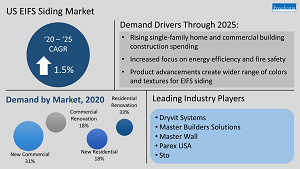
Demand for EIFS siding in the US is projected to increase 1.5% per year through 2025 to 2.9 million squares valued at $490 million. Gains will be driven by:
- rising building construction activity
- increased interest in EIFS due to its energy efficiency, as home and business owners alike look to save costs
- product developments that are expanding the range of colors and textures in which EIFS siding is available, allowing the material to be used in a wider range of styles (for example to mimic a brick aesthetic)
However, faster demand gains will be restrained by intense competition from alternative stucco and fiber cement, which have similar aesthetics and are more familiar to consumers and building construction professionals.
Product Improvements to Boost Adoption in Residential Applications
As manufacturers continue to improve EIFS durability and moisture resistance, more consumers are likely to opt for this product, particularly in areas of the country where the look of EIFS and stucco is already popular, such as the Southeastern states and in the West.
Outside of these areas, the widening range of colors and textures that EIFS can emulate will also increase demand for these products. Introduction of EIFS siding that imitates bricks, for example, can increase use of this material in the Northeast and Middle Atlantic states where brick aesthetics predominate. Additionally, rising contractor familiarity with EIFS will support demand, as this will limit improper installation of EIFS, which in the past has led to a negative perception of the material.
EIFS Benefits from Performance Characteristics in the Commercial Market
Demand for EIFS siding in the commercial market is expected to increase through 2025, as more commercial building owners opt for the material due to its:
- strong fire-resistant properties, especially as building codes increasingly focus on fire safety
- insulative qualities, which will appeal to building owners looking to either lower costs through improved energy efficiency or to earn credits for sustainable building practices
- durability relative to other lower cost siding materials
However, the market for EIFS will remain somewhat limited to those building owners who are interested in a uniform, stucco-like appearance.

Historical Market Trends
EIFS siding demand tends to follow trends in overall siding and building construction activity, and it is used in similar amounts in residential and commercial applications. For instance, EIFS siding demand is correlated with new home construction, as siding is included on virtually every new house, and EIFS products are increasingly being installed at the time of the home’s construction.
EIFS siding demand is also impacted by trends in home renovation activity, as the residential re-siding market is the leading application for EIFS siding. Homeowners looking to upgrade the appearance of their homes may do so in ways that promote EIFS siding demand. For instance, more homeowners – particularly in Southeast states – will specify EIFS siding.
Pricing Trends
EIFS siding falls among the middle of siding materials in terms of price, as it is more expensive than vinyl and engineered wood but less expensive than metal panels and stone siding.
Through 2025, EIFS siding pricing is projected to expand 3.2% annually to $167 per square. Price growth will be driven by improvements in product design. In the near term, supply chain issues and labor shortages that push up production costs will also contribute to price increases.
However, the general reliance on domestically sourced materials will cause prices to rise more slowly than other products that import materials from abroad.
Competitive Products
EIFS siding products compete with a variety of other siding materials. Consumers decide which siding material to use based on a variety of factors, the most important of which being price, aesthetics, and material performance. Advantages of EIFS siding include:
- energy efficiency
- durability
- moisture control
- fire resistance
EIFS is also known as synthetic stucco, and competes primarily with traditional stucco products. Relative to traditional stucco, EIFS holds advantages such as better performance in harsh weather, superior moisture resistance, and an easier replacement process, as damaged traditional stucco typically requires the re-siding of an entire wall.
Disadvantages of EIFS relative to traditional stucco have historically included a significantly higher initial cost, a more difficult initial installation process, and fewer design options.
Factors Impacting EIFS Siding Demand
Construction Industry Outlook
The most important factor to siding sales is the health of the US construction industry, and in particular the construction of buildings. Siding is a critical and necessary component of all buildings constructed in the US, although the type of siding may vary significantly depending on whether the structure is residential or commercial and whether it is new construction or renovation.
Real (inflation-adjusted) expenditures on building construction in the US are expected to grow 1.0% per year through 2025, a significant deceleration from the 2015-2020 period.
Trends affecting the residential market for siding include:
- New single-family housing will offer better prospects than multifamily housing, but housing starts will only increase in 2020 and 2021, before declining through 2025.
- Multifamily housing construction will fall over this period, though average unit size will increase, mitigating the negative impact on siding demand.
- The sizable stock of older housing will support gains in improvement spending. However, growth will decelerate from the 2010-2020 period.
Commercial construction activity is anticipated to moderate, as there will be less impetus for businesses to expand; demand for their products and services will not increase as quickly as it did between 2015 and 2019, in part due to the business closures and building vacancies resulting from the COVID-19 pandemic.
The segments of commercial building construction will see the following trends:
- The fastest gains will be for industrial buildings as construction rebounds from declines posted during the 2015-2020 period. However, spending in 2025 will remain below the peak level of 2015.
- Economic expansion will support demand for some new office space.
- Construction of warehouses and distribution centers will expand as retailers hone their omnichannel sales strategies and attempt to reduce delivery times, particularly in response to the shortages of many goods resulting from the COVID-19 pandemic. Trends in construction of retail outlets will be weaker.
- Institutional building construction expenditures will rise, although construction of educational buildings will be restrained by little or no population growth in the prime school ages. Spending on education and religious segments will remain below 2010 levels.
- Executive Summary
- Figure 1-1 | US EIFS Siding Market
- About This Report
- Report Details
- Study Scope & Product Description
- Figure 2-1 | EIFS Siding: Product Examples
- Impact of COVID-19 Pandemic on the EIFS Siding Industry
- Table | Annual EIFS Siding Demand by Market & Application, 2019 - 2022
- Figure 2-2 | Annual EIFS Siding Area Demand by Market & Application, 2019 - 2023
- Overview
- Historical Market Trends
- Table | EIFS Siding Demand, 2010 - 2021
- Figure 3-1 | EIFS Siding Demand, 2003 - 2021
- Demand Outlook
- Table | EIFS Siding Demand, 2010 - 2030
- Figure 3-2 | EIFS Siding Demand, 2010 - 2030
- Pricing Trends
- Figure 3-3 | EIFS Average Price, 2003 - 2025
- Competitive Products
- Figure 3-4 | Comparative Demand Growth: EIFS Siding & Competitive Products, 2020 - 2025
- Figure 3-5 | EIFS Siding: Key Competitive Factors
- Factors Impacting EIFS Siding Demand
- Construction Industry Outlook
- Figure 3-6 | Building Construction Expenditures, 2000 - 2025
- Building Codes & Product Standards
- Green Building Standards (ICC Codes & LEED)
- New Product Development
- Construction Industry Outlook
- Historical Market Trends
- Markets
- Demand by Market
- Table | EIFS Siding Demand by Market, 2010 - 2030
- Figure 4-1 | EIFS Siding Demand by Market, 2010 - 2030
- Residential Buildings
- Table | Residential EIFS Siding Demand by Application & Housing Type, 2010 - 2030
- Commercial Buildings
- Table | Commercial EIFS Siding Demand by Application, 2010 - 2030
- Demand by Market
- Competitive Landscape
- Industry Composition
- Key Suppliers
- Appendix
- Scope
- Table | Relevant Industry Codes
- Table | Relevant HS Codes
- Definitions
- Freedonia Methodology
- Study-Specific Methodology
- Sources
- Associations & Agencies
- Related Studies & Reports
- Macroeconomic Assumptions
- Economic Environment
- Table | Macroeconomic Indicators, 2010 - 2030
- Demographic Trends
- Table | Population & Households, 2010 - 2030
- Building Construction
- Table | Building Construction Expenditures, 2010 - 2030
- Residential Building Construction
- Table | Residential Building Construction Expenditures, 2010 - 2030
- Residential Improvements & Repairs
- Table | Residential Improvement & Repair Expenditures, 2010 - 2030
- Commercial Building Construction
- Table | Commercial Building Construction Expenditures, 2010 - 2030
- Commercial Building Improvements & Repairs
- Table | Commercial Building Improvement & Repair Expenditures, 2010 - 2030
- Housing Completions
- Table | New Housing Indicators, 2010 - 2030
- Housing Stock
- Table | Housing Stock by Type, 2010 - 2030
- Figure 6-1 | Housing Stock: Share by Year of Construction, 2020
- Economic Environment
- Scope
Exterior insulation and finish systems (EIFS) are a type of non-loadbearing building siding system that provides exterior walls with an insulated, water-resistant surface.
Demand for EIFS siding in the US is projected to increase 1.5% per year through 2025 to 2.9 million squares valued at $490 million.
Gains are expected to be strongest in the Southeastern states and West, where stucco aesthetic is popular