Frozen Food Tubs, Cups, & Bowls
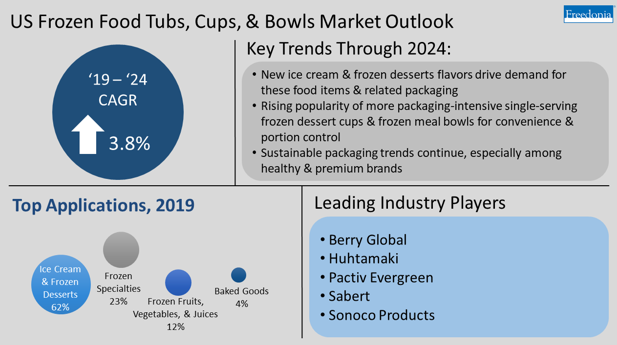
Through 2024, US demand for frozen food tubs, cups, and bowls is forecast to rise 3.8% per year to $844 million.
Free Sample Report
Request a free sample of this report and our team will email it to you.
Report Overview
Featuring 13 tables and 17 figures – now available in Excel and Powerpoint! Learn More
 This study analyzes the market for frozen food tubs, cups, and bowls. Historical (2009, 2014 and 2019) data and forecasts to 2024 are presented in current dollars
Demand by Type
Through 2024, frozen food demand for tubs, cups, and bowls will be driven by:
- rising demand for single-serve ice cream and premium frozen desserts (e.g., gelato, clean-label options), the leading applications for these products
- continued introduction of new frozen dinners and breakfast foods in bowls rather than traditional trays, particularly for items marketed as premium and healthy
- elevated retail ice cream sales during the COVID-19 pandemic, leading major brand owners to introduce new flavors and styles
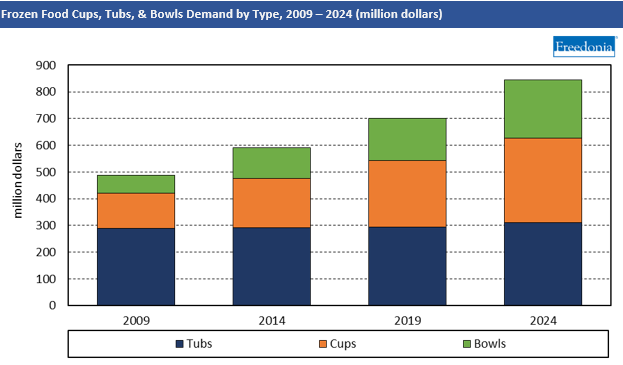
Tubs and cups account for the largest portion of sales, due to their widespread use in ice cream applications. Paperboard tubs and cups, especially square-round types, have largely supplanted square “brick” cartons and tall round paperboard tubs in the packaging of consumer ice cream products due to advantages of better freshness protection and easier scooping.
Bowls comprise a smaller – though quickly expanding – share of sales due to the growing popularity of frozen bowl meals. However, competition from trays remains strong in some frozen meal applications, as bowls are generally less conducive to compartmentalization without additional packaging.
Demand by Material (Plastic, Paperboard, & Molded Pulp)
Plastic is expected to eclipse paper as the leading material for tubs, cups, and bowls in frozen food packaging by 2024, when it will account for 51% of sales. Demand for plastic types will be driven by such advantages as:
- transparency, enabling consumers to see and inspect frozen food products
- strength and rigidity
- high moisture and barrier properties
- the use of in-mold labels that improve the aesthetics of plastic ice cream tubs
- recyclability (paper tubs, cups, and bowls are not recyclable in all locations due to the coatings used in their manufacture)
Nonetheless, paperboard will continue to see widespread use in ice cream applications due to its low cost and good environmental image. Paperboard will also remain the material of choice for large tubs of ice cream sold for foodservice applications due to its light weight and cost advantages.
Additionally, product development has led to adoption of paperboard tubs and cups that do not need plastic coatings, which traditionally provide moisture resistance but prevent the paperboard from being recycled or degrading. For instance:
- In 2019 and 2020, premium frozen dessert brands Coconut Bliss and Oatly replaced the polyethylene coating with a sugarcane-based polyethylene.
- In August 2020, Charta Global added a new plastic-free, two-sided cupstock paper board to its APP Foopak Bio Natura portfolio of sustainable packaging products:
- The cupstock utilizes the company’s proprietary sustainable water-based coating instead of traditional polyethylene, enabling the product to break down in an industrial composting facility.
- The new product is intended for use in single-serving frozen food applications including specialty meals and entrées, shakes, yogurt, and smoothies.
Molded pulp is projected to see expanding use by food suppliers interested in more sustainable packaging options.
Pricing Trends
Given the highly competitive nature of the food packaging industry, pricing plays a crucial role in the success or failure of a given container type as a packaging choice:
- Frozen foods generally have higher gross margins than most “center store” food items, a factor that can make product manufacturers more willing to use value-added packaging to help convey a premium image for their products.
- The more specialized packaging requirements for some types of microwavable frozen foods such as frozen meal bowls can add to packaging costs.
- Convenience and quality can outweigh pricing issues since consumers are generally willing to pay more for products that save time or are high quality.
Price competition in frozen food packaging is intense, both between different materials and between vendors of comparable products, because many of these packaging types are low technology, commodities. Pricing advantages for one packaging material over another tend to fluctuate depending on economic conditions, raw material costs, excess capacity, or price discounting.
Applications covered include:
- frozen specialty foods:
- appetizers
- breakfast foods such as waffles, pancakes, French toast, and toaster pastries
- breakfast sandwiches
- entrées
- frozen dinners
- hand-held entrées
- plant-based meat alternative products
- pizzas such as pizza pies, slices, flatbreads, pizza pockets, and pizza rolls
- side dishes
- soups
- whipped toppings
- ice cream and other frozen desserts:
- hard and soft ice cream
- hard and soft frozen yogurt
- sherbet
- sorbet
- gelato
- frozen custard
- flavored ices
- ice cream cakes
- ice cream novelties (i.e., single-serve units of any of the above
- other frozen food applications, including meat, poultry, and seafood; frozen baked goods; fruits and vegetables (including frozen juice concentrates); and all other frozen food products – e.g., sauces, baby food, pet food, cocktail mixers, nondairy creamers, liquid eggs, herbs, drink mixes, etc.
Excluded from the scope of this study are
- packaged ice
- frozen carryout
- meal delivery program foods
- shelf-stable products that are frozen after purchase
Also excluded are separately sold lids, caps, and closures as well as rigid plastic pails.
Through 2024, US demand for frozen food tubs, cups, and bowls is forecast to rise 3.8% per year to $844 million. Near-term growth will be boosted by surging retail sales of ice cream and frozen desserts amid the COVID-19 pandemic, though decreased foodservice activity will somewhat offset overall gains. Long-term advances will be driven by:
- ongoing introductions of new ice cream and frozen dessert flavors and styles, including superpremium items such as gelato and protein-packed ice cream, which often employ higher value packaging
- rising demand for more packaging-intensive single-serving frozen food items in cups and bowls for convenience and portion control
- rapidly growing popularity of frozen meal bowls due to their convenience and the increasingly wide range of flavors and healthy options available
However, growth will be limited by market maturity in the tubs segment, as well as by ongoing competition from other packaging formats such as plastic trays.
Cups to Overtake Tubs as Leading Product Type by 2024, Partly Due to Single-Serving Trends
Though a well-established packaging format for ice cream quarts and half-gallons, tubs are expected to continue to lose market share to cups, which are forecast to account for the largest share of market gains through 2024, when they will eclipse tubs as the leading product type. Demand for ice cream cups will be primarily driven by rapidly rising demand for smaller single-serving ice cream and frozen desserts – which are convenient and provide portion control – as well as for multipacks of these single-serve items.
Bowls Continue to Carve Strong Niche in the Frozen Meals Market
Demand growth for frozen food bowls will continue to benefit from the rapidly rising popularity of single-serving, ready-to-heat frozen dinner and breakfast food bowls due to their convenience, ability to provide easy portion control, and the increasingly wide range of flavors and healthy options that is available.
However, frozen food bowls are most widely used in applications where the contents are intended to be mixed together (e.g., curries, stir-fry, pasta dishes, soups, stews, risottos). Bowls are less amenable to compartmentalization without additional packaging than trays, which can easily be pre-formed with compartments. As a result, bowls will not make strong inroads in applications where separation of foods is required.
Sustainability Trends Increase Demand Value, Especially for Healthy & Premium Brands
Demand for frozen food tubs, cups, and bowls will be bolstered by growing adoption of higher value products sourced from more environmentally friendly or biobased materials over traditional plastics due to rising consumer demand for sustainable packaging. Sustainability trends are particularly strong in markets, such as frozen food bowls, where healthy eating and clean label trends are more prevalent.
- Executive Summary
- About This Report
- Report Details
- Study Scope & Product Description
- Impact of COVID-19 Pandemic
- Overview
- Historical Market Trends
- Demand by Type
- Tubs
- Cups
- Bowls
- Demand by Material (Plastic, Paperboard, & Molded Pulp)
- Pricing Trends
- Competitive Products
- Sustainability Initiatives
- Recycling & Recycled Content
- Source Reduction (Weight Reduction)
- Alternative Materials
- Applications
- Demand by Application
- Ice Cream & Frozen Desserts
- Frozen Specialty Foods
- Other Frozen Food Applications
- Key Suppliers & Market Share
- Industry Composition
- Market Share
- Appendix
- Scope
- Definitions
- Freedonia Methodology
- Study-Specific Methodology
- Sources
- Associations & Agencies
- Related Studies & Reports
- Macroeconomic Assumptions
- Economic Environment
- Demographics
- Consumer Spending
Plastic is expected to eclipse paper as the leading material for tubs, cups, and bowls in frozen food packaging by 2024, when it will account for 51% of sales.
Through 2024, US demand for frozen food tubs, cups, and bowls is forecast to rise 3.8% per year to $844 million.
Though a well-established packaging format for ice cream quarts and half-gallons, tubs are expected to continue to lose market share to cups, which are forecast to account for the largest share of market gains through 2024, when they will eclipse tubs as the leading product type.