Global Plastic Potable Water Pipe
Plastic potable water pipe comprises all of the systems required to deliver safe drinking water and potable-quality water for other uses, such as fire suppression and radiant flooring.
Free Sample Report
Request a free sample of this report and our team will email it to you.
Report Overview
Featuring 49 tables and 12 figures – now available in Excel and Powerpoint! Learn More
Plastic potable water pipe comprises all of the systems required to deliver safe drinking water and potable-quality water for other uses, such as fire suppression and radiant flooring. For the purposes of this study, the potable water market is segmented into the following categories:
- municipal water transmission lines
- water distribution pipe within buildings
- service lines
- pipe used for rural water systems including transmission lines and drop, discharge, and casing pipes for water wells
Study Scope and Executive Summary
Resins covered include:
- polyvinyl chloride
- polyethylene (e.g., HDPE, PEX)
- other resins, such as chlorinated PVC, fiberglass, polybutylene, and polypropylene
Historical data for 2009, 2014, and 2019 and forecasts for the years 2024 and 2029 are provided. Data for plastic potable pipe are presented in meters.
Data from the US Census Department were consulted in the preparation of this study and a list of related codes is presented here for informational purposes. However, these codes may not include all products covered in this report or may exclude some products of interest and the data have thus been adjusted accordingly.
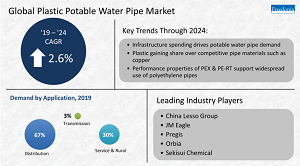
Demand for plastic potable water pipe is projected to expand 2.6% per year to 13.1 billion meters in 2024. Gains will be fueled by increasing spending on water transmission and service infrastructure, particularly in low-income countries. While demand will decline in 2020 due to the COVID-19 pandemic, growth is expected to rebound considerably the following year and continue through 2024.
Transmission Pipe Sales to Benefit from Infrastructure Spending
Despite a slowdown in construction spending across the globe through 2024, the transmission of clean drinking water will remain a priority for national and local governments alike:
- In higher income countries, this will mostly comprise the replacement of older iron or steel lines with plastic pipes. In addition, the larger diameters of these plastic pipes will support gains in value and weight terms.
- In lower- and middle-income countries, transmission networks will continue to expand due to growing and urbanizing populations, some of which do not currently have access to potable water.
Material Substitution & Higher Incomes Support Growth in Distribution Pipe
A variety of factors will drive demand growth for plastic potable water distribution pipe through 2024, including:
- plastic gaining share over competitive pipe materials such as copper
- higher personal incomes, particularly in developing countries, leading many to access indoor plumbing for the first time
- greater use of amenities such as radiant flooring in new homes
Polyethylene Pipe to Remain Most Used
Polyethylene pipe will remain the most widely used type for potable water applications through 2024. This is highly influenced by the use of PEX and PE-RT in water distribution, as these pipes are utilized for long lengths in small diameters. In addition, these more advanced variants of polyethylene have such performance properties as:
- higher temperature resistance, making them ideally suited for hot water, both at taps and in radiant flooring
- flexibility, making them easier to install than other plastics such as PVC
- resistance to scaling and damage from biocides in water
In transmission and service and rural lines, PVC will remain the dominant material due to its impact resistance and durability.
- Executive Summary
- About This Report
- Report Details
- Study Scope & Product Description
- Impact of COVID-19 Pandemic
- Overview
- Historical Market Trends
- Demand by Resin
- Demand by Application
- Potable Water Distribution Pipe
- Potable Water Transmission Pipe
- Service & Rural Potable Water Pipe
- Demand by Region
- Leading Country Markets
- Competitive Products
- Leading Producers
- North America
- North America: Demand by Country & Resin
- United States
- Mexico
- Canada
- Central & South America
- Central & South America: Demand by Country & Resin
- Brazil
- Other Central & South America
- Western Europe
- Western Europe: Demand by Country & Resin
- Germany
- United Kingdom
- France
- Italy
- Spain
- Other Western Europe
- Eastern Europe
- Eastern Europe: Demand by Country & Resin
- Russia
- Other Eastern Europe
- Asia/Pacific
- Asia/Pacific: Demand by Country & Resin
- China
- India
- Japan
- Indonesia
- South Korea
- Australia
- Other Asia/Pacific
- Africa/Mideast
- Africa/Mideast: Demand by Country & Resin
- Turkey
- Iran
- Saudi Arabia
- Other Africa/Mideast
- Appendix
- Scope
- Definitions
- Freedonia Methodology
- Study-Specific Methodology
- Macroeconomic & Demographic Indicators
- Purchasing Power Parity
- Sources
- Associations & Agencies
- Related Studies & Reports
- Country Lists by Region
- Macroeconomic Assumptions
- Global Economic Outlook
- Demographic Trends
- Global Manufacturing Outlook
- Global Building Construction Outlook
- Global Nonbuilding Construction Outlook