Global Wind Turbines
Wind turbine systems use blades spinning on either a horizontal or vertical axis in response to the kinetic energy of wind to create a force that can be used to power an electric generator.
Free Sample Report
Request a free sample of this report and our team will email it to you.
Report Overview
Featuring 22 tables and 28 figures – now available in Excel and Powerpoint! Learn More
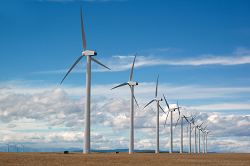
Wind turbine systems use blades spinning on either a horizontal or vertical axis in response to the kinetic energy of wind to create a force that can be used to power an electric generator. In most commercial-scale wind turbines, the electric generator is housed in the nacelle, making all of these products turbine generators.
Individual wind turbines – the majority of which have outputs of between 50 kilowatts (kW) and 4 megawatts (MW) – are generally configured together into “wind farms” or “wind parks” to provide grid-connected power, and such farms create the majority of demand for wind turbines in any given year.
Wind turbines are considered one of the most environmentally appealing solutions for electricity production. However, the area needed for large-scale wind power installations has led to a number of concerns. For example, coastal areas often rely on scenic views for property values and tourism, and wind turbines are considered by many as aesthetically unappealing, limiting the area in which coastal farms can be constructed. Additionally, the potential negative impact on wildlife has also been an issue to greater adoption.
Excluded from the scope of this report are turbine blades and other separately sold parts and components of complete wind turbines.
Global demand for wind turbines is forecast to increase 3.6% per year through 2024 to $67.2 billion. Despite an expected 26% decline in wind turbine demand in 2020, largely due to projected delays caused by the COVID-19 pandemic, most countries have ramped wind turbine construction to meet renewable energy targets set by federal governments or established as part of a larger signatory body such as the Paris Agreement. Many of these renewable energy targets are set for 2025 and will likely lead to a ramping up of new wind energy installations in 2023 and 2024.
Wind turbine demand, while growing rapidly on a global level, can be quite volatile in specific countries on year-over-year basis, responding in many cases to public sector incentives for installation and use. This type of volatility makes forecasting demand difficult. However, a number of factors allow general trends to be discerned and predicted, including:
- the prevalence of wind in a country
- the amount of land mass and coastline in the country
- the robustness of a nation’s electric grid
- the stability of the governmental/regulatory regime and its amenability to adopting wind energy
Through 2024, the vast majority of additional wind energy demand will come from the Asia/Pacific region, driven by strong expected growth in China. In order to meet its renewable energy commitment to the Paris Agreement, China needs to construct substantial amounts of wind turbines by 2025.
Western Europe will be responsible for the next largest share of additional wind turbine demand. Many nations in the region are committed to reducing or eliminating fossil fuel energy generation over the next decade, resulting in continued demand for wind turbines. However, because many West European nations already have well established wind energy industries, growth in the region will be slow.
The fastest gains will be in countries with less advanced infrastructure, particularly Eastern Europe, though this is primarily because of the underdeveloped wind industry in these areas. Wind turbine demand is particularly volatile in these areas, as many nations are not required to meet renewable energy targets and thus have little incentive to invest in wind turbine systems. Limited government support for wind turbines (and renewable energy sources in general) also prevents more rapid gains.
- Executive Summary
- Overview
- Scope
- Installed Wind Energy Generation Capacity by Region
- New Wind Energy Generation Capacity by Region
- Wind Turbine Demand by Region
- Impact of COVID-19 on Wind Turbine Demand in 2020
- Market Share
- North America
- Wind Energy Generation Capacity by Country
- Wind Turbine Demand by Country
- United States
- Central & South America
- Wind Energy Generation Capacity by Country
- Wind Turbine Demand by Country
- Western Europe
- Wind Energy Generation Capacity by Country
- Wind Turbine Demand by Country
- United Kingdom
- Spain
- Germany
- Sweden
- France
- Other Western Europe
- Eastern Europe
- Wind Energy Generation Capacity by Country
- Wind Turbine Demand by Country
- Asia/Pacific
- Wind Energy Generation Capacity by Country
- Wind Turbine Demand by Country
- China
- India
- Australia
- Other Asia/Pacific
- Africa/Mideast
- Appendix
- Methodology
- Sources, Associations, & Agencies
- Related Studies & Reports
- Country Lists by Region
- Macroeconomic Assumptions
- Economic Environment
- Demographic Trends