Oriented Strand Board
This study examines the US market for oriented strand board (OSB) wood panels.
Free Sample Report
Request a free sample of this report and our team will email it to you.
Report Overview
Featuring 17 tables and 11 figures – now available in Excel and Powerpoint! Learn More
This study examines the US market for oriented strand board (OSB) wood panels.
Markets for these products encompass construction and industrial uses. Construction uses include:
- roofing
- siding
- wall sheathing
- flooring (subflooring and finish flooring)
Industrial applications include:
- engineered wood products
- material handling products
- furniture and fixtures
- transportation equipment
Historical data for 2009, 2014, and 2019 and forecasts to the years 2024 and 2029 are provided for OSB production and demand in square feet and current dollars. Data in square feet are actually volumetric measurements, since the various types of wood panels are each associated with a standard thickness. The standard thickness (as most commonly accepted within the industry) for OSB is 3/8 inch.
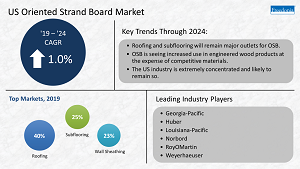
Demand for OSB wood panels is forecast to increase 1.0% annually through 2024 to 21.4 million square feet, as measured on a 3/8 inch basis. OSB wood panel demand is expected to drop significantly in 2020 due to the COVID-19 pandemic, which is forecast to cause:
- a decline in new home construction
- a heavy drop in commercial construction as many businesses are forced to shut down or operate at reduced capacities
- a fall in the production engineered wood products
However, demand will return to growth beginning in 2021 and continue to expand through 2024, driven by growth in new single-family home construction and rising spending on home renovation projects.
Subflooring & Roofing to Drive OSB Demand Gains
Roofing and subflooring will remain the leading applications for OSB panels, accounting for almost two-thirds of demand gains through 2024:
- OSB will continue to be the dominant wood panel subflooring material because it offers advantages such as higher rigidity and increased resistance to splitting and delamination.
- OSB demand in roofing applications is forecast to rise as the product continues to take share from softwood plywood because of its lower cost.
OSB To Gain Share in Engineered Wood & Finish Flooring Products
OSB is heavily used in engineered wood applications such as I-joists and rim boards, as the material offers such performance benefits as durability and versatility. Demand for OSB in engineered wood products is forecast to grow at an above average pace as OSB takes share from medium density fiberboard and particleboard on the strength of its significantly lower cost.
Although from a small base, finish flooring will be the fastest growing application for OSB. Engineered wood flooring is increasingly being installed in residences and other areas where hard surface flooring is becoming more desirable, as it has better aesthetics than many LVT and laminate products but is less expensive and has better performance than natural wood.
OSB Industry to Remain Heavily Concentrated
In 2019, the top six suppliers of OSB to the US accounted for over 75% of demand and an even greater amount of US production of these products. The leading manufacturers have extensive resources devoted to product development, manufacturing techniques, marketing, and distribution. However, weakness in the OSB market in late 2019 and 2020 has led some major manufacturers – including Georgia-Pacific, Louisiana Pacific, and Norbord to cut back on production.
- Executive Summary
- About This Report
- Report Details
- Study Scope & Product Description
- Impact of COVID-19 Pandemic
- Overview
- Historical Market Trends
- Supply & Demand
- Demand Drivers & Restraints
- Pricing Trends
- New Product Development
- Competitive Products
- Markets
- Demand by Market
- Construction Markets
- Roofing & Siding
- Flooring
- Wall Sheathing
- Industrial Market
- Key Suppliers & Market Share
- Industry Composition
- Capacity & Leading Producers
- Market Share
- Appendix
- Scope
- Definitions
- Freedonia Methodology
- Study-Specific Methodology
- Sources
- Associations & Agencies
- Related Studies & Reports
- Macroeconomic Assumptions
- Economic Environment
- Demographic Trends
- Residential Building Construction
- Residential Improvements & Repairs
- Commercial Building Construction
- Commercial Building Improvements & Repairs
- Manufacturers’ Shipments