Spices, Dry Mixes, & Extracts Packaging
Packaging for spices, dry mixes, and extracts is forecast to grow 2.4% per year to $1.1 billion in 2025
Free Sample Report
Request a free sample of this report and our team will email it to you.
Report Overview
Featuring 26 tables and 24 figures – now available in Excel and Powerpoint! Learn More
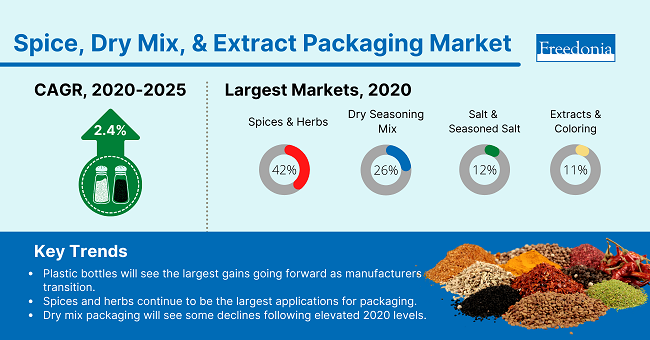
 Packaging for spices, dry mixes, and extracts is forecast to grow 2.4% per year to $1.1 billion in 2025 off of a high 2020 base, when sales of these products spiked as a result of a shift in eating habits at the onset of the COVID-19 pandemic. Growth will be supported by the popularity and variety of spices and other seasoning products offered by retailers, as well as the increasing usage of premium packaging for product differentiation purposes.
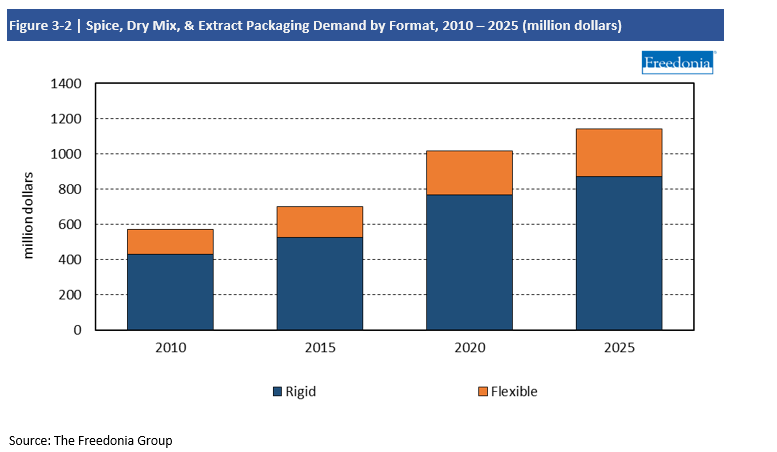
Demand by Packaging Format (Rigid vs. Flexible)
Packaging for spices, dry mixes, and extracts is dominated by rigid packaging, although this varies greatly in the individual segments. In many other food categories, rigid packaging has been losing share to flexible due to the latter’s lighter weight and amenability to source reduction. However, due to the ease-of-use of rigid containers – especially important when working in the kitchen – salt, spices and seasonings remains one of the few food categories where flexible packaging will lose slight share to rigid.
Flexible packaging such as pouches and bags are still used to some extent with these products, usually for single-serving items – foodservice salt and pepper packets or recipe mixes in side-seal pouches – or for commercial sized foodservice products (bags and liners). Bags and pouches are also used for refill applications (currently almost all by specialty online spice retailers) and this could be a growth opportunity for flexible packaging if trends toward refills take hold as they have in some non-food sectors.
Materials Trends
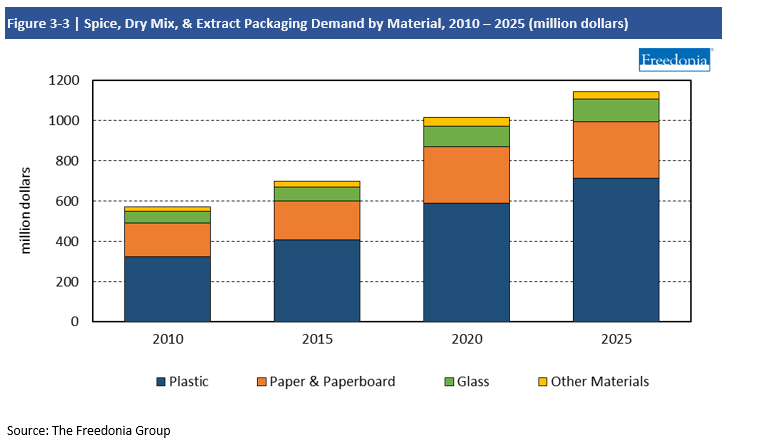
Demand by Material
Plastic is the most common material used in the packaging of spices, dry mixes, and extracts due to its prevalence in bottles, pouches, and bags. Plastic bottles benefit from their enhanced performance and lower cost compared to glass and paperboard alternatives, and they will continue to take market share from containers based on other materials going forward. This trend is evident in Morton Salt’s recent move to replace its iconic paper canisters with plastic bottles.
Despite competition from plastics, paper and paperboard packaging will continue to see use where paper pouches or folding cartons are prevalent; glass will continue to be used with specialty spices due to its premium image.
Other materials, mainly metal, will continue to lose share going forward as manufacturers switch to other, less costly options.
Factors Impacting Packaging Demand
Spice & Seasoning Shipment Trends
Demand for packaging used with spices, dry mixes, and extracts is directly influenced by the demand and production of the products themselves, as well as their target end users. Both the overall levels of spice production and the fluctuating shares of different types of spices, seasonings and mixes – which may require different amounts and types of packaging – have an impact on packaging demand.
US shipments of spices, dry mix, and extracts will increase nearly 1.0% annually to $9.7 billion in 2025, with advances limited by coming off a high 2020 base. However, usage will continue to be supported by an expanding variety of spices, mixes, and seasoning products, including international spices, unique seasoning mixes, and premium salts.
Packaging will benefit as products like spices and herbs increase their share of the overall product mix, as these tend to be the most packaging intensive.
The scope of this report includes packaging for spices, herbs, seasonings, dry mixes, salt, extracts, and food coloring. These items are generally sold in a dedicated section of retail store but are also used by foodservice establishments.
Specific applications covered in this report include:
- dip and dressing mixes, including mixes to make salad dressings and savory dips
- dry seasoning mixes, which are blends of spices, herbs and other food products that are used to prepare a specific dish, such as tacos
- flavoring extracts and food colors, including emulsions, liquid flavors, pastes, and gels
- salt and seasoned salt (a blend that is predominantly salt with other added spices or seasonings), including salt substitutes
- other dry mixes, including:
- sauce mixes, used to make cheese sauces, ethnic sauces, gravy and other savory sauces
- spices and herbs, such as black pepper, turmeric, thyme, and spice blends
Excluded from this study are a variety of products including:
- synthetic food colors
- bulk salt, dry mixes, extracts, and spices used in food manufacturing
- salt for other consumer, agricultural, or industrial applications
- dry mixes used to make sweet foods such as cakes, cookies, frosting, or pudding
- corrugated boxes and protective packaging used specifically for shipping purposes as opposed to product packaging
Specific packaging products used for spices, dry mixes, and extracts are:
- bottles and jars
- pouches and bags
- boxes and cartons
- canisters
- other packaging such as tubs and pails
Historical data (2010, 2015, and 2020) and forecasts for 2025 and 2030 are presented for demand for spice packaging by value in current dollars (including inflation); demand data by market is presented in current dollars. “Demand” (or sales) is defined as all shipments from US plants, plus imports minus exports.
Demand for packaging used with spices, dry mixes, and extracts is projected to grow 2.4% per year to $1.1 billion in 2025 from a high base in 2020, when the market for these products was boosted by the pandemic. While growth will be below historical norms, the market will benefit from:
- the increasing popularity and variety of spices offered by retailers
- rising use of premium packaging for product differentiation purposes
- a lingering higher level of interest in home cooking and baking
Plastic Bottles to Experience the Largest Gains as Manufacturers Transition
McCormick and Morton – the biggest spice and salt suppliers, respectively – have begun transitioning away from metal and paperboard canisters toward plastic bottles, which are lighter and easier to recycle:
- In Morton’s case, the bottles feature a plethora of convenience features and are designed to have increased shelf appeal. They are also transparent, allowing consumers to see the salt inside and gauge how much is left.
- McCormick has used plastic canisters in many of its products for some time and has moved away from metal for iconic brands like Old Bay, in part to increase sustainability of these high-volume products. The company has also pledged to decrease the environmental impact of its plastic packaging by using more recycled content in its creation and ensuring that the containers can be reused or recycled by 2025.
Spice & Herb Packaging Continues To Be the Largest Market
Spices and herbs are intensive users of packaging, as containers tend to be smaller and use higher value features than other seasonings. In addition, an increasing variety of ethnic and specialty spices continues to become available. Spices and herbs are the only category to make significant use of glass packaging, which imparts the perception of quality and freshness and is commonly used with premium spices and herbs.
Demand for Dry Seasoning Mixes Packaging to Face Declines from Elevated Level in 2020
While all spice and seasoning categories saw increased demand in 2020 as consumers cooked and baked at home more frequently, dry mixes experienced an especially high bounce in part because they are premeasured and easy-to-use in the kitchen. This was especially important for consumers with little or no cooking experience who began cooking more during the first year of the pandemic. While sales of dry mixes are expected to return more sustainable levels, demand is expected to remain above historical levels. Even as consumers begin to spend more time out of the home, those who became accustomed to using dry seasoning mixes are likely to continue to do so more often.

Demand by Packaging Format (Rigid vs. Flexible)
Packaging for spices, dry mixes, and extracts is dominated by rigid packaging, although this varies greatly in the individual segments. In many other food categories, rigid packaging has been losing share to flexible due to the latter’s lighter weight and amenability to source reduction. However, due to the ease-of-use of rigid containers – especially important when working in the kitchen – salt, spices and seasonings remains one of the few food categories where flexible packaging will lose slight share to rigid.
Flexible packaging such as pouches and bags are still used to some extent with these products, usually for single-serving items – foodservice salt and pepper packets or recipe mixes in side-seal pouches – or for commercial sized foodservice products (bags and liners). Bags and pouches are also used for refill applications (currently almost all by specialty online spice retailers) and this could be a growth opportunity for flexible packaging if trends toward refills take hold as they have in some non-food sectors.

Materials Trends
Demand by Material
Plastic is the most common material used in the packaging of spices, dry mixes, and extracts due to its prevalence in bottles, pouches, and bags. Plastic bottles benefit from their enhanced performance and lower cost compared to glass and paperboard alternatives, and they will continue to take market share from containers based on other materials going forward. This trend is evident in Morton Salt’s recent move to replace its iconic paper canisters with plastic bottles.
Despite competition from plastics, paper and paperboard packaging will continue to see use where paper pouches or folding cartons are prevalent; glass will continue to be used with specialty spices due to its premium image.
Other materials, mainly metal, will continue to lose share going forward as manufacturers switch to other, less costly options.

Factors Impacting Packaging Demand
Spice & Seasoning Shipment Trends
Demand for packaging used with spices, dry mixes, and extracts is directly influenced by the demand and production of the products themselves, as well as their target end users. Both the overall levels of spice production and the fluctuating shares of different types of spices, seasonings and mixes – which may require different amounts and types of packaging – have an impact on packaging demand.
US shipments of spices, dry mix, and extracts will increase nearly 1.0% annually to $9.7 billion in 2025, with advances limited by coming off a high 2020 base. However, usage will continue to be supported by an expanding variety of spices, mixes, and seasoning products, including international spices, unique seasoning mixes, and premium salts.
Packaging will benefit as products like spices and herbs increase their share of the overall product mix, as these tend to be the most packaging intensive.
The scope of this report includes packaging for spices, herbs, seasonings, dry mixes, salt, extracts, and food coloring. These items are generally sold in a dedicated section of retail store but are also used by foodservice establishments.
Specific applications covered in this report include:
- dip and dressing mixes, including mixes to make salad dressings and savory dips
- dry seasoning mixes, which are blends of spices, herbs and other food products that are used to prepare a specific dish, such as tacos
- flavoring extracts and food colors, including emulsions, liquid flavors, pastes, and gels
- salt and seasoned salt (a blend that is predominantly salt with other added spices or seasonings), including salt substitutes
- other dry mixes, including:
- sauce mixes, used to make cheese sauces, ethnic sauces, gravy and other savory sauces
- spices and herbs, such as black pepper, turmeric, thyme, and spice blends
Excluded from this study are a variety of products including:
- synthetic food colors
- bulk salt, dry mixes, extracts, and spices used in food manufacturing
- salt for other consumer, agricultural, or industrial applications
- dry mixes used to make sweet foods such as cakes, cookies, frosting, or pudding
- corrugated boxes and protective packaging used specifically for shipping purposes as opposed to product packaging
Specific packaging products used for spices, dry mixes, and extracts are:
- bottles and jars
- pouches and bags
- boxes and cartons
- canisters
- other packaging such as tubs and pails
Historical data (2010, 2015, and 2020) and forecasts for 2025 and 2030 are presented for demand for spice packaging by value in current dollars (including inflation); demand data by market is presented in current dollars. “Demand” (or sales) is defined as all shipments from US plants, plus imports minus exports.
Demand for packaging used with spices, dry mixes, and extracts is projected to grow 2.4% per year to $1.1 billion in 2025 from a high base in 2020, when the market for these products was boosted by the pandemic. While growth will be below historical norms, the market will benefit from:
- the increasing popularity and variety of spices offered by retailers
- rising use of premium packaging for product differentiation purposes
- a lingering higher level of interest in home cooking and baking
Plastic Bottles to Experience the Largest Gains as Manufacturers Transition
McCormick and Morton – the biggest spice and salt suppliers, respectively – have begun transitioning away from metal and paperboard canisters toward plastic bottles, which are lighter and easier to recycle:
- In Morton’s case, the bottles feature a plethora of convenience features and are designed to have increased shelf appeal. They are also transparent, allowing consumers to see the salt inside and gauge how much is left.
- McCormick has used plastic canisters in many of its products for some time and has moved away from metal for iconic brands like Old Bay, in part to increase sustainability of these high-volume products. The company has also pledged to decrease the environmental impact of its plastic packaging by using more recycled content in its creation and ensuring that the containers can be reused or recycled by 2025.
Spice & Herb Packaging Continues To Be the Largest Market
Spices and herbs are intensive users of packaging, as containers tend to be smaller and use higher value features than other seasonings. In addition, an increasing variety of ethnic and specialty spices continues to become available. Spices and herbs are the only category to make significant use of glass packaging, which imparts the perception of quality and freshness and is commonly used with premium spices and herbs.
Demand for Dry Seasoning Mixes Packaging to Face Declines from Elevated Level in 2020
While all spice and seasoning categories saw increased demand in 2020 as consumers cooked and baked at home more frequently, dry mixes experienced an especially high bounce in part because they are premeasured and easy-to-use in the kitchen. This was especially important for consumers with little or no cooking experience who began cooking more during the first year of the pandemic. While sales of dry mixes are expected to return more sustainable levels, demand is expected to remain above historical levels. Even as consumers begin to spend more time out of the home, those who became accustomed to using dry seasoning mixes are likely to continue to do so more often.
- Executive Summary
- Figure 1-1 | Spice, Dry Mix, &Extract Packaging Market Outlook
- About This Report
- Report Details
- Study Scope & Product Description
- Figure 2-1 | Spice, Dry Mix, &Extract Packaging: Product Examples
- Impact of COVID-19 Pandemic
- Table | Annual Spice, Dry Mix, &Extract Packaging Demand by Product, 2019 - 2021
- Figure 2-2 | Annual Spice, Dry Mix, &Extract Packaging Demand, 2018 - 2022
- Overview
- Historical Market Trends
- Table | Spice, Dry Mix, &Extract Packaging Demand, 2010 - 2020
- Figure 3-1 | Spice, Dry Mix, &Extract Packaging Demand, 2000 - 2020
- Demand by Packaging Format (Rigid vs. Flexible)
- Table | Spice, Dry Mix, &Extract Packaging Demand by Packaging Format, 2010 - 2025
- Figure 3-2 | Spice, Dry Mix, &Extract Packaging Demand by Format, 2010 - 2025
- Materials Trends
- Demand by Material
- Table | Spice, Dry Mix, &Extract Packaging Demand by Material, 2010 - 2025
- Figure 3-3 | Spice, Dry Mix, &Extract Packaging Demand by Material, 2010 - 2025
- Plastic
- Table | Plastic Spice, Dry Mix, &Extract Packaging Demand by Application & Product, 2010 - 2025
- Figure 3-4 | Plastic Spice, Dry Mix, &Extract Packaging Demand by Application, 2010 - 2025
- Paper & Paperboard
- Table | Paper & Paperboard Spice, Dry Mix, &Extract Packaging Demand by Application & Product, 2010 - 2025
- Figure 3-5 | Paper & Paperboard Spice, Dry Mix, &Extract Packaging Demand by Application, 2010 - 202
- Glass
- Table | Glass Spice, Dry Mix, &Extract Packaging Demand by Application, 2010 - 2025
- Figure 3-6 | Glass Spice, Dry Mix, &Extract Packaging Demand by Application, 2010 - 2025
- Other Materials
- Table | Other Spice, Dry Mix, &Extract Packaging Material Demand by Application, 2010 - 2025
- Figure 3-7 | Other Materials Spice, Dry Mix, &Extract Packaging Demand by Application, 2010 - 2025
- Demand by Material
- Factors Impacting Packaging Demand
- Spice & Seasoning Shipment Trends
- Figure 3-8 | Spice, Dry Mix, &Extract US Shipments by Application, 2010 - 2025
- Product Innovation & Sustainability Initiatives
- Figure 3-9 | Spice, Dry Mix, &Extract Packaging: Product Innovations
- Spice & Seasoning Shipment Trends
- Historical Market Trends
- Applications
- Demand by Application
- Table | Spice, Dry Mix, &Extract Packaging Demand by Application, 2010 - 2025
- Figure 4-1 | Spice, Dry Mix, &Extract Packaging Demand by Application, 2010 - 2025
- Spices & Herbs
- Table | Spice & Herb Packaging Demand by Product & Material, 2010 - 2025
- Figure 4-2 | Spice & Herb Packaging Demand by Product, 2010 - 2025
- Dry Seasoning Mixes
- Table | Dry Seasoning Mix Packaging Demand by Product & Material, 2010 - 2025
- Figure 4-3 | Dry Seasoning Mix Packaging Demand by Product, 2010 - 2025
- Salt & Seasoned Salt
- Table | Salt & Seasoned Salt Packaging Demand by Product & Material, 2010 - 2025
- Figure 4-4 | Salt & Seasoned Salt Packaging Demand by Product, 2010 - 2025
- Flavoring Extracts & Food Coloring
- Table | Flavoring Extract & Food Coloring Packaging Demand by Product & Material, 2010 - 2025
- Figure 4-5 | Flavoring Extract & Food Coloring Packaging Demand by Product, 2010 - 2025
- Other Dry Mixes
- Table | Other Dry Mix Packaging Demand by Product & Material, 2010 - 2025
- Figure 4-6 | Other Dry Mix Packaging Demand by Product, 2010 - 2025
- Demand by Application
- Packaging Products
- Demand by Product
- Table | Spice, Dry Mix, &Extract Packaging Demand by Product, 2010 - 2025
- Figure 5-1 | Spice, Dry Mix, &Extract Packaging Demand by Product, 2010 - 2025
- Bottles & Jars
- Table | Spice, Dry Mix, &Extract Bottle & Jar Demand by Application & Material, 2010 - 2025
- Figure 5-2 | Bottle & Jar Demand in Spices, Dry Mixes, &Extracts by Application, 2010 - 2025
- Pouches & Bags
- Table | Spice, Dry Mix, &Extract Pouch & Bag Demand by Application & Material, 2010 - 2025
- Figure 5-3 | Pouch & Bag Demand in Spices, Dry Mixes, &Extracts by Application, 2010 - 2025
- Boxes & Cartons
- Table | Spice, Dry Mix, &Extract Box & Carton Demand by Application, 2010 - 2025
- Figure 5-4 | Spice, Dry Mix, &Extract Box & Carton Demand by Application, 2010 - 2025
- Canisters
- Table | Spice, Dry Mix, &Extract Canister Demand by Application & Material, 2010 - 2025
- Figure 5-5 | Canister Demand in Spices, Dry Mixes, &Extracts by Market & Application, 2010 - 2025
- Other Packaging
- Table | Other Spice, Dry Mix, &Extract Packaging Demand by Application & Material, 2010 - 2025
- Figure 5-6 | Other Packaging Demand in Spices, Dry Mixes, &Extracts by Market & Application, 2010 -
- Demand by Product
- Key Suppliers & Industry Trends
- Industry Composition
- Leading Suppliers
- Appendix
- Scope
- Table | Relevant Industry Codes
- Table | Relevant HS Codes
- Definitions
- Freedonia Methodology
- Study-Specific Methodology
- Sources
- Associations & Agencies
- Related Studies & Reports
- Macroeconomic Assumptions
- Economic Environment
- Table | Macroeconomic Indicators, 2010 – 2025
- Demographics
- Table | Population & Households, 2010 - 2025
- Consumer Spending
- Table | Personal Consumption Expenditures, 2010 – 2025
- Retail Sales
- Table | Nondurable Goods Retail Sales, 2010 – 2025
- Economic Environment
- Scope
Spices and herbs is the largest category for plastic packaging, primarily because it is the largest market category overall.
Demand for packaging used with spices, dry mixes, and extracts is projected to grow 2.4% per year to $1.1 billion in 2025 from a high base in 2020, when the market for these products was boosted by the pandemic.
Plastic bottles will experience the largest gains as manufacturers transition.