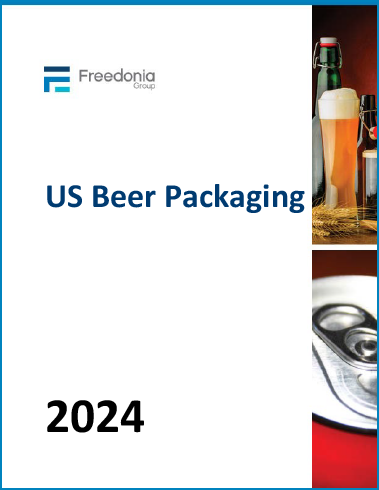
US Beer Packaging
This Freedonia industry study analyzes the $6.6 billion beer packaging industry. It presents historical demand data (2012, 2017, and 2022) and forecasts (2027) by product and material. Annual historical data and forecasts are also provided from 2019 to 2026.
Free Sample Report
Request a free sample of this report and our team will email it to you.
Report Overview
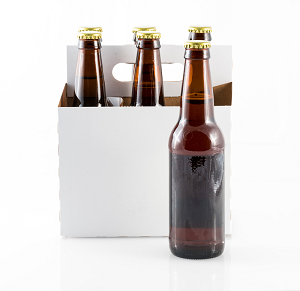 Innovation geared toward sustainability presents unique opportunities for growth in carrier rings.
This Freedonia industry study analyzes the $6.6 billion beer packaging industry. It presents historical demand data (2012, 2017, and 2022) and forecasts (2027) by product (beer containers, multipack packaging, closures and labels) and material (metal, glass, plastic, paperboard). Annual historical data and forecasts are also provided from 2019 to 2026. Data are given in unit and dollar value.
Featuring 44 tables and 22 figures – available in Excel and Powerpoint! Learn More
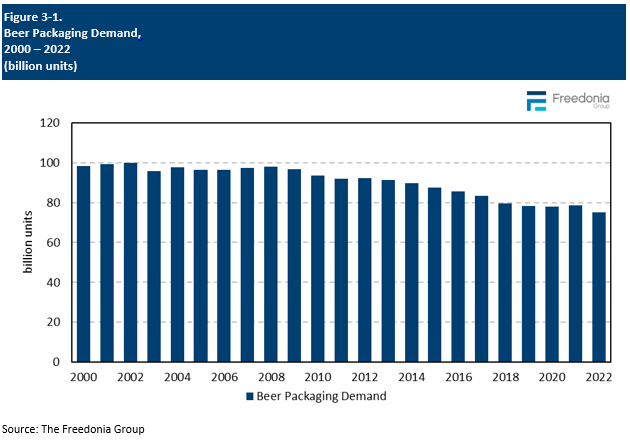
Market value for beer packaging is forecast rise minimally to $8.1 billion in 2027, while unit demand is expected to decline 1.1% per year to 70.9 billion units. Demand will be negatively affected by beer’s declining popularity due to growing competition from other alcoholic beverages:
-
Aluminum cans will remain the most used type of beer container, while aluminum and plastic bottles offer the best growth prospects for containers.
-
Sustainable innovations in multipack packaging – including multipack holders – reflect a commitment to environmental responsibility and consumer convenience.
Aluminum Is Most Popular Container Material, Although Trends Differ for Cans & Bottles
Aluminum will remain by far the most popular material for beer packaging, supported by its convenience, cost efficiency and environmental sustainability. However, there is a notable difference in the forecast for aluminum cans versus aluminum bottles:
-
While aluminum cans have benefited from their increasing usage with craft beer, they are a mature product and declines in beer production and beer consumption will negatively impact demand.
-
Aluminum bottles will experience healthy growth, as beer companies increasingly favor this packaging for its distinctive appearance and design potential. Venues such as stadiums and arenas – where glass bottles are often prohibited – will continue to be a key end user for aluminum bottles.
Higher Value Graphics & Use of More Sustainable Materials Boosts Multipack Packaging
Although unit demand for multipack packaging will be negatively affected by weakness in the beer market, market value for these packaging types will continue to grow:
-
Moving away from traditional plastic rings, the beer sector is embracing higher value biodegradable and compostable solutions for multipack holders such as molded fiber and paperboard carrier rings, which use more sustainable materials.
- Beer brands will increasingly use higher value folding cartons that feature more intensive and eye-catching graphics in order to stand out from their competitors.
Historical Market Trends
The US beer packaging industry is heavily dependent upon general trends in beer consumption and production. The prospects for the beer industry are impacted by a range of variables, many of which are beyond the control of industry participants. These include:
-
macroeconomic shifts, as in levels of consumer spending and disposable income or overall economic growth and inflation
-
demographic factors like the size of the resident population, age distribution patterns, ethnic diversity, geographic distribution, and immigration
The beer industry is also influenced by less predictable factors – weather patterns, crop harvests, raw material prices, technological innovations, medical- and health-related research, governmental regulations, foreign trade, and changes in consumer preferences and tastes – that are beyond the control of beer manufacturers. What those companies do have control over are advertising, marketing, and new product introductions – among other factors – which all typically have a greater impact on the product mix than total beer demand; they can also impact the level and type of packaging used.
Beer packaging demand is also influenced by overall trends in the packaging industry. Among the factors included here are environmental and regulatory issues such as sustainability initiatives, which can spur demand for packaging that is perceived to be environmentally friendly. Other key considerations that affect consumer preferences for beer packaging include convenience, size (e.g., single-serving, multipacks), image, and technological developments (e.g., smart packaging, materials innovations).
Materials Competition
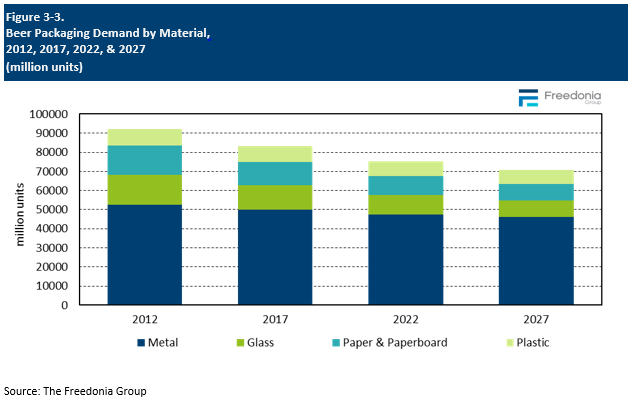
While metal remains the dominant material used in the packaging of beer, comprising 61% of value demand in 2022, it will continue to experience volume declines. However, demand in value terms will see some gains as prices rise. Aluminum bottles benefit from their comparable cost to glass bottles with improving production technologies, lighter weight, shatter resistance, and product differentiation capabilities.
Glass comprises much of the remainder, capturing a 27% share of demand value in 2022. Going forward, real demand for glass will continue to decline based on the material’s risk of breakage and generally higher value costs to breweries. Also restraining unit demand will be continued banning of glass containers by venues such as concerts and sporting events due to the danger they may pose. Despite this, glass will continue to account for a sizable share of beer packaging due to its great barrier properties and upscale appearance.
Paperboard demand in beer packaging is, for the moment, entirely comprised of multipacks – folding cartons, boxes, multipack holders, and rings. However, numerous companies continue to experiment with paperboard bottles, which are typically composed of a paperboard shell and inner plastic pouch or lining, to reach their sustainability goals. One obvious shortcoming, though, is that these bottles have increased difficulty providing a sufficient oxygen barrier for carbonated beverages and therefore may compromise beer quality.
Plastic comprises a smaller share of beer packaging and is used to make bottles, labels, caps and closures, and multipack holders. Although plastic bottles are a niche product, they will continue to experience slight gains in value and volume, owing to their low cost, light weight, and – most importantly – shatter resistance. However, other plastic packaging – namely flexible plastic rings and labels – will experience declines in real terms and market value stagnation.
Foodservice Industry Outlook
The types and sizes of packaging used for beer sold to restaurants and other foodservice establishments vary significantly from that for sale in retail stores. Consequently, understanding the trends in consumer spending on beer for the home versus those sold by foodservice providers is a key variable in analyzing the beer packaging industry.
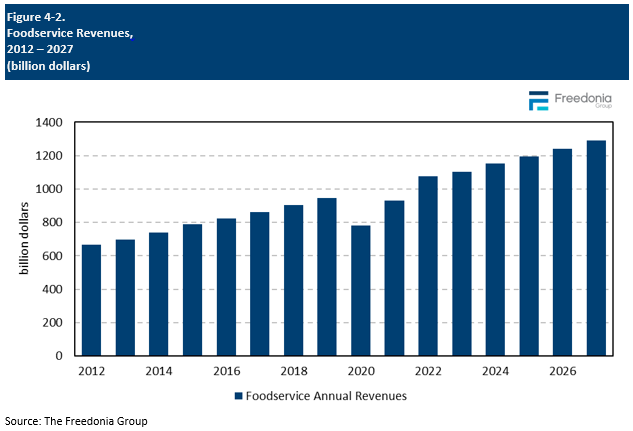
Foodservice revenues are forecast to grow 3.7% per year to $1.3 trillion in 2027, supported by continued real recovery in the foodservice industry and trends toward eating away from home. However, advances in market value will be limited to some extent as pricing normalizes from the inflated levels of 2022.
Foodservice operators generally purchase beer from major wholesale distributors that form a midpoint along the supply chain as they sell beer to restaurants, hospitality, and other foodservice venues.
The rise of delivery options from third-party service providers (e.g., Uber Eats, DoorDash) and the convenience of ordering both carryout and delivery via an app will continue to be key to foodservice industry growth – most notably for full-service restaurants. These services broaden the potential market of customers beyond those who are able and willing to visit restaurant establishments. However, this will not benefit foodservice beer consumption as much as it will food consumption, as beer is less likely to be purchased with carryout or delivery orders compared to on-premises orders.
Market value for beer packaging is forecast rise minimally to $8.1 billion in 2027, while unit demand is expected to decline 1.1% per year to 70.9 billion units. Demand will be negatively affected by beer’s declining popularity due to growing competition from other alcoholic beverages:
-
Aluminum cans will remain the most used type of beer container, while aluminum and plastic bottles offer the best growth prospects for containers.
-
Sustainable innovations in multipack packaging – including multipack holders – reflect a commitment to environmental responsibility and consumer convenience.
Aluminum Is Most Popular Container Material, Although Trends Differ for Cans & Bottles
Aluminum will remain by far the most popular material for beer packaging, supported by its convenience, cost efficiency and environmental sustainability. However, there is a notable difference in the forecast for aluminum cans versus aluminum bottles:
-
While aluminum cans have benefited from their increasing usage with craft beer, they are a mature product and declines in beer production and beer consumption will negatively impact demand.
-
Aluminum bottles will experience healthy growth, as beer companies increasingly favor this packaging for its distinctive appearance and design potential. Venues such as stadiums and arenas – where glass bottles are often prohibited – will continue to be a key end user for aluminum bottles.
Higher Value Graphics & Use of More Sustainable Materials Boosts Multipack Packaging
Although unit demand for multipack packaging will be negatively affected by weakness in the beer market, market value for these packaging types will continue to grow:
-
Moving away from traditional plastic rings, the beer sector is embracing higher value biodegradable and compostable solutions for multipack holders such as molded fiber and paperboard carrier rings, which use more sustainable materials.
- Beer brands will increasingly use higher value folding cartons that feature more intensive and eye-catching graphics in order to stand out from their competitors.
Historical Market Trends
The US beer packaging industry is heavily dependent upon general trends in beer consumption and production. The prospects for the beer industry are impacted by a range of variables, many of which are beyond the control of industry participants. These include:
-
macroeconomic shifts, as in levels of consumer spending and disposable income or overall economic growth and inflation
-
demographic factors like the size of the resident population, age distribution patterns, ethnic diversity, geographic distribution, and immigration
The beer industry is also influenced by less predictable factors – weather patterns, crop harvests, raw material prices, technological innovations, medical- and health-related research, governmental regulations, foreign trade, and changes in consumer preferences and tastes – that are beyond the control of beer manufacturers. What those companies do have control over are advertising, marketing, and new product introductions – among other factors – which all typically have a greater impact on the product mix than total beer demand; they can also impact the level and type of packaging used.
Beer packaging demand is also influenced by overall trends in the packaging industry. Among the factors included here are environmental and regulatory issues such as sustainability initiatives, which can spur demand for packaging that is perceived to be environmentally friendly. Other key considerations that affect consumer preferences for beer packaging include convenience, size (e.g., single-serving, multipacks), image, and technological developments (e.g., smart packaging, materials innovations).

Materials Competition
While metal remains the dominant material used in the packaging of beer, comprising 61% of value demand in 2022, it will continue to experience volume declines. However, demand in value terms will see some gains as prices rise. Aluminum bottles benefit from their comparable cost to glass bottles with improving production technologies, lighter weight, shatter resistance, and product differentiation capabilities.
Glass comprises much of the remainder, capturing a 27% share of demand value in 2022. Going forward, real demand for glass will continue to decline based on the material’s risk of breakage and generally higher value costs to breweries. Also restraining unit demand will be continued banning of glass containers by venues such as concerts and sporting events due to the danger they may pose. Despite this, glass will continue to account for a sizable share of beer packaging due to its great barrier properties and upscale appearance.
Paperboard demand in beer packaging is, for the moment, entirely comprised of multipacks – folding cartons, boxes, multipack holders, and rings. However, numerous companies continue to experiment with paperboard bottles, which are typically composed of a paperboard shell and inner plastic pouch or lining, to reach their sustainability goals. One obvious shortcoming, though, is that these bottles have increased difficulty providing a sufficient oxygen barrier for carbonated beverages and therefore may compromise beer quality.
Plastic comprises a smaller share of beer packaging and is used to make bottles, labels, caps and closures, and multipack holders. Although plastic bottles are a niche product, they will continue to experience slight gains in value and volume, owing to their low cost, light weight, and – most importantly – shatter resistance. However, other plastic packaging – namely flexible plastic rings and labels – will experience declines in real terms and market value stagnation.

Foodservice Industry Outlook
The types and sizes of packaging used for beer sold to restaurants and other foodservice establishments vary significantly from that for sale in retail stores. Consequently, understanding the trends in consumer spending on beer for the home versus those sold by foodservice providers is a key variable in analyzing the beer packaging industry.
Foodservice revenues are forecast to grow 3.7% per year to $1.3 trillion in 2027, supported by continued real recovery in the foodservice industry and trends toward eating away from home. However, advances in market value will be limited to some extent as pricing normalizes from the inflated levels of 2022.
Foodservice operators generally purchase beer from major wholesale distributors that form a midpoint along the supply chain as they sell beer to restaurants, hospitality, and other foodservice venues.
The rise of delivery options from third-party service providers (e.g., Uber Eats, DoorDash) and the convenience of ordering both carryout and delivery via an app will continue to be key to foodservice industry growth – most notably for full-service restaurants. These services broaden the potential market of customers beyond those who are able and willing to visit restaurant establishments. However, this will not benefit foodservice beer consumption as much as it will food consumption, as beer is less likely to be purchased with carryout or delivery orders compared to on-premises orders.

- Executive Summary
- Figure 1-1. Beer Packaging Market Outlook
- About This Report
- Report Details
- Market Scope & Product Description
- Short-Term Beer Packaging Trends
- Table | Annual Beer Packaging Demand by Product, 2020 - 2024
- Figure 2-1. Beer Packaging Value & Volume Demand Growth, 2020 - 2025
- Overview
- Historical Market Trends
- Table | Beer Packaging Demand, 2012 - 2022
- Figure 3-1. Beer Packaging Demand, 2000 - 2022
- Packaging Product Trends
- Table | Beer Packaging Demand by Product, 2012, 2017, 2022, &2027
- Table | Annual Beer Packaging Demand by Product, 2019 - 2026
- Figure 3-2. Beer Packaging Demand by Product, 2012, 2017, 2022, &2027
- Materials Competition
- Table | Beer Packaging Demand by Material, 2012, 2017, 2022, &2027
- Table | Annual Beer Packaging Demand by Material, 2019 - 2026
- Figure 3-3. Beer Packaging Demand by Material, 2012, 2017, 2022, &2027
- Pricing Trends
- Table | Selected Beer Packaging Product Pricing, 2012, 2017, 2022, &2027
- Table | Annual Selected Beer Packaging Product Pricing, 2019 - 2026
- Figure 3-4. Selected Beer Packaging Pricing, 2012 - 2027
- Foreign Trade
- Historical Market Trends
- Factors Impacting Beer Packaging Demand
- Beer Production Outlook
- Table | US Beer Production, 2012, 2017, 2022, &2027
- Figure 4-1. US Packaged Beer Production, 2012, 2017, 2022, &2027
- Retail Sales Trends
- Foodservice Industry Outlook
- Figure 4-2. Foodservice Revenues, 2012 - 2027
- Multipack Options
- Sustainability Initiatives
- Recycling & Recycled Content
- Biodegradability & Compostability
- Reporting & Disclosure
- Consumer Preferences
- Beer Purchasing
- Beer Purchasing by Size of Packaging
- Beer Production Outlook
- Beer Containers
- Demand by Container Type
- Table | Beer Container Demand by Product, 2012, 2017, 2022, &2027
- Table | Annual Beer Container Demand by Product, 2019 - 2026
- Figure 5-1. Beer Container Demand by Product, 2012, 2017, 2022, &2027
- Aluminum Cans
- Scope & Product Description
- Figure 5-2. Aluminum Beer Cans: Product Examples
- Demand Outlook
- Table | Aluminum Beer Can Demand, 2012, 2017, 2022, &2027
- Table | Annual Aluminum Beer Can Demand, 2019 - 2026
- Figure 5-3. Aluminum Beer Can Demand, 2012, 2017, 2022, &2027
- Leading Suppliers
- Scope & Product Description
- Bottles
- Demand by Material
- Table | Beer Bottle Demand by Material, 2012, 2017, 2022, &2027
- Table | Annual Beer Bottle Demand by Material, 2019 - 2026
- Figure 5-4. Beer Bottle Demand by Material, 2012, 2017, 2022, &2027
- Figure 5-5. Beer Bottles: Product Examples
- Glass Beer Bottles
- Table | Glass Beer Bottle Demand, 2012, 2017, 2022, &2027
- Table | Annual Glass Beer Bottle Demand, 2019 - 2026
- Aluminum Beer Bottles
- Table | Aluminum Beer Bottle Demand, 2012, 2017, 2022, &2027
- Table | Annual Aluminum Beer Bottle Demand, 2019 - 2026
- Plastic Beer Bottles
- Table | Plastic Beer Bottle Demand, 2012, 2017, 2022, &2027
- Table | Annual Plastic Bottle Demand, 2019 - 2026
- Demand by Material
- Metal Mini-Kegs
- Scope & Product Description
- Figure 5-6. Aluminum Mini-Kegs: Product Examples
- Demand Outlook
- Table | Metal Mini-Keg Demand, 2012, 2017, 2022, &2027
- Table | Annual Metal Mini-Keg Demand, 2019 - 2026
- Scope & Product Description
- Demand by Container Type
- Multipack Packaging for Beer
- Demand by Packaging Type
- Table | Beer Multipack Packaging Demand by Product, 2012, 2017, 2022, &2027
- Table | Annual Beer Multipack Packaging Demand by Product, 2019 - 2026
- Figure 6-1. Beer Multipack Packaging Demand by Product, 2012, 2017, 2022, &2027
- Folding Cartons (Cases & Bottle Carriers)
- Scope & Product Description
- Figure 6-2. Folding Cartons for Beer: Product Examples
- Demand Forecast
- Table | Beer Folding Carton Demand, 2012, 2017, 2022, &2027
- Table | Annual Beer Folding Carton Demand, 2019 - 2026
- Leading Suppliers
- Scope & Product Description
- Corrugated Boxes (Packaging Boxes & Shipping Boxes)
- Scope & Product Description
- Figure 6-3. Corrugated Boxes for Beer: Product Examples
- Demand Forecast
- Table | Beer Corrugated Box Demand, 2012, 2017, 2022, &2027
- Table | Annual Beer Corrugated Box Demand, 2019 - 2026
- Leading Suppliers
- Scope & Product Description
- Multipack Holders (Carrier Rings)
- Scope & Product Description
- Figure 6-4. Beer Multipack Holders: Product Examples
- Demand by Type
- Table | Beer Multipack Holder Demand by Material, 2012, 2017, 2022, &2027
- Table | Annual Beer Multipack Holder Demand by Material, 2019 - 2026
- Leading Suppliers
- Scope & Product Description
- Sleeves
- Scope & Product Description
- Figure 6-5. Beer Sleeves: Product Examples
- Demand Outlook
- Table | Beer Sleeve Demand, 2012, 2017, 2022, &2027
- Table | Annual Beer Sleeve Demand, 2019 - 2026
- Scope & Product Description
- Demand by Packaging Type
- Beer Closures & Labels
- Demand by Type
- Table | Beer Closure & Label Demand by Type, 2012, 2017, 2022, &2027
- Table | Annual Beer Closure & Label Demand by Type, 2019 - 2026
- Figure 7-1. Beer Closure & Label Demand by Type, 2012, 2017, 2022, &2027
- Caps & Closures
- Scope & Product Description
- Figure 7-2. Beer Caps & Closures: Product Examples
- Demand by Type & Material
- Table | Beer Cap & Closure Demand by Material, 2012, 2017, 2022, &2027
- Table | Annual Beer Cap & Closure Demand by Material, 2019 - 2026
- Leading Suppliers
- Scope & Product Description
- Labels
- Scope & Product Description
- Figure 7-3. Beer Labels: Product Examples
- Demand by Type & Material
- Table | Beer Label Demand by Material & Type, 2012, 2017, 2022, &2027
- Table | Annual Beer Label Demand by Material & Type, 2019 - 2026
- Leading Suppliers
- Scope & Product Description
- Demand by Type
- Key Suppliers & Industry Structure
- Industry Composition & Key Suppliers
- Appendix
- Scope
- Table | Industry Codes Related to Beverage Packaging
- Definitions
- Freedonia Methodology
- Study-Specific Methodology
- Sources
- Associations & Agencies
- Related Studies & Reports
- Macroeconomic Assumptions
- Economic Environment
- Table | Macroeconomic Indicators, 2012, 2017, 2022, &2027
- Demographic Trends
- Table | Population & Households, 2012, 2017, 2022, &2027
- Consumer Spending
- Table | Personal Consumption Expenditures & Retail Sales, 2012, 2017, 2022, &2027
- Retail Sales
- Table | Nondurable Goods Retail Sales, 2012, 2017, 2022, &2027
- Economic Environment
- Scope
Containers used for beer packaging are aluminum cans, glass, aluminum and plastic bottles and metal mini-kegs.
All major beer container materials are recycled to some extent, with aluminum cans exhibiting higher consumer recycling rates than glass and plastic bottles
The market size for beer packaging is $8 billion.
Top beer packaging companies include Amcor, Ardagh, Ball and Crown Holdings.