US Kitchen Cabinets Market – Industry Research Report
This Freedonia study analyzes the US kitchen cabinets industry. Historical data (2013, 2018, and 2023) and forecasts for 2028 and 2033 are presented for kitchen cabinet demand in current US dollars (including inflation) and in units. Annual data are presented for 2020 through 2027.
Free Sample Report
Request a free sample of this report and our team will email it to you.
Report Overview
Kitchen cabinets are more than basic storage, providing opportunities for added style in a show piece kitchen and creative ways to maximize kitchen functionality.
Featuring 49 tables and 12 figures
Demand for kitchen cabinets in the US is forecast to rise 2.2% annually to $20.6 billion in 2028. In unit terms, demand is expected to grow 1.0% per year to 89.7 million units. Going forward, market advances in unit terms will be restrained by a decline in housing completions, although a return to growth for home remodeling spending after a poor performance in 2023 will support gains.
Market value will decelerate significantly from the previous period as price growth for kitchen cabinets normalizes following spikes in 2021 and 2022. However, market value growth will be supported by trends favoring higher-end cabinet products.
Consumers Looking to Impress Visitors With “Showpiece” Kitchens Boosts Custom Cabinets
Custom kitchen cabinets are expected to remain popular as homeowners continue to show interest in creating “showpiece” kitchens that impress visitors – custom cabinets are often one of the main additions to a kitchen to impart a more luxurious appearance. Custom cabinets that help to facilitate at-home meal preparation and cooking will also support gains, adding to a kitchen’s functionality.
Frameless “European” Style Cabinets Gain Momentum in Modern Kitchens
Frameless kitchen cabinets are expected to see more rapid growth going forward compared to face frame units. Installations of frameless kitchen cabinets will be boosted by:
-
consumer interest in creating a more modern or contemporary look to their kitchens, an aesthetic that frameless cabinets can help impart
-
their narrower width compared to most face frame cabinets, which makes them ideal for smaller kitchens (such as those found in starter homes and multifamily units)
-
increased storage space when compared to framed varieties
Seamless Integration: Hub & Dirty Kitchens Unite for Ultimate Cabinet Functionality
Kitchens have evolved from pure cooking spaces to central hubs for socializing, working, studying, entertaining, and even wellness activities. Well-designed multifunctional hub kitchens, such as those that feature large islands for dining and entertaining (and which often include additional cabinetry) can boost the overall value of a home. The popularity of hub kitchens and their related deemphasis on cooking has increased demand for dirty kitchens. These spaces (also known as back kitchens or butler pantries) are primarily used to prepare and store food and are generally customized with cabinetry and other features to maximize their effectiveness.
Historical Market Trends & Growth Factors
Demand for kitchen cabinets is almost entirely dependent on trends in building construction and remodeling activity, with the most significant being:
-
new housing construction (new home completions)
-
single-family residential remodels, which often include the replacement of kitchen cabinets.
-
commercial building construction, especially restaurants but also other buildings in markets that utilize kitchens.
Other factors impacting on demand for kitchen cabinets and the mix of products used include:
-
the average size of homes and kitchens in new buildings
-
the health of the economy and level of interest rates, both of which can impact the ability of consumers to afford new housing or renovations
-
shifts in consumer taste such as a change in preference toward cabinets with a more natural aesthetic or a preference for freestanding furniture
-
raw material costs and shifts in the types of cabinets used, which can impact trends in market value
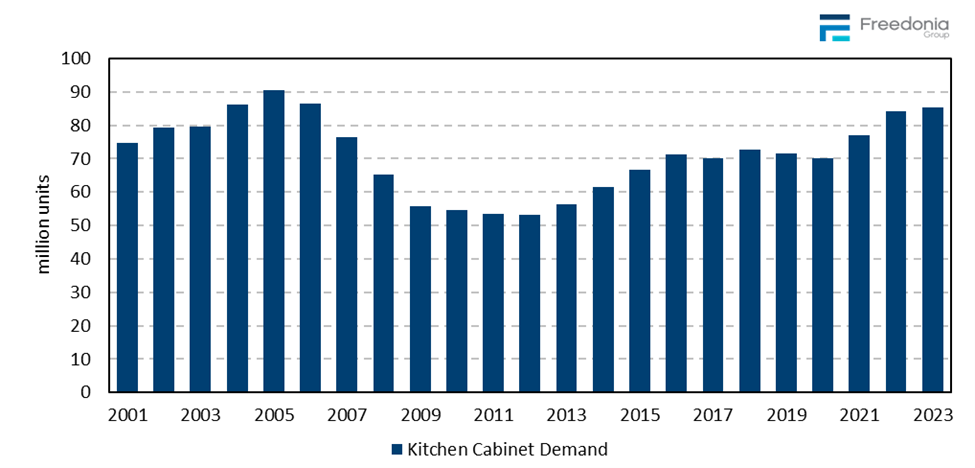
Year-to-year volatility in unit demand for cabinets is primarily a function of cyclicality in the building construction industry. However, major fluctuations in the cost of materials used in the construction of cabinets (such as lumber) can result in volatility in value demand as well.
Materials Trends
Wood vs Non-Wood Cabinets
Wood-based materials accounted for the vast majority of kitchen cabinet demand in 2023 and will continue to do so through 2028, due to the:
-
high level of homeowner preferences for the look of wood in their residences
-
the generally lower cost of most wood materials compared to metal and some niche cabinet materials
-
the favorable performance properties of wood, including structural strength and resistance to wear
While wood dominates overall cabinet demand, a variety of other materials are used in cabinet construction including metal, laminates, and plastic. Among non-wood types, metal kitchen cabinets will continue to see use among residential consumers looking for a more contemporary look. However, greater unit demand gains for these cabinets will be restrained by their:
-
higher cost
-
concerns about the difficulty of keeping these cabinets clean – metal surfaces can be susceptible to smudges from daily use
Plastic kitchen cabinets will experience slow growth due to competition from other materials, the rise in eco-consciousness and the demand for more sustainable products.
Regional Trends
The South will remain the largest regional market for cabinets and will account for most demand gains, driven by growth in population and existing home sales. As more people move to the South and purchase homes, residential renovation demand for kitchen cabinets will rise as homeowners remodel kitchens either prior to the sale of a home – to make it more appealing to potential purchasers.
The West, which is the second largest regional kitchen cabinet market, will record healthy demand gains due to above average growth in existing home sales and housing completions. Demand growth in the Midwest and Northeast will be spurred by healthy increases in existing home sales.
Residential Building Construction Activity
Kitchen cabinets are primarily used in residential buildings so the outlook for new residential building construction and trends in addition or improvements are especially important. In addition to the overall number of homes that are being built, other key factors in the residential market include the number and size of kitchens per building.
Demand for kitchen cabinets is related primarily to building construction activity, especially construction activity in the residential market. Consequently, cyclicality in the construction industry can have a significant impact on the outlook for the kitchen cabinets market. Kitchen cabinets are essential components of many buildings, although the characteristics of the cabinets used may vary significantly depending on whether the structure is residential or commercial.
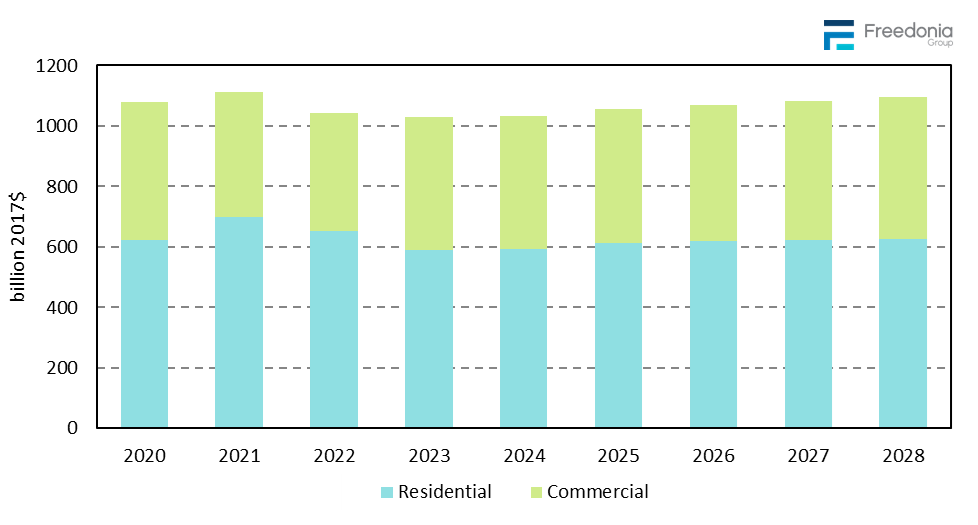
Real building construction expenditures are expected to rebound to an average of 1.3% per year through 2028:
-
Residential building construction is also expected to rebound from the previous period, due to a return to more stable growth in single-family housing and renovation expenditures, after the surges in 2020 and 2021, and declines in 2022 and 2023 that resulted from a variety of pandemic-related trends.
-
Commercial building construction is also anticipated to rebound from the pandemic-induced declines of the 2018-2023 period, thereby supporting the construction of office, lodging, and institutional facilities.
Scope
Kitchen cabinets (base, wall, and tall) comprise those cabinets installed in the kitchen of a home or commercial structure to provide concealed storage. Cabinets differ from other storage solutions in that they are affixed to the wall or floor and cannot be moved. Types of kitchen cabinet included in the scope of this report include base, wall, and tall.
The main kitchen cabinet materials covered in the scope of this report are:
-
wood-based materials
-
hardwood and softwood lumber
-
engineered wood products (e.g., particleboard; plywood; medium-density fiberboard, or MDF)
-
wood veneers
-
-
non-wood materials
-
metal (stainless steel and aluminum)
-
decorative laminates (both low-pressure and high-pressure types, as well as edgebanding)
-
plastic and other non-wood materials, including glass, wheatboard, and bamboo
-
In addition, the study discusses kitchen cabinet demand by US region and subregion. Major manufacturers are identified and profiled, and the key industry competitive variables are discussed. Kitchen cabinet demand is also segmented by:
-
box construction
-
face frame (also known as “American-style” cabinets, face frame allow for easier installation and door adjustment)
-
frameless (also known as “European style” cabinets, frameless cabinets feature flat surfaces and flush doors, with little or no hardware)
-
-
construction method
-
stock cabinets (pre-manufactured cabinets with no customization options)
-
semicustom cabinets (pre-manufactured cabinets with few customization options)
-
custom cabinets (cabinets made to order)
-
Kitchen cabinet demand is provided in both market value and unit terms.
Historical data (2013, 2018, and 2023) and forecasts for 2028 and 2033 are presented for kitchen cabinet demand in current US dollars (including inflation) and in units. Annual data are presented for 2020 through 2027.
- Executive Summary
- Figure 1-1. US Kitchen Cabinets Market
- About This Report
- Report Details
- Market Scope & Product Description
- Figure 2-1. Kitchen Cabinets: Product Examples
- Short-Term Kitchen Cabinet Trends
- Table | Annual Kitchen Cabinet Demand by Product Type, 2021 - 2025
- Figure 2-2. Kitchen Cabinet Volume Demand Growth by Market, 2020 - 2025
- Overview
- Historical Market Trends & Growth Factors
- Table | Kitchen Cabinet Demand, 2013 - 2023
- Figure 3-1. Kitchen Cabinet Demand, 2001 - 2023
- Markets Overview (Residential vs. Commercial)
- Table | Kitchen Cabinet Demand by Market, 2013, 2018, 2023, 2028, &2033
- Table | Annual Kitchen Cabinet Demand by Market, 2020 - 2027
- Materials Trends
- Wood vs Non-Wood Cabinets
- Table | Kitchen Cabinet Demand: Wood vs. Non-Wood, 2013, 2018, 2023, 2028, &2033
- Table | Annual Kitchen Cabinet Demand: Wood vs. Non-Wood, 2020 - 2027
- Wood Kitchen Cabinets
- Table | Wood Kitchen Cabinet Demand, 2013, 2018, 2023, 2028, &2033
- Table | Annual Wood Kitchen Cabinet Demand, 2020 - 2027
- Non-Wood Kitchen Cabinets (Metal, Laminate, Other)
- Table | Non-Wood Kitchen Cabinet Demand by Material, 2013, 2018, 2023, 2028, &2033
- Table | Annual Non-Wood Kitchen Cabinet Demand by Material, 2020 - 2027
- Wood vs Non-Wood Cabinets
- Regional Trends
- Table | Kitchen Cabinet Demand by US Region, 2013, 2018, 2023, 2028, &2033
- Table | Annual Kitchen Cabinet Demand by US Region, 2020 - 2027
- Pricing & Inflation
- Table | Selected Kitchen Cabinet Product Prices, 2013, 2018, 2023, 2028, &2033
- Table | Annual Selected Kitchen Cabinet Product Prices, 2020 - 2027
- Market Share & Leading Suppliers
- Figure 3-2. Kitchen Cabinet Market Share by Company, 2023
- Historical Market Trends & Growth Factors
- Factors Impacting Kitchen Cabinet Demand
- Residential Building Construction Activity
- Figure 4-1. Building Construction Expenditures, 2020 - 2028
- Home Remodeling Spending
- Table | Home Remodeling Spending, 2013, 2018, 2023, 2028, &2033
- Kitchen Design Trends
- Cabinet Design Trends
- Improved Color Design Options & Amenities
- Frameless Cabinets
- Growth in the Appeal of Natural Wood Cabinets
- Floor-to-Ceiling Cabinetry
- Comparative Installation Costs
- Table | Selected Kitchen Cabinet Installation Costs, 2013, 2018, 2023, 2028, &2033
- Table | Annual Selected Kitchen Cabinet Installation Costs, 2020 - 2027
- Labor Shortages
- Impact of Tariffs
- Environmental & Sustainability Issues
- LEED & Other Green Building Codes
- Regulation of Formaldehyde Emissions
- Recycling/Disposal of Old Cabinets & Sustainable Forestry Practices
- Residential Building Construction Activity
- Kitchen Cabinet Products
- Demand by Product Type
- Table | Kitchen Cabinet Demand by Product Type, 2013, 2018, 2023, 2028, &2033
- Table | Annual Kitchen Cabinet Demand by Product Type, 2020 - 2027
- Figure 5-1. Kitchen Cabinet Demand by Product Type, 2013, 2018, 2023, 2028, &2033
- Base Kitchen Cabinets
- Table | Base Kitchen Cabinet Demand by Market, 2013, 2018, 2023, 2028, &2033
- Table | Annual Base Kitchen Cabinet Demand by Market, 2020 - 2027
- Figure 5-2. Base Kitchen Cabinet Demand by Market, 2013, 2018, 2023, 2028, &2033
- Wall Cabinets
- Table | Wall Kitchen Cabinet Demand by Market, 2013, 2018, 2023, 2028, &2033
- Table | Annual Wall Kitchen Cabinet Demand by Market, 2020 - 2027
- Figure 5-3. Wall Kitchen Cabinet Demand by Market, 2013, 2018, 2023, 2028, &2033
- Tall/Pantry Cabinets
- Table | Tall/Pantry Kitchen Cabinet Demand by Market, 2013, 2018, 2023, 2028, &2033
- Table | Annual Tall/Pantry Kitchen Cabinet Demand by Market, 2020 - 2027
- Figure 5-4. Tall/Pantry Kitchen Cabinet Demand by Market, 2013, 2018, 2023, 2028, &2033
- Demand by Product Type
- Construction Methods
- Definitions
- Demand by Construction Method
- Table | Kitchen Cabinet Demand by Construction Method, 2013, 2018, 2023, 2028, &2033
- Table | Annual Kitchen Cabinet Demand by Construction Method, 2020 - 2027
- Figure 6-1. Kitchen Cabinet Demand by Construction Method, 2013, 2018, 2023, 2028, &2033
- Stock Kitchen Cabinets
- Table | Stock Kitchen Cabinet Demand by Market, 2013, 2018, 2023, 2028, &2033
- Table | Annual Stock Kitchen Cabinet Demand by Market, 2020 - 2027
- Semicustom Kitchen Cabinets
- Table | Semicustom Kitchen Cabinet Demand by Market, 2013, 2018, 2023, 2028, &2033
- Table | Annual Semicustom Kitchen Cabinet Demand by Market, 2020 - 2027
- Custom Kitchen Cabinets
- Table | Custom Kitchen Cabinet Demand by Market, 2013, 2018, 2023, 2028, &2033
- Table | Annual Custom Kitchen Cabinet Demand by Market, 2020 - 2027
- Demand by Box Construction (Frameless vs. Face Frame)
- Table | Kitchen Cabinet Demand: Frameless vs. Face Frame, 2013, 2018, 2023, 2028, &2033
- Table | Annual Kitchen Cabinet Demand: Faceless vs. Face Frame, 2020 - 2027
- Appendix
- Scope
- Table | Relevant Industry Codes
- Table | Relevant HTS Codes
- Definitions
- Freedonia Methodology
- Study-Specific Methodology
- Sources
- Associations & Agencies
- Related Studies & Reports
- Macroeconomic Assumptions
- Economic Environment
- Table | Macroeconomic Indicators, 2013, 2018, 2023, 2028, &2033
- Demographic Trends
- Table | Population & Households, 2013, 2018, 2023, 2028, &2033
- Consumer Spending
- Table | Personal Consumption Expenditures, 2013, 2018, 2023, 2028, &2033
- Consumer Financing
- Table | Consumer Financing Environment, 2013 - 2023
- Residential Building Construction
- Table | Residential Building Construction Expenditures, 2013, 2018, 2023, 2028, &2033
- Housing Completions
- Table | New Housing Indicators, 2013, 2018, 2023, 2028, &2033
- Housing Stock
- Table | Housing Stock by Type, 2013, 2018, 2023, 2028, &2033
- Figure 7-1. Housing Stock: Share by Year of Construction, 2023
- Residential Improvements & Repairs
- Table | Residential Improvement & Repair Expenditures, 2013, 2018, 2023, 2028, &2033
- Commercial Building Construction
- Table | Commercial Building Construction Expenditures, 2013, 2018, 2023, 2028, &2033
- Commercial Building Stock
- Table | Commercial Building Stock by Type, 2013, 2018, 2023, 2028, &2033
- Commercial Building Improvements & Repairs
- Table | Commercial Building Improvement & Repair Expenditures, 2013, 2018, 2023, 2028, &2033
- Nonbuilding Construction Expenditures
- Table | Nonbuilding Construction Expenditures, 2013, 2018, 2023, 2028, &2033
- Economic Environment
- Scope
Base cabinets accounted for the largest share of kitchen cabinet demand in 2023 and will continue to do so.
Demand in 2024 for kitchen cabinets is 83 million units.
Top kitchen cabinet companies include MasterBrand, CabinetWorks, and American Woodmark.