US Lawn & Garden Growing Media
This study analyzes US demand for lawn and garden growing media by end user (consumer, professional), market, application (lawn care, gardens and borders, other), and product type.
Free Sample Report
Request a free sample of this report and our team will email it to you.
Report Overview
Featuring 50 tables and 14 figures – available in Excel and Powerpoint! Learn More
This study analyzes US demand for lawn and garden growing media by end user (consumer, professional), market, application (lawn care, gardens and borders, other), and product type.
 Market segments include:
- residential
- golf courses
- government and institutional
- commercial and industry
- other, including nurseries, sod farms, and sports venues
- packaged soil
- potting soil
- garden soil
- topsoil
- planting mix
- soil amendments
- compost
- sphagnum peat moss
- perlite
- humus
- manure
- vermiculite
Inflationary Trends Impact Lawn & Garden Growing Media Spending
Near-term growth rates for many segments will be challenged by an inflationary environment that has fostered price sensitivity. Consumers are looking for value, not just a low cost. In some cases, gains in value terms in 2022 stemmed from price increases more than sales volume gains. However, interest in value-added versions temporarily slipped as customers found the high prices challenging to their budgets. Price increases were also upheld due to shortages from products such as peat moss, which has been challenged by reduced supplies coming from Canada as wet weather in 2022 limited harvest and extraction for the 2023 season, while regulations make expansions slow and challenging.Return to DIFM Services Impacts Growing Media Sales
Many US consumers have embraced a DIY ethic for lawn and garden projects. The widespread availability of gardening information – both practical advice from experts and inspirational content from social media influencers on TikTok, Instagram, and other outlets – helps to maintain this trend.However, use of DIFM landscaping services has grown again as consumers return to pre-pandemic habits. This is particularly important with growing media, which is typically applied seasonally as consumers seek to condition their lawns and establish their garden beds or containers. Increasingly, consumers are relegating these seasonal cleanup tasks to professionals who are more efficient and have the skill and knowledge to select the right growing media and apply them properly. Still, that trend has been somewhat counterbalanced by rising inflation, which has led many consumers to economize and cancel some services. Furthermore, the shortage of professional landscape workers has made such services either too expensive or too unreliable for some homeowners.
Product Innovations Continue to Support Value Gains
Market value gains will be bolstered by an ongoing shift in the product mix toward innovative, value-added products. Key value-added growing media types include pre-blended soil mixes that offer improved performance characteristics, such as moisture retention, added fertilizers or pesticides, and the inclusion of soil amendments, and products that feature improved sustainability.Historical Market Trends
Overall, year-to-year fluctuations in demand for lawn and garden growing media are influenced by a variety of factors, including:- personal incomes and levels of discretionary spending
- residential and commercial construction, which generally involves the installation of new lawns and landscaping
- trends in average lot size and maintained areas
- changes in the way living spaces are used and the frequency they are used
- the number of people participating in gardening as a hobby
- weather patterns and climate change
- variability in active ingredient and raw material pricing and availability
- changes in where gardens are planted, urban v. rural and in-ground v. raised beds and containers
- a shift in product mix favoring either economy or value-added formulations
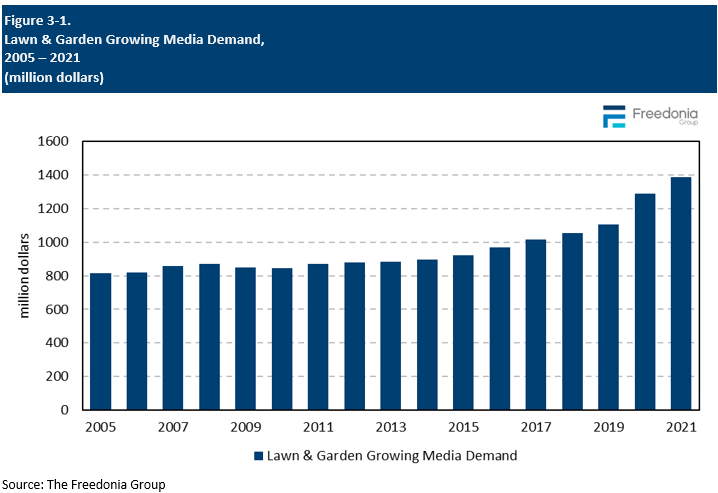
In 2020 and 2021, demand for lawn and garden growing media surged because of increased investment in outdoor projects, particularly in the residential market. As consumers stayed at home more, a greater importance was placed on the areas in and around their homes. Funds typically allocated for entertainment outside the home were used to renovate their outdoor areas.
Consumer Market Trends
Demand for lawn and garden growing media for consumer users is expected to decline slightly from a high pandemic-related 2021 base to $847 million in 2026. However, sales will be well above pre-pandemic levels and the 2026 total will represent an increase from the expected low of 2023. Sales will be supported by efforts to retain many of these newer gardeners who picked up the hobby during the pandemic.Value gains will stem from two main factors: shortages from products such as peat, as well as shifts in the product mix to include higher value products. Key value-added growing media types include pre-blended soil mixes that offer improved performance characteristics, such as moisture retention, added fertilizers or pesticides, and the inclusion of soil amendments.
Soil blends for specific applications – such as those for indoor houseplants or vegetable gardens – will offer some opportunities, as the number of inexperienced gardeners participating in DIY gardening and landscaping increases. These products will also be valued by more experienced home gardeners, who may be willing to pay for more expensive products that increase their efficiency and success.
The trend toward raised bed, container gardening or other above-ground formats as well as potted plants, indoors and out, will also sustain growing media sales. In many cases, these types of gardening, which are suitable for urban areas, at rental properties, and by older gardeners looking spend less time or effort bending over or getting up off the ground, require greater use of packaged soil and soil amendments to make them suitable for raising plants.
Demand by Application (Lawn Care, Gardens, & Other)
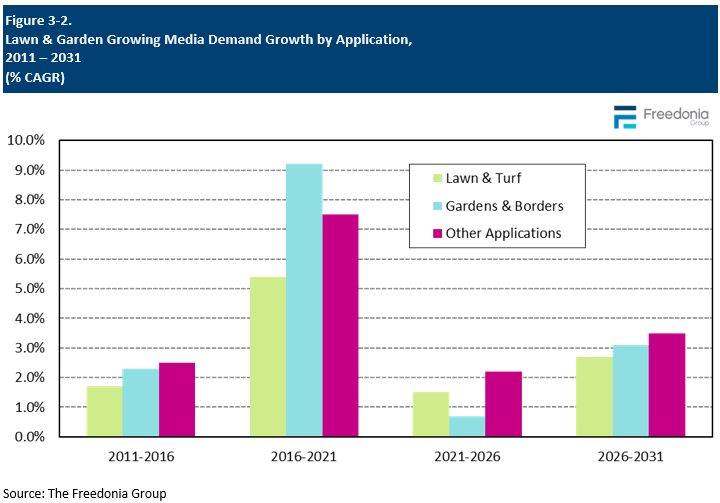
The primary applications for packaged growing media are for gardens and borders, but lawn and turf – as well as potted plants – are also significant outlets. In non-lawn and turf related applications, smaller volumes of soil may be needed. As such, the cost savings of bulk products often do not offset the added convenience of packaged products. However, larger-volume applications (such as the installation of entirely new garden beds or landscaping features) will continue to be dominated by bulk soil sales.Gains in demand for packaged growing media will be supported by the continued popularity of value-added soil blends marketed for specific purposes (e.g., Miracle-Gro garden soil for vegetables and herbs, or Espoma’s cactus potting soil).
Soil amendments are typically used before the installation of a new lawn and in garden beds and pots before planting. In soils that are less than ideal for growing the desired types of plants, soil amendments can be a less expensive solution than buying topsoil, garden soil, or potting soil.
Pricing Trends
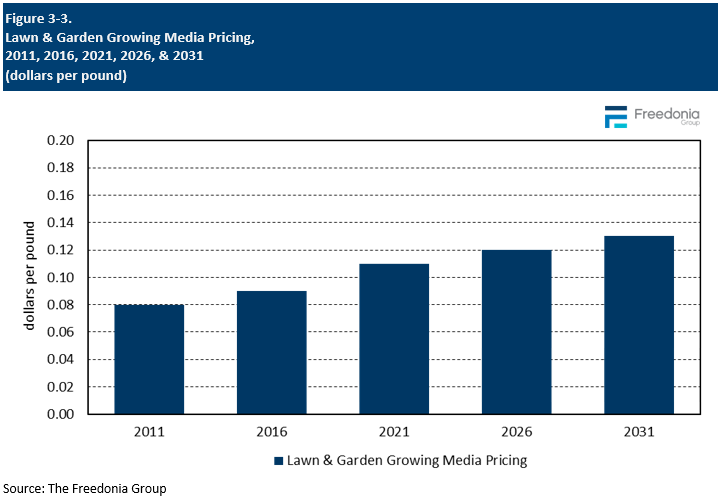
Average prices for growing media are forecast to grow 1.8% per year to reach 12 cents per pound in 2026. Lawn and garden growing media prices are generally much lower than prices for more technologically advanced lawn and garden consumables, such as pesticides and seeds with special traits. Traditionally, growing media is considered a commodity – low cost products for which brand differentiation can be challenging.Still, there are factors influencing pricing fluctuations for growing media, including:
- raw material and commodity costs
- new product introductions
- trends in the product mix
Otherwise, average prices for growing media will be supported as an increasing number of higher value products enter the market. As these products become more widely used, this new product mix will boost average prices.
Inflationary Trends Impact Lawn & Garden Growing Media Spending
Near-term growth rates for many segments will be challenged by an inflationary environment that has fostered price sensitivity. Consumers are looking for value, not just a low cost. In some cases, gains in value terms in 2022 stemmed from price increases more than sales volume gains. However, interest in value-added versions temporarily slipped as customers found the high prices challenging to their budgets. Price increases were also upheld due to shortages from products such as peat moss, which has been challenged by reduced supplies coming from Canada as wet weather in 2022 limited harvest and extraction for the 2023 season, while regulations make expansions slow and challenging.Return to DIFM Services Impacts Growing Media Sales
Many US consumers have embraced a DIY ethic for lawn and garden projects. The widespread availability of gardening information – both practical advice from experts and inspirational content from social media influencers on TikTok, Instagram, and other outlets – helps to maintain this trend.However, use of DIFM landscaping services has grown again as consumers return to pre-pandemic habits. This is particularly important with growing media, which is typically applied seasonally as consumers seek to condition their lawns and establish their garden beds or containers. Increasingly, consumers are relegating these seasonal cleanup tasks to professionals who are more efficient and have the skill and knowledge to select the right growing media and apply them properly. Still, that trend has been somewhat counterbalanced by rising inflation, which has led many consumers to economize and cancel some services. Furthermore, the shortage of professional landscape workers has made such services either too expensive or too unreliable for some homeowners.
Product Innovations Continue to Support Value Gains
Market value gains will be bolstered by an ongoing shift in the product mix toward innovative, value-added products. Key value-added growing media types include pre-blended soil mixes that offer improved performance characteristics, such as moisture retention, added fertilizers or pesticides, and the inclusion of soil amendments, and products that feature improved sustainability.Historical Market Trends
Overall, year-to-year fluctuations in demand for lawn and garden growing media are influenced by a variety of factors, including:- personal incomes and levels of discretionary spending
- residential and commercial construction, which generally involves the installation of new lawns and landscaping
- trends in average lot size and maintained areas
- changes in the way living spaces are used and the frequency they are used
- the number of people participating in gardening as a hobby
- weather patterns and climate change
- variability in active ingredient and raw material pricing and availability
- changes in where gardens are planted, urban v. rural and in-ground v. raised beds and containers
- a shift in product mix favoring either economy or value-added formulations
In 2020 and 2021, demand for lawn and garden growing media surged because of increased investment in outdoor projects, particularly in the residential market. As consumers stayed at home more, a greater importance was placed on the areas in and around their homes. Funds typically allocated for entertainment outside the home were used to renovate their outdoor areas.

Consumer Market Trends
Demand for lawn and garden growing media for consumer users is expected to decline slightly from a high pandemic-related 2021 base to $847 million in 2026. However, sales will be well above pre-pandemic levels and the 2026 total will represent an increase from the expected low of 2023. Sales will be supported by efforts to retain many of these newer gardeners who picked up the hobby during the pandemic.Value gains will stem from two main factors: shortages from products such as peat, as well as shifts in the product mix to include higher value products. Key value-added growing media types include pre-blended soil mixes that offer improved performance characteristics, such as moisture retention, added fertilizers or pesticides, and the inclusion of soil amendments.
Soil blends for specific applications – such as those for indoor houseplants or vegetable gardens – will offer some opportunities, as the number of inexperienced gardeners participating in DIY gardening and landscaping increases. These products will also be valued by more experienced home gardeners, who may be willing to pay for more expensive products that increase their efficiency and success.
The trend toward raised bed, container gardening or other above-ground formats as well as potted plants, indoors and out, will also sustain growing media sales. In many cases, these types of gardening, which are suitable for urban areas, at rental properties, and by older gardeners looking spend less time or effort bending over or getting up off the ground, require greater use of packaged soil and soil amendments to make them suitable for raising plants.
Demand by Application (Lawn Care, Gardens, & Other)
The primary applications for packaged growing media are for gardens and borders, but lawn and turf – as well as potted plants – are also significant outlets. In non-lawn and turf related applications, smaller volumes of soil may be needed. As such, the cost savings of bulk products often do not offset the added convenience of packaged products. However, larger-volume applications (such as the installation of entirely new garden beds or landscaping features) will continue to be dominated by bulk soil sales.Gains in demand for packaged growing media will be supported by the continued popularity of value-added soil blends marketed for specific purposes (e.g., Miracle-Gro garden soil for vegetables and herbs, or Espoma’s cactus potting soil).
Soil amendments are typically used before the installation of a new lawn and in garden beds and pots before planting. In soils that are less than ideal for growing the desired types of plants, soil amendments can be a less expensive solution than buying topsoil, garden soil, or potting soil.

Pricing Trends
Average prices for growing media are forecast to grow 1.8% per year to reach 12 cents per pound in 2026. Lawn and garden growing media prices are generally much lower than prices for more technologically advanced lawn and garden consumables, such as pesticides and seeds with special traits. Traditionally, growing media is considered a commodity – low cost products for which brand differentiation can be challenging.Still, there are factors influencing pricing fluctuations for growing media, including:
- raw material and commodity costs
- new product introductions
- trends in the product mix
Otherwise, average prices for growing media will be supported as an increasing number of higher value products enter the market. As these products become more widely used, this new product mix will boost average prices.

- Executive Summary
- Figure 1-1. Lawn & Garden Growing Media Market Outlook
- About This Report
- Report Details
- Study Scope & Product Description
- Figure 2-1. Lawn & Garden Growing Media: Product Examples
- Short-Term Trends
- Table | Lawn & Garden Growing Media Demand by Application & End User, 2019 – 2023
- Table | Lawn & Garden Growing Media Demand by Market, 2019 – 2022
- Figure 2-2. Lawn & Garden Growing Media Demand by End User, 2019 – 2024
- Overview
- Historical Market Trends
- Table | Lawn & Garden Growing Media Demand, 2011 – 2021
- Figure 3-1. Lawn & Garden Growing Media Demand, 2005 – 2021
- Demand by End User
- Table | Lawn & Garden Growing Media Demand by End User, 2011, 2016, 2021, 2026, &2031
- Table | Annual Lawn & Garden Growing Media Demand by End User, 2018 – 2025
- Consumer Market Trends
- Table | Consumer Lawn & Garden Growing Media Demand by Application, 2011, 2016, 2021, 2026, &2031
- Table | Annual Lawn & Garden Consumer Growing Media Demand by Application, 2018 – 2025
- Professional Market Trends
- Table | Professional Lawn & Garden Growing Media Demand by Application & End-User, 2011, 2016, 2021, 2026, &
- Table | Annual Professional Lawn & Garden Growing Media Demand by Application & End-User, 2018 – 2025
- Demand by Application (Lawn Care, Gardens, &Other)
- Table | Lawn & Garden Growing Media Demand by Application, 2011, 2016, 2021, 2026, &2031
- Table | Annual Lawn & Garden Growing Media Demand by Application, 2018 – 2025
- Figure 3-2. Lawn & Garden Growing Media Demand Growth by Application, 2011 – 2031
- Pricing Trends
- Table | Lawn & Garden Growing Media Demand & Pricing, 2011, 2016, 2021, 2026, &2031
- Table | Lawn & Garden Growing Media Demand & Pricing, 2018 – 2025
- Figure 3-3. Lawn & Garden Growing Media Pricing, 2011, 2016, 2021, 2026, &2031
- Historical Market Trends
- Factors Impacting Lawn & Garden Growing Media Demand
- Demographic Trends
- Urbanization Trends
- Table | Households by Type, 2011, 2016, 2021, 2026, &2031
- Figure 4-1. Households by Type, 2011 – 2031
- Homeownership Trends
- Ownership vs. Rentals
- Table | US Homeownership & Rental Rates, 2012 – 2022
- Annual Household Income
- Table | US Homeownership & Rental Rates by Household Income Bracket, 2022
- Age of Head of Household
- Table | US Homeownership & Rental Rates by Age of Head of Household, 2012 – 2022
- Ownership vs. Rentals
- Average Lot Size & Outdoor Space Trends
- Lot Size Over Time
- Table | US Homeownership Rates by Property Size, 2012 – 2022
- Lot Size by Locations
- Table | Lot Size Owned by Urban vs. Rural Setting, 2022
- Table | Lot Size Owned by Geographic Region, 2022
- Lot Size Over Time
- Sustainability Trends & Issues
- Water Conservation
- Organic Gardening
- Climate & Seasonality
- Climate Change
- Urban Green Spaces & Park Investment
- Local Soil Quality
- Container Gardening
- Location of Gardening
- Table | “Where Do You Grow Your Plants?” by gender, age group, urban vs. rural setting, region, &type of hou
- New Product Development
- Growing Media Products
- Demand by Product Type
- Table | Lawn & Garden Growing Media Demand by Product Type, 2011, 2016, 2021, 2026, &2031
- Table | Annual Lawn & Garden Growing Media Demand by Product Type, 2018 – 2025
- Figure 5-1. Lawn & Garden Growing Media: Key Demand Drivers
- Packaged Soil
- Table | Lawn & Garden Soil Demand by Product Type, 2011, 2016, 2021, 2026, &2031
- Table | Annual Lawn & Garden Soil Demand by Product Type, 2018 – 2025
- Soil Amendments
- Demand by Type
- Table | Lawn & Garden Soil Amendment Demand by Product Type, 2011, 2016, 2021, 2026, &2031
- Table | Annual Lawn & Garden Soil Amendment Demand by Product Type, 2018 – 2025
- Compost
- Figure 5-2. Lawn & Garden Compost: Product Examples
- Peat
- Figure 5-3. Lawn & Garden Peat: Product Examples
- Other Soil Amendments (Perlite, Polymers, Coir, Manure, Sand)
- Figure 5-4. Other Lawn & Garden Soil Amendments: Product Examples
- Demand by Type
- Demand by Product Type
- Markets
- Demand by Market
- Table | Lawn & Garden Growing Media Demand by Market, 2011, 2016, 2021, 2026, &2031
- Table | Annual Lawn & Garden Growing Media Demand by Market, 2018 – 2025
- Figure 6-1. Lawn & Garden Growing Media Demand by Market, 2011, 2016, 2021, 2026, &2031
- Residential
- Overview
- Table | Residential Lawn & Garden Growing Media Demand by Application & End User, 2011, 2016, 2021, 2026, &2
- Table | Annual Residential Lawn & Garden Growing Media Demand by Application & End User, 2018 – 2025
- Consumer Insights: Purchases by Gardening Activity
- Table | Growing Media Purchases in the Last 12 Months by Gardening Activity, 2023
- Consumer Insights: Purchases Over Time
- Table | Growing Media Purchases in the Last 12 Months, 2015 – 2023
- Overview
- Golf Courses
- Table | Golf Course Lawn & Garden Growing Media Demand by Application, 2011, 2016, 2021, 2026, &2031
- Table | Annual Golf Course Lawn & Garden Growing Media Demand by Application, 2018 – 2025
- Government & Institutional
- Table | Government & Institutional Lawn & Garden Growing Media Demand by Application, 2011, 2016, 2021, 2026
- Table | Annual Government & Institutional Lawn & Garden Growing Media Demand by Application, 2018 – 2025
- Commercial & Industrial
- Table | Commercial & Industrial Lawn & Garden Growing Media Demand by Application, 2011, 2016, 2021, 2026, &
- Table | Annual Commercial & Industrial Lawn & Garden Growing Media Demand by Application, 2018 – 2025
- Other Markets (Nurseries, Sod Farms, &Sports Venues)
- Table | Other Lawn & Garden Growing Media Markets Demand by Application, 2011, 2016, 2021, 2026, &2031
- Table | Annual Other Lawn & Garden Growing Media Markets Demand by Application, 2018 – 2025
- Demand by Market
- Key Suppliers & Market Share
- Industry Composition
- Market Share
- Figure 7-1. Lawn & Garden Growing Media Market Share, 2021
- Table | Selected Growing Media Suppliers & Products
- Mergers & Acquisitions
- Table | Selected Mergers & Acquisitions
- Appendix
- Scope
- Definitions
- Freedonia Methodology
- Study-Specific Methodology
- Sources
- Related Studies & Reports
- Macroeconomic Assumptions
- Economic Environment
- Table | Macroeconomic Indicators, 2011, 2016, 2021, 2026, &2031
- Demographic Trends
- Table | Population & Households, 2011, 2016, 2021, 2026, &2031
- Consumer Spending
- Table | Personal Consumption Expenditures, 2011, 2016, 2021, 2026, &2031
- Housing Stock
- Table | Housing Stock by Type, 2011, 2016, 2021, 2026, &2031
- Figure 8-1. Housing Stock: Share by Year of Construction, 2021
- Regional Population & Housing Starts
- Table | Population by Region & Subregion, 2011, 2016, 2021, 2026, &2031
- Table | Single Family Housing Starts by Region & Subregion, 2011, 2016, 2021, 2026, &2031
- Table | Multifamily Housing Starts by Region & Subregion, 2011, 2016, 2021, 2026, &2031
- Economic Environment
Leading suppliers for lawn & garden growing media include Scotts Miracle Grow, CRH, Premier Tech, Sun Gro and Lebanon Seaboard.
Growing media include a variety of products such as packaged soil (e.g., potting soil, garden soil, topsoil, planting mix) and soil amendments (e.g., compost, sphagnum peat moss, perlite, humus, manure, vermiculite).
Demand for packaged lawn and garden growing media in 2022 was $1.4 billion.
Demand for packaged soil in lawn and garden applications is projected to rise 1.4% per year off of a high pandemic-related base to $1.2 billion in 2026.