US Wood & Competitive Decking
This Freedonia industry study analyzes the $13.9 billion US decking industry. It presents historical demand data (2012, 2017, and 2022), forecasts (2027 and 2032), and annual historical and forecast data from 2019 to 2026 by market, by material and product.
Free Sample Report
Request a free sample of this report and our team will email it to you.
Report Overview
Explore analysis of top decking trends.
-
Sizable stock of wood decks in need of replacement
-
Aluminum, cable, and glass railing gaining market share
This Freedonia industry study analyzes the $13.9 billion US decking industry. It presents historical demand data (2012, 2017, and 2022), forecasts (2027 and 2032), and annual historical and forecast data from 2019 to 2026 by market (residential, commercial, nonbuilding), by material (wood, wood-plastic composite, plastic, other) and product (decking board, railing accessories). The study also evaluates company market share and competitive analysis on such industry players as AZEK Company, Cornerstone Building Brands, CRH (Oldcastle AG), Fortune Brands (Fiberon), Owens Corning (WearDeck), TAMKO Building Products (Envision Outdoor Living), Trex, UFP Industries, VEKA, West Fraser, and Weyerhaeuser.
Featuring 144 tables and 26 figures – available in Excel and Powerpoint! Learn More
Read the Blog: Alternative Decking Materials – Bamboo, Rubber, Glass?
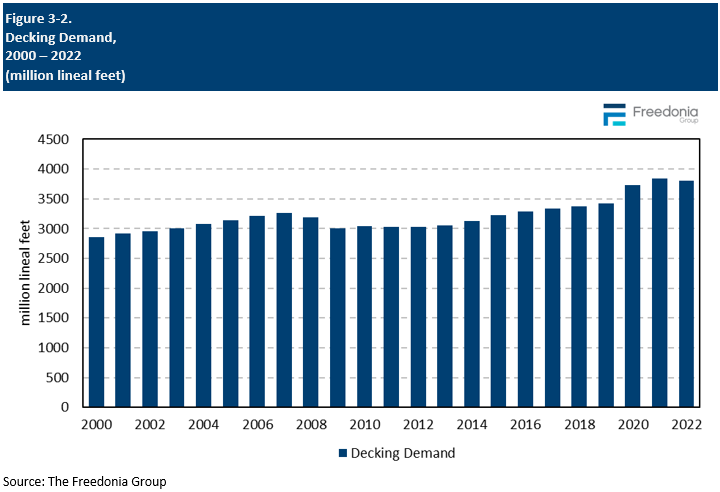
Demand for decking in the US is forecast to remain stagnate at 3.8 billion lineal feet in 2027 (valued at $12.7 billion), restrained by slow growth in residential improvement and repair activity. Growth will also be limited by the large number of residential decks that were installed in 2020 and 2021, when the onset of the COVID-19 pandemic caused home renovations to soar – these decks are not likely to be replaced in the near future. Market value will also be negatively impacted by a significant moderation in wood prices from elevated levels during the pandemic.
Although the overall outlook is weak, growth will occur in some segments such as:
-
the commercial market, thanks to a strong rebound in the construction of hotels and resorts, where decks are frequently installed in outdoor gathering areas
-
the nonbuilding market, due to design trends that call for more gathering and recreation areas in public parks and other facilities
-
nonwood decking materials, which offer greater durability and require less maintenance than wood
Popularity of Wood-Plastic Composite Decking Continues to Rise
Wood-plastic composite is expected to capture a larger share of the US decking market through 2027, primarily at the expense of pressure-treated wood. Wood-plastic composite is gaining popularity because it is durable and maintains a wood-like appearance. Advances in product aesthetics and the use of capstock-coated decking – which provides enhanced protection against mold growth and premature degradation – will further boost wood-plastic composite decking demand.
Wood Decking Prices will Moderate from Record Highs
2020 and 2021 saw record high prices for lumber, especially pressure-treated varieties; the surge was caused by pandemic-induced shutdowns leading to severe shortages among domestic suppliers. Additionally, shortages in the Canadian market – which is a major source of US supply – exacerbated price pressures, precipitating significant increases and volatility. This resulted in a highly inflated value for the US decking market. For example, demand volume grew 12% from 2019 to 2021, while demand value increased by over 105%. This was primarily due to a 150% increase in the price of lumber during that period.
Prices in 2022 remained elevated, but began to stabilize as supply chains normalized and construction activity began to dampen. In 2023, prices for wood decking moderated significantly, and will remain below 2022 levels for the rest of the forecast period.
Historical Market Trends
Demand for decking tends to follow trends in building construction activity, especially in the residential renovation market. Other factors beyond the outlook for residential building construction that impact the number of decks and the overall market size include:
-
levels of disposable income, which impact consumers’ abilities to spend on discretionary items such as decks
-
residential lot size, which determines both the feasibility of having a deck and its ultimate size
-
trends in the popularity of outdoor living and dining
-
the outlook for spending at commercial establishments like restaurants and lodging, where decks are often key features
-
parks and other recreational areas purchasing structures such as freestanding decks, boardwalks and marinas.
-
the complexity of deck design, particularly when including the amount of accessories often required
-
changes in the mix of materials used and their relative pricing
-
overall levels of inflation and the costs of raw materials and labor
Prior to the pandemic, demand growth in lineal feet terms was fairly consistent over the historical period. However, demand grew quickly in 2020 as home improvement and repair activity surged. Growth in value terms has shown more volatility over the historical period due primarily to wood pricing. However, market value grew at record rates in 2020 and 2021 as wood shortages and high raw material costs sent prices skyrocketing.
Markets Overview
Markets for decking products can be divided into three main segments, each of which has both new and renovation demand:
-
residential
-
single-family
-
multifamily
-
manufactured housing
-
commercial, which includes decks installed near commercial buildings such as bars, restaurants, hotels, casinos, resorts, spas, and other entertainment facilities
-
nonbuilding, which is comprised of decks that are not attached to buildings:
-
The majority of these are in coastal or other waterfront areas and serve as boardwalks, docks, marinas, and piers.
-
Nonbuilding decks also include walkways and platforms at national, state, or local parks; amusement parks; water parks; and playgrounds. In many cases, decks in these applications are built through municipal or other government contracts.
-
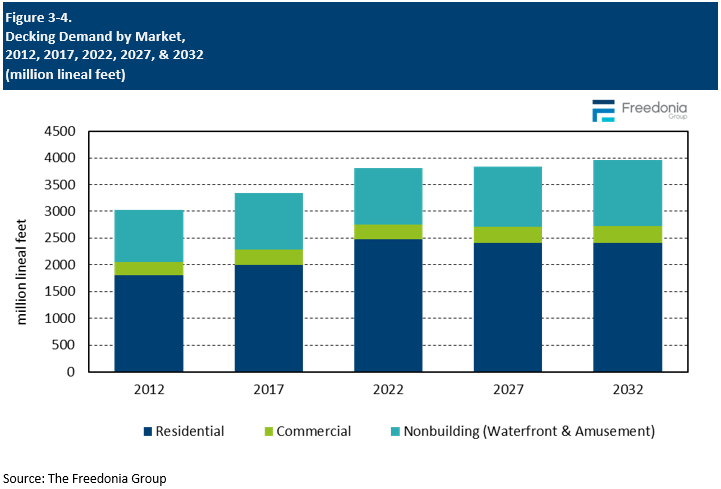
The residential market accounted for 65% of decking demand in area terms in 2022. Despite demand falling slightly in this market through 2027 from a high base, it will be sustained by:
-
an increase in the average size of decks
-
the large stock of wood decks in need of replacement
-
consumers being willing to increase their spending on outdoor living spaces
Demand for decking in the commercial market will be driven by rising construction of deck-intensive structures such as restaurants, hotels, and resorts, and other hospitality and entertainment venues. In many cases, renovations of these decks were delayed during the pandemic.
In the nonbuilding market, decking demand will be supported by the large stock of installed decks in places like parks, lakeshores, and marinas, some of which will require renovation. Further gains will be supported by design trends that call for more gathering and recreation in public parks and other facilities.
Installation Trends (Professional vs. DIY)
Decking products can either be installed by professionals or consumers.
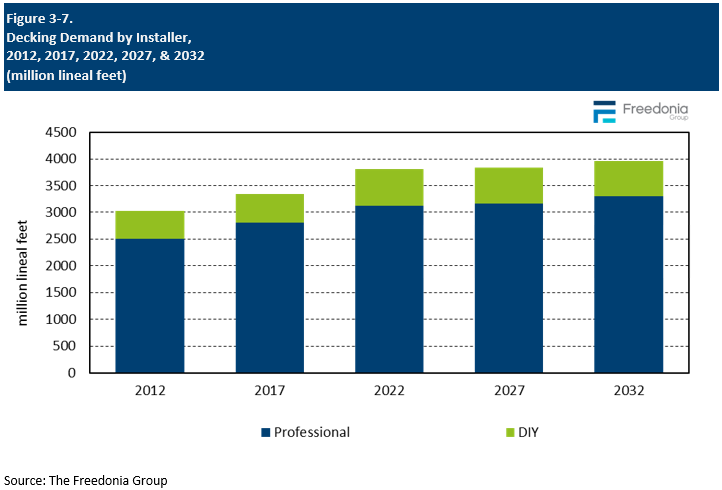
Professional installations dominate the decking market, accounting for 82% of the market in 2022. Given the complexity of deck work and safety and building code regulations in the commercial and nonbuilding markets, essentially all decks in these segments are installed by licensed, professional contractors.
DIY demand hit record high levels in 2020 and 2021; consumers significantly increased their levels of home improvement spending, and there was a severe shortage of skilled installers. Demand in the DIY segment is almost entirely limited to the residential market, particularly in the installation of treated-lumber decks (the material is much easier to use than wood-plastic composite, plastic, or metal). However, levels of DIY decking activity are expected to return to historical norms, precipitating a slight drop in DIY installations through 2027.
Pricing & Inflation
In this study, prices for decking materials are measured at the manufacturer’s level. Prices for decking products depend on a variety of factors, including:
-
raw material costs
-
production costs such as energy or labor
-
the mix of materials used in the production of decking products
-
product quality and design, including the use of coatings or other treatments
Tariffs can also affect the cost of raw materials, though this effect is somewhat limited due to the relatively small role imports play in the market.
Even within a specific type of decking material, prices can vary because of material quality, customer location, or product design. For example:
-
the price of capstock-coated wood-plastic composite and cellular PVC decking are higher than those for standard varieties of those materials
-
price variations in the nonwood segments stem from both material costs and differences in the characteristics of the decking itself
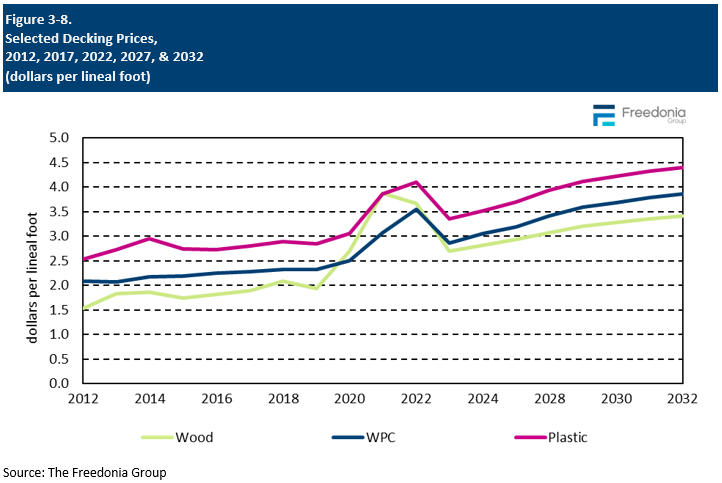
Prices for pressure-treated lumber, wood-plastic composite, and plastic decking products surged in 2020 and 2021 and either remained elevated or surged again in 2022. These price spikes were the result of:
-
pandemic-induced shutdowns causing domestic shortages
-
shortages in the Canadian market – a major source of US supply – which exacerbated price pressures, precipitating significant increases and volatility
-
prices for raw materials used in vinyl and wood-plastic composite decking soaring
However, the increasing use of materials such as wood-plastic composite or plastic will serve as a check to more significant overall price decreases.
Read the Blog: Alternative Decking Materials – Bamboo, Rubber, Glass?
Demand for decking in the US is forecast to remain stagnate at 3.8 billion lineal feet in 2027 (valued at $12.7 billion), restrained by slow growth in residential improvement and repair activity. Growth will also be limited by the large number of residential decks that were installed in 2020 and 2021, when the onset of the COVID-19 pandemic caused home renovations to soar – these decks are not likely to be replaced in the near future. Market value will also be negatively impacted by a significant moderation in wood prices from elevated levels during the pandemic.
Although the overall outlook is weak, growth will occur in some segments such as:
-
the commercial market, thanks to a strong rebound in the construction of hotels and resorts, where decks are frequently installed in outdoor gathering areas
-
the nonbuilding market, due to design trends that call for more gathering and recreation areas in public parks and other facilities
-
nonwood decking materials, which offer greater durability and require less maintenance than wood
Popularity of Wood-Plastic Composite Decking Continues to Rise
Wood-plastic composite is expected to capture a larger share of the US decking market through 2027, primarily at the expense of pressure-treated wood. Wood-plastic composite is gaining popularity because it is durable and maintains a wood-like appearance. Advances in product aesthetics and the use of capstock-coated decking – which provides enhanced protection against mold growth and premature degradation – will further boost wood-plastic composite decking demand.
Wood Decking Prices will Moderate from Record Highs
2020 and 2021 saw record high prices for lumber, especially pressure-treated varieties; the surge was caused by pandemic-induced shutdowns leading to severe shortages among domestic suppliers. Additionally, shortages in the Canadian market – which is a major source of US supply – exacerbated price pressures, precipitating significant increases and volatility. This resulted in a highly inflated value for the US decking market. For example, demand volume grew 12% from 2019 to 2021, while demand value increased by over 105%. This was primarily due to a 150% increase in the price of lumber during that period.
Prices in 2022 remained elevated, but began to stabilize as supply chains normalized and construction activity began to dampen. In 2023, prices for wood decking moderated significantly, and will remain below 2022 levels for the rest of the forecast period.
Historical Market Trends
Demand for decking tends to follow trends in building construction activity, especially in the residential renovation market. Other factors beyond the outlook for residential building construction that impact the number of decks and the overall market size include:
-
levels of disposable income, which impact consumers’ abilities to spend on discretionary items such as decks
-
residential lot size, which determines both the feasibility of having a deck and its ultimate size
-
trends in the popularity of outdoor living and dining
-
the outlook for spending at commercial establishments like restaurants and lodging, where decks are often key features
-
parks and other recreational areas purchasing structures such as freestanding decks, boardwalks and marinas.
-
the complexity of deck design, particularly when including the amount of accessories often required
-
changes in the mix of materials used and their relative pricing
-
overall levels of inflation and the costs of raw materials and labor
Prior to the pandemic, demand growth in lineal feet terms was fairly consistent over the historical period. However, demand grew quickly in 2020 as home improvement and repair activity surged. Growth in value terms has shown more volatility over the historical period due primarily to wood pricing. However, market value grew at record rates in 2020 and 2021 as wood shortages and high raw material costs sent prices skyrocketing.

Markets Overview
Markets for decking products can be divided into three main segments, each of which has both new and renovation demand:
-
residential
-
single-family
-
multifamily
-
manufactured housing
-
commercial, which includes decks installed near commercial buildings such as bars, restaurants, hotels, casinos, resorts, spas, and other entertainment facilities
-
nonbuilding, which is comprised of decks that are not attached to buildings:
-
The majority of these are in coastal or other waterfront areas and serve as boardwalks, docks, marinas, and piers.
-
Nonbuilding decks also include walkways and platforms at national, state, or local parks; amusement parks; water parks; and playgrounds. In many cases, decks in these applications are built through municipal or other government contracts.
-
The residential market accounted for 65% of decking demand in area terms in 2022. Despite demand falling slightly in this market through 2027 from a high base, it will be sustained by:
-
an increase in the average size of decks
-
the large stock of wood decks in need of replacement
-
consumers being willing to increase their spending on outdoor living spaces
Demand for decking in the commercial market will be driven by rising construction of deck-intensive structures such as restaurants, hotels, and resorts, and other hospitality and entertainment venues. In many cases, renovations of these decks were delayed during the pandemic.
In the nonbuilding market, decking demand will be supported by the large stock of installed decks in places like parks, lakeshores, and marinas, some of which will require renovation. Further gains will be supported by design trends that call for more gathering and recreation in public parks and other facilities.

Installation Trends (Professional vs. DIY)
Decking products can either be installed by professionals or consumers.
Professional installations dominate the decking market, accounting for 82% of the market in 2022. Given the complexity of deck work and safety and building code regulations in the commercial and nonbuilding markets, essentially all decks in these segments are installed by licensed, professional contractors.
DIY demand hit record high levels in 2020 and 2021; consumers significantly increased their levels of home improvement spending, and there was a severe shortage of skilled installers. Demand in the DIY segment is almost entirely limited to the residential market, particularly in the installation of treated-lumber decks (the material is much easier to use than wood-plastic composite, plastic, or metal). However, levels of DIY decking activity are expected to return to historical norms, precipitating a slight drop in DIY installations through 2027.

Pricing & Inflation
In this study, prices for decking materials are measured at the manufacturer’s level. Prices for decking products depend on a variety of factors, including:
-
raw material costs
-
production costs such as energy or labor
-
the mix of materials used in the production of decking products
-
product quality and design, including the use of coatings or other treatments
Tariffs can also affect the cost of raw materials, though this effect is somewhat limited due to the relatively small role imports play in the market.
Even within a specific type of decking material, prices can vary because of material quality, customer location, or product design. For example:
-
the price of capstock-coated wood-plastic composite and cellular PVC decking are higher than those for standard varieties of those materials
-
price variations in the nonwood segments stem from both material costs and differences in the characteristics of the decking itself
Prices for pressure-treated lumber, wood-plastic composite, and plastic decking products surged in 2020 and 2021 and either remained elevated or surged again in 2022. These price spikes were the result of:
-
pandemic-induced shutdowns causing domestic shortages
-
shortages in the Canadian market – a major source of US supply – which exacerbated price pressures, precipitating significant increases and volatility
-
prices for raw materials used in vinyl and wood-plastic composite decking soaring
However, the increasing use of materials such as wood-plastic composite or plastic will serve as a check to more significant overall price decreases.

- Executive Summary
- Figure 1-1. US Wood & Competitive Decking Market
- Short-Term Analysis
- Economic Forecast
- Table | Macroeconomic Indicators, 2020 – 2024
- Figure 2-1. Real GDP by Economic Sector, 2020 – 2023
- Short-Term Construction Outlook
- Table | Construction Expenditures, 2020 – 2024
- Decking Industry Short-Term Analysis
- Table | Annual Decking Demand by Material, 2020 – 2024
- Table | Annual Decking Demand by Market, 2020 - 2024
- Figure 2-2. Decking Volume & Value Demand Growth, 2020 - 2025
- Economic Forecast
- Overview
- Study Scope
- Figure 3-1. Decking: Product Examples
- Historical Market Trends
- Table | Decking Demand, 2012 - 2022
- Figure 3-2. Decking Demand, 2000 - 2022
- Decking Board vs. Railing & Accessory Trends
- Demand by Function
- Table | Decking Demand by Function, 2012, 2017, 2022, 2027, &2032
- Table | Annual Decking Demand by Function, 2019 - 2026
- Figure 3-3. Decking Demand by Function, 2012, 2017, 2022, 2027, &2032
- Decking Boards
- Table | Decking Board Demand by Material, 2012, 2017, 2022, 2027, &2032
- Table | Annual Decking Board Demand by Material, 2019 - 2026
- Railings & Accessories
- Table | Decking Railing & Accessories Demand by Type, 2012, 2017, 2022, 2027, &2032
- Table | Annual Decking Railing & Accessories Demand by Type, 2019 - 2026
- Demand by Function
- Markets Overview
- Table | Decking Demand by Market, 2012, 2017, 2022, 2027, &2032
- Table | Annual Decking Demand by Market, 2019 - 2026
- Figure 3-4. Decking Demand by Market, 2012, 2017, 2022, 2027, &2032
- Materials Trends
- Volume Demand (Lineal Feet)
- Table | Decking Demand by Material, 2012, 2017, 2022, 2027, &2032
- Table | Annual Decking Demand by Material, 2019 - 2026
- Figure 3-5. Decking Demand by Material, 2012, 2017, 2022, 2027, &2032
- Market Value
- Table | Decking Demand by Material, 2012, 2017, 2022, 2027, &2032
- Table | Annual Decking Demand by Material, 2019 - 2026
- Figure 3-6. Decking Demand by Material, 2012, 2017, 2022, 2027, &2032
- Volume Demand (Lineal Feet)
- Installation Trends (Professional vs. DIY)
- Table | Decking Demand by Installer, 2012, 2017, 2022, 2027, &2032
- Table | Annual Decking Demand by Installer, 2019 - 2026
- Figure 3-7. Decking Demand by Installer, 2012, 2017, 2022, 2027, &2032
- Decking Substructure Market Outlook
- Table | Decking Substructure Demand by Market, 2012, 2017, 2022, 2027, &2032
- Table | Annual Decking Substructure Demand by Market, 2019 - 2026
- Pricing & Inflation
- Table | Selected Decking Product Prices, 2012, 2017, 2022, 2027, &2032
- Table | Annual Selected Decking Prices, 2019 - 2026
- Figure 3-8. Selected Decking Prices, 2012, 2017, 2022, 2027, &2032
- Foreign Trade & Tariffs
- Study Scope
- Factors Impacting Decking Demand
- Construction Industry Outlook
- Table | Construction Expenditures, 2012, 2017, 2022, 2027, &2032
- Figure 4-1. Construction Expenditures, 2022 - 2027
- Lifecycle Costs
- Decking Installation & Labor Shortages
- Figure 4-2. Installation Information for Selected Decking Materials
- Building Codes
- Sustainability Initiatives
- Timber Harvesting & Forest Management
- Recycling & Use of Recycled Content
- Regulation of Wood Preservatives
- Style Trends & Aesthetics
- Construction Industry Outlook
- Wood Decking
- Scope & Product Description
- Figure 5-1. Wood Decking: Product Examples
- Demand Outlook: Real Growth & Market Value
- Table | Wood Decking Demand by Function, 2012, 2017, 2022, 2027, &2032
- Table | Annual Wood Decking Demand by Function, 2019 - 2026
- Types of Wood
- Demand by Wood Type
- Table | Wood Decking Demand by Type, 2012, 2017, 2022, 2027, &2032
- Table | Annual Wood Decking Demand by Type, 2019 - 2026
- Figure 5-2. Advantages of Selected Wood Decking Types
- Pressure-Treated Wood
- Table | Pressure-Treated Wood Decking Demand by Function & Species, 2012, 2017, 2022, 2027, &2032
- Table | Annual Pressure-Treated Wood Decking Demand by Function & Species, 2019 - 2026
- Redwood
- Table | Redwood Decking Demand by Function, 2012, 2017, 2022, 2027, &2032
- Table | Annual Redwood Decking Demand by Function, 2019 - 2026
- Cedar
- Table | Cedar Decking Demand by Function, 2012, 2017, 2022, 2027, &2032
- Table | Annual Cedar Decking Demand by Function, 2019 - 2026
- Tropical Hardwood & Other Wood Types
- Table | Tropical Hardwood & Other Wood Decking Demand by Function, 2012, 2017, 2022, 2027, &2032
- Table | Annual Tropical Hardwood & Other Wood Decking Demand by Function, 2019 - 2026
- Demand by Wood Type
- Market Trends
- Table | Wood Decking Demand by Market, 2012, 2017, 2022, 2027, &2032
- Table | Annual Wood Decking Demand by Market, 2019 - 2026
- New Build vs. Renovation
- Table | Wood Decking Demand: New Build vs. Renovation, 2012, 2017, 2022, 2027, &2032
- Table | Annual Wood Decking Demand: New Build vs. Renovation, 2019 - 2026
- Installation Methods
- Table | Wood Decking Demand by Installer, 2012, 2017, 2022, 2027, &2032
- Table | Annual Wood Decking Demand by Installer, 2019 - 2026
- Key Suppliers
- Scope & Product Description
- Composite Decking (Wood-Plastic)
- Scope & Product Description
- Figure 6-1. Composite Decking: Product Examples
- Demand Outlook: Real Growth & Market Value
- Table | Composite Decking Demand by Function, 2012, 2017, 2022, 2027, &2032
- Table | Annual Composite Decking Demand by Function, 2019 - 2026
- Demand by Plastic Type
- Table | Composite Decking Demand by Plastic Type, 2012, 2017, 2022, 2027, &2032
- Table | Annual Composite Decking Demand by Plastic Type, 2019 - 2026
- Market Trends
- Table | Composite Decking Demand by Market, 2012, 2017, 2022, 2027, &2032
- Table | Annual Composite Decking Demand by Market, 2019 - 2026
- New Build vs. Renovation
- Table | Composite Decking Demand: New Build vs. Renovation, 2012, 2017, 2022, 2027, &2032
- Table | Annual Composite Decking Demand: New Build vs. Renovation, 2019 - 2026
- Installation Methods
- Table | Composite Decking Demand by Installer, 2012, 2017, 2022, 2027, &2032
- Table | Annual Composite Decking Demand by Installer, 2019 - 2026
- Demand by Surface Treatment
- Table | Wood-Plastic Composite Decking Demand by Surface Treatment, 2012, 2017, 2022, 2027, &2032
- Table | Annual Wood-Plastic Composite Decking Demand by Surface Treatment, 2019 - 2026
- Key Suppliers
- Scope & Product Description
- Plastic, Metal, &Other Decking
- Plastic Decking
- Scope & Product Description
- Figure 7-1. Plastic Decking: Product Examples
- Demand Outlook: Real Growth & Market Value
- Table | Plastic Decking Demand by Function, 2012, 2017, 2022, 2027, &2032
- Table | Annual Plastic Decking Demand by Function, 2019 - 2026
- Demand by Plastic Type
- Table | Plastic Decking Demand by Plastic Resin, 2012, 2017, 2022, 2027, &2032
- Table | Annual Plastic Decking Demand by Plastic Resin, 2019 - 2026
- Vinyl
- Table | Vinyl Decking Demand by Function, 2012, 2017, 2022, 2027, &2032
- Table | Annual Vinyl Decking Demand by Function, 2019 - 2026
- Table | Vinyl Decking Demand by Type, 2012, 2017, 2022, 2027, &2032
- Table | Annual Vinyl Decking Demand by Type. 2019 - 2026
- Polyethylene
- Figure 7-2. Polyethylene Decking Demand, 2012 - 2022
- Other Plastics (Polypropylene & Other Plastics)
- Market Trends
- Table | Plastic Decking Demand by Market, 2012, 2017, 2022, 2027, &2032
- Table | Annual Plastic Decking Demand by Market, 2019 - 2026
- New Build vs. Renovation
- Table | Plastic Decking Demand by Application, 2012, 2017, 2022, 2027, &2032
- Table | Annual Plastic Decking Demand by Application, 2019 - 2026
- Installation Methods
- Table | Plastic Decking Demand by Installer, 2012, 2017, 2022, 2027, &2032
- Table | Annual Plastic Decking Demand by Installer, 2019 - 2026
- Key Suppliers
- Scope & Product Description
- Metal & Other Decking Materials
- Scope & Product Description
- Figure 7-3. Other Decking Materials: Product Examples
- Demand Outlook: Real Growth & Market Value
- Table | Other Decking Material Demand by Function, 2012, 2017, 2022, 2027, &2032
- Table | Annual Other Decking Material Demand by Function, 2019 - 2026
- Market Trends
- Table | Other Decking Material Demand by Market, 2012, 2017, 2022, 2027, &2032
- Table | Annual Other Decking Material Demand by Market, 2019 - 2026
- New Build vs. Renovation
- Table | Other Decking Material Demand by Application, 2012, 2017, 2022, 2027, &2032
- Table | Annual Other Decking Material Demand by Application, 2019 - 2026
- Installation Method
- Table | Other Decking Material Demand by Installer, 2012, 2017, 2022, 2027, &2032
- Table | Annual Other Decking Material Demand by Installer, 2019 - 2026
- Scope & Product Description
- Plastic Decking
- Residential Decking Market
- Market Scope
- Materials Trends
- Table | Residential Decking Demand by Material, 2012, 2017, 2022, 2027, &2032
- Table | Annual Residential Decking Demand by Material, 2019 - 2026
- Applications
- Demand by Application
- Table | Residential Decking Demand: New vs. Renovation, 2012, 2017, 2022, 2027, &2032
- Table | Annual Residential Decking Demand: New vs. Renovation, 2019 - 2026
- New Construction
- Table | New Residential Decking Demand by Material, 2012, 2017, 2022, 2027, &2032
- Table | Annual New Residential Decking Demand by Material, 2019 - 2026
- Renovation
- Table | Residential Renovation Decking Demand by Material, 2012, 2017, 2022, 2027, &2032
- Table | Annual Residential Renovation Decking Demand by Material, 2019 - 2026
- Demand by Application
- Housing Types
- Demand by Housing Type
- Table | Residential Decking Demand by Housing Type, 2012, 2017, 2022, 2027, &2032
- Table | Annual Residential Decking Demand by Housing Type, 2019 - 2026
- Single-Family Housing
- Table | Single-Family Housing Decking Demand by Application & Material, 2012, 2017, 2022, 2027, &2032
- Table | Annual Single-Family Housing Decking Demand by Application & Material, 2019 - 2026
- Multifamily Housing
- Table | Multifamily Housing Decking Demand by Application & Material, 2012, 2017, 2022, 2027, &2032
- Table | Annual Multifamily Housing Decking Demand by Application & Material, 2019 - 2026
- Manufactured Housing
- Table | Manufactured Housing Decking Demand by Application & Material, 2012, 2017, 2022, 2027, &2032
- Table | Annual Manufactured Housing Decking Demand by Application & Material, 2019 - 2026
- Demand by Housing Type
- Commercial Decking Market
- Market Scope
- Materials Trends
- Table | Commercial Decking Demand by Material, 2012, 2017, 2022, 2027, &2032
- Table | Annual Commercial Decking Demand by Material, 2019 - 2026
- Applications
- Demand by Application
- Table | Commercial Decking Demand: New vs. Renovation, 2012, 2017, 2022, 2027, &2032
- Table | Annual Commercial Decking Demand: New vs. Renovation, 2019 - 2026
- New Construction
- Table | New Commercial Decking Demand by Material, 2012, 2017, 2022, 2027, &2032
- Table | Annual New Commercial Decking Demand by Material, 2019 - 2026
- Renovation
- Table | Commercial Renovation & Repair Decking Demand by Material, 2012, 2017, 2022, 2027, &2032
- Table | Annual Commercial Renovation & Repair Decking Demand by Material, 2019 - 2026
- Demand by Application
- Building Types
- Table | Commercial Decking Demand by Building Type, 2012, 2017, 2022, 2027, &2032
- Table | Annual Commercial Decking Demand by Building Type, 2019 - 2026
- Nonbuilding (Waterfront & Amusement)
- Market Scope
- Materials Trends
- Table | Nonbuilding (Waterfront & Amusement) Decking Demand by Material, 2012, 2017, 2022, 2027, &2032
- Table | Annual Nonbuilding (Waterfront & Amusement) Decking Demand by Material, 2019 - 2026
- Applications
- Demand by Application
- Table | Nonbuilding (Waterfront & Amusement) Decking Demand: New vs. Renovation, 2012, 2017, 2022, 2027, &20
- Table | Annual Nonbuilding (Waterfront & Amusement) Decking Demand: New vs. Renovation, 2019 - 2026
- New Construction
- Table | New Nonbuilding (Waterfront & Amusement) Decking Demand by Material, 2012, 2017, 2022, 2027, &2032
- Table | Annual New Nonbuilding (Waterfront & Amusement) Decking Demand by Material, 2019 - 2026
- Renovation
- Table | Nonbuilding (Waterfront & Amusement) Renovation Decking Demand by Material, 2012, 2017, 2022, 2027,
- Table | Annual Nonbuilding (Waterfront & Amusement) Renovation Decking Demand by Material, 2019 - 2026
- Demand by Application
- Regions
- Demand by Region
- Table | Decking Demand by Region, 2012, 2017, 2022, 2027, &2032
- Table | Annual Decking Demand by Region, 2019 - 2026
- Figure 11-1. Decking Demand by Region, 2012, 2017, 2022, 2027, &2032
- Northeast
- Northeast: Demand by Market
- Table | Northeast: Decking Demand by Market, 2012, 2017, 2022, 2027, &2032
- Table | Northeast: Annual Decking Demand by Market, 2019 - 2026
- Northeast: Demand by Subregion (Northeast & Middle Atlantic)
- Table | Northeast: Decking Demand by Subregion, 2012, 2017, 2022, 2027, &2032
- Table | Northeast: Annual Decking Demand by Subregion, 2019 - 2026
- Northeast: Demand by Market
- Midwest
- Midwest: Demand by Market
- Table | Midwest: Decking Demand by Market, 2012, 2017, 2022, 2027, &2032
- Table | Midwest: Annual Decking Demand by Market, 2019 - 2026
- Midwest: Demand by Subregion (East North Central & West North Central)
- Table | Midwest: Decking Demand by Subregion, 2012, 2017, 2022, 2027, &2032
- Table | Midwest: Annual Decking Demand by Subregion, 2019 - 2026
- Midwest: Demand by Market
- South
- South: Demand by Market
- Table | South: Decking Demand by Market, 2012, 2017, 2022, 2027, &2032
- Table | South: Annual Decking Demand by Market, 2019 - 2026
- South: Demand by Subregion (South Atlantic, East South Central, West South Central)
- Table | South: Decking Demand by Subregion, 2012, 2017, 2022, 2027, &2032
- Table | South: Annual Decking Demand by Subregion, 2019 - 2026
- South: Demand by Market
- West
- West: Demand by Market
- Table | West: Decking Demand by Market, 2012, 2017, 2022, 2027, &2032
- Table | West: Annual Decking Demand by Market, 2019 - 2026
- West: Demand by Subregion (Mountain & Pacific)
- Table | West: Decking Demand by Subregion, 2012, 2017, 2022, 2027, &2032
- Table | West: Annual Decking Demand by Subregion, 2019 - 2026
- West: Demand by Market
- Demand by Region
- Industry Structure
- Key Findings & Industry Composition
- Table | US Decking Sales by Company, 2022
- Market Share
- Figure 12-1. US Decking Market Share by Company, 2022
- Figure 12-2. US Decking Market: Leading Supplier, 2022
- Figure 12-3. US Decking Market: Second Leading Supplier, 2022
- Figure 12-4. US Decking Market: Third Leading Supplier, 2022
- Figure 12-5. US Decking Market: Fourth Leading Supplier, 2022
- Figure 12-6. US Decking Market: Fifth Leading Supplier, 2022
- Mergers & Acquisitions
- Table | Selected Mergers & Acquisitions
- New Product Development
- Marketing
- Distribution
- List of Industry Participants
- Table | Selected Industry Participants
- Key Findings & Industry Composition
- Appendix
- Report Details
- Table | US Geographic Regions & Subregions
- Table | Relevant Industry Codes
- Table | Relevant HS Codes
- Definitions
- Abbreviations
- Table | Abbreviations & Acronyms Used in Study
- Freedonia Methodology
- Study-Specific Methodology
- Data Changes from Previous Version
- Sources
- Associations & Agencies
- Related Studies & Reports
- Macroeconomic Assumptions
- Economic Environment
- Table | Macroeconomic Indicators, 2012, 2017, 2022, 2027, &2032
- Demographic Trends
- Table | Population & Households, 2012, 2017, 2022, 2027, &2032
- Construction Expenditures
- Table | Construction Expenditures, 2012, 2017, 2022, 2027, &2032
- Building Construction
- Table | Building Construction Expenditures, 2012, 2017, 2022, 2027, &2032
- Residential Building Construction
- Table | Residential Building Construction Expenditures, 2012, 2017, 2022, 2027, &2032
- Residential Improvements & Repairs
- Table | Residential Improvement & Repair Expenditures, 2012, 2017, 2022, 2027, &2032
- Commercial Building Construction
- Table | Commercial Building Construction Expenditures, 2012, 2017, 2022, 2027, &2032
- Commercial Building Improvements & Repairs
- Table | Commercial Building Improvement & Repair Expenditures, 2012, 2017, 2022, 2027, &2032
- Nonbuilding Construction Expenditures
- Table | Nonbuilding Construction Expenditures, 2012, 2017, 2022, 2027, &2032
- Economic Environment
- Report Details
Style and aesthetics are key drivers of purchasing decisions, as building owners increasingly look for products that provide their desired aesthetics.
Wood decking can be made of several lumber species, including pressure-treated pine and fir, redwood, cedar, and tropical hardwoods.
Pressure-treated wood is the most common decking material, accounting for 75% of wood decking demand and 58% of total decking demand by volume in 2022.
In 2022, the five leading suppliers to the US decking market included Trex, Universal Forest Products, AZEK, Weyerhaeuser, and Fiberon.