Pet food shoppers are paying closer attention to price, but affordability alone does not determine which products reach their carts or remain in their pets’ bowls.
Packaged Facts projects that US retail sales of dog and cat food will surpass $57 billion in 2026, representing an increase of 4% from 2025. Renewed inflation is contributing to dollar growth, but it is also intensifying the financial pressure on pet-owning households.
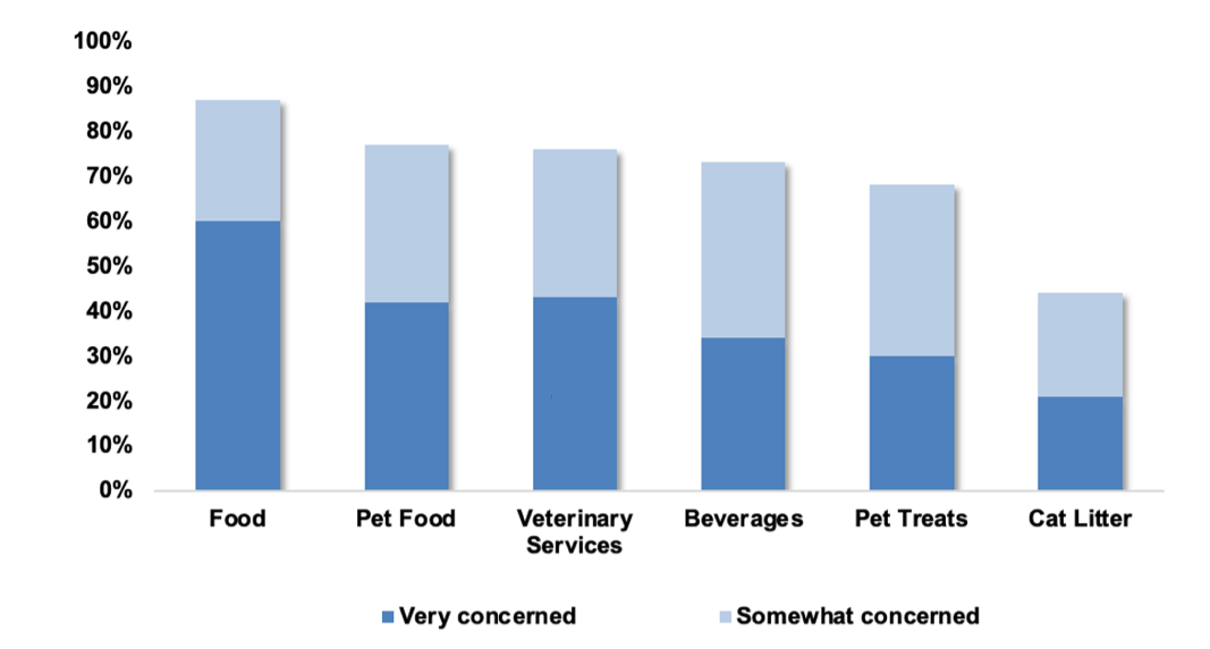
In Packaged Facts’ August 2026 Survey of Pet Owners, 77% of pet owners expressed concern about rising pet food prices, up from 66% in September 2025.
Level of Concern About Rising Prices in Consumer Categories, August 2026
Percent of pet owners. Source: Packaged Facts August 2026 Surveys of Pet Owners.
These concerns are prompting consumers to reconsider where they shop, which brands they buy, and how they feed their pets. Yet the value equation remains considerably more complicated than finding the lowest-priced product.
Pets Have the Final Say
When dog and cat owners were asked which factors had affected their pet food purchase decisions during the previous 12 months, the most common answer was whether their pet would eat and enjoy the food.
Cat owners were especially likely to emphasize palatability, reflecting cats’ reputation for being selective about flavor, aroma, texture, and familiarity. Here is a fundamental challenge for pet food marketers: a lower-priced food offers little value if the pet refuses to eat it, while a premium product may retain customers if it consistently delivers on taste, nutrition, and convenience.
As such, palatability is more than a product-development consideration. It is a customer-acquisition and retention tool. For pet owners considering other options, sampling programs, trial-size packages, introductory offers, and gradual-transition guidance can reduce the perceived risk of trying a new food.
Once a product has been accepted by the pet and incorporated into the household routine, consistent quality and reliable availability can help turn that trial into a longer-term relationship.
Health Benefits Still Support Premiumization
Even as pet owners become more price-conscious, many remain willing to invest in foods that offer meaningful health benefits. Pet food is widely viewed as an important part of preventive pet care, and consumers continue to show interest in products positioned around digestive health, immune support, skin and coat condition, mobility, weight management, healthy aging, and other specific concerns, despite the higher cost involved.
In the functional food market, credibility plays an important role in pet owner acceptance of product claims. Broad wellness claims may not be enough to justify a higher price when household budgets are strained. Marketers need to clarify what a product does, why its ingredients or formulation matter, and how it fits into the pet’s overall health and wellness regimen.
While science-based positioning, veterinary expertise, transparent ingredient information, and clearly communicated nutritional benefits can strengthen the value proposition, these attributes must still be paired with palatability and convenience. A food that makes a compelling nutritional promise but is difficult to purchase, serve, store, or persuade the pet to eat may struggle to retain customers.
Flexible Feeding Creates a Middle Ground
The expansion of fresh, frozen, refrigerated, freeze-dried, air-dried, and other alternative formats has raised consumer expectations for pet food quality and variety. At the same time, feeding these products exclusively may be impractical for many households, particularly those with large dogs or multiple pets.
Flexible feeding offers a middle ground. Owners can combine conventional kibble with wet, fresh, freeze-dried, or other complete and balanced foods, adding variety, moisture, texture, or perceived nutritional benefits without assuming the full cost of an exclusively premium diet.
Toppers and mixers can serve a similar purpose when they are clearly positioned as supplemental products.
For marketers, this approach expands the potential customer base beyond households able to afford full-time premium feeding. Smaller packages, portion-controlled formats, flexible meal plans, and products designed specifically for mixed feeding can help consumers participate in premium trends while managing their budgets.
Private Label and Promotions Gain Relevance
Heightened price sensitivity also creates opportunities for retailer-owned brands. Private label pet foods increasingly extend beyond economy positioning, offering premium ingredients, functional benefits, and specialized formulations at prices that can be lower than those of national brands.
National brands, meanwhile, do not necessarily need to compete primarily through permanent price reductions. Loyalty rewards, autoship discounts, targeted promotions, and trial offers can help consumers manage immediate costs without weakening the brand’s broader positioning.
The most effective strategies will recognize that different households define affordability differently. Some shoppers may want the lowest cost per serving, while others may prioritize package price, perceived health benefits, or the confidence that their pet will reliably eat the product.
Communicating the Complete Value Proposition
Pet food value is ultimately a combination of price, palatability, nutrition, trust, convenience, and suitability for the individual pet. Economic uncertainty is making consumers more deliberate, but it is not eliminating their interest in quality or innovation.
Brands that rely solely on premium imagery or generalized health claims may find it harder to defend higher prices. Those that clearly demonstrate what their products deliver, and provide practical ways for consumers to incorporate those benefits into their budgets, will be better positioned to attract and retain increasingly selective pet food shoppers.
Shannon Landry is a veteran pet market research analyst with a wide range of experience identifying and analyzing industry-specific marketing and consumer trends and putting them in context of broader market dynamics.
About Packaged Facts
Packaged Facts, a division of the Freedonia Group, publishes market intelligence on a wide range of consumer market topics, including consumer demographics and shopper insights, consumer financial products and services, consumer goods and retailing, and pet products and services. Packaged Facts also offers a full range of custom research services. Reports can be purchased at freedoniagroup.com/packaged-facts.
For more essential insights from Packaged Facts be sure to follow us on LinkedIn.