US Metal Roofing Market – Industry Research Report
This Freedonia industry study analyzes the $5.3 billion US market for metal roofing. It presents historical demand data (2011, 2016, and 2021) and forecasts (2026 and 2031) as well as annual data for years 2018-2025.
Free Sample Report
Request a free sample of this report and our team will email it to you.
Report Overview
Learn more about benefits and challenges in the metal roofing market.
-
Metal roofing is used more evenly in residential and commercial applications.
-
Metal roofing is making high gains in the residential market.
 It presents historical demand data (2011, 2016, and 2021) and forecasts (2026 and 2031) as well as annual data for years 2018-2025. Unit demand and value demand data is shown for roofing by product type (standing seam, metal shingle, metal shake, metal tile, corrugated panel) and market (new and reroofing demand in both residential and commercial buildings). The study also evaluates company market share and competitive analysis on industry competitors including BlueScope Steel, Carlisle SynTec, Cornerstone, Elevate, Kingspan, and Nucor.
Featuring 124 tables and 26 figures – available in Excel and Powerpoint! Learn More
This report includes data from 2011-2031 in 5 year intervals and tables featuring year-by-year data for 2018-2025.
US demand for metal roofing is forecast to grow at an annual average rate of 0.7% to 38.07 million squares in 2026. Gains will be restrained by the high levels of metal roofing demand in 2020 and 2021 that were attributable to increased housing construction and home renovations and several severe weather events. Market value will have a more positive outlook because:
- metal prices will remain well above 2021 levels following a spike in 2022
- use of less expensive metal products – like corrugated panels – is either slowing or outright declining while metal roofing products with enhanced performance and aesthetics become increasingly popular
Standing Seam Will See Above Average Gains in the Residential Market
Standing seam roofing will continue to capture a growing share of metal roofing demand as more homeowners chose to replace their asphalt shingle roofs with metal. Standing seam metal roofing is becoming favored by homeowners due to its:
- resistance to uplift and leads, making it useful for homes located in storm-prone areas
- ability to improve energy efficiency either through its cool roofing properties or when attached to insulation
Metal Shingles, Shakes, & Tiles Will Grow at the Fastest Rate of Any Metal Roofing Product
In the commercial and residential markets alike, metal shingles, shakes, and tiles see the fastest rate of growth:
- In residential applications, growing demand for durable roofing products that are aesthetically pleasing and blend in with traditional home materials will be a driver.
- In the commercial market, the lower prices of metal shingles, shakes, and tiles (compared to slate) will drive gains, specifically among institutional buildings like religious and university facilities.
Severe Weather & Warm Climate Create Demand for Metal Roofing in the South
The South will offer the best opportunities for metal roofing of any region, due to:
- the frequency of severe weather, such as hurricanes, which produce strong winds in the region – homeowner demand for wind- and heavy rain-resistant roofing supports demand for metal roofing products, especially in coastal regions
- the region’s hot summer climate that creates demand for cool roofing products such as metal roofing, which reflects sun rays and lowers the amount of heat absorbed by the roof, thus reducing energy costs
Historical Market Trends
Demand shifts for metal roofing can vary from year to year and are determined by numerous factors, primarily those related to building construction activity. They include:
- levels of housing starts, particularly in the single-family housing segment
- the size and age of the US housing stock
- interest rates – low interest rates may encourage home and business owners to take out lines of credit often used to fund roof repair and replacement projects
- the number and types of commercial buildings erected or repaired in any given year
- the type of roof (e.g., steep-slope or low-slope) installed on a structure that will be repaired or replaced
- the types of roofing materials most often specified by contractors and other consumers in a particular region of the US
- the roofing materials originally installed on the structure
The US has a significant number of homes and businesses with roofs that are at or near the end of their life expectancies. Thus, age-related reroofing is the most significant driver of metal roofing demand in the US.
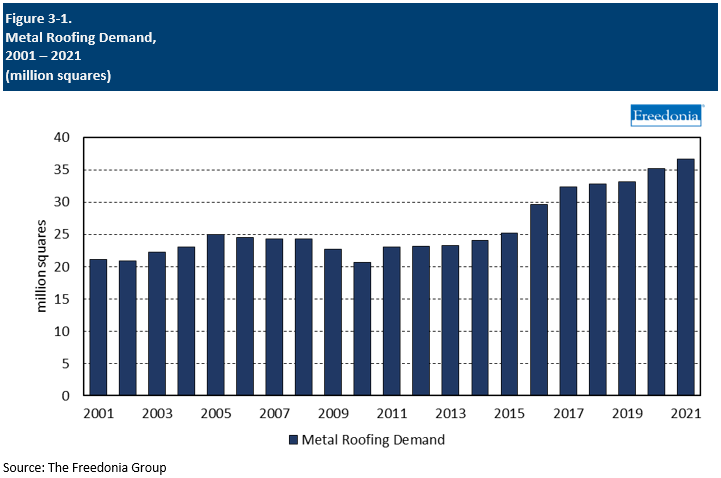
Metal roofing demand advanced at a healthy rate in 2020, a marked contrast to the weaker demand growth of 2018 and 2019. This growth was spurred by multiple outbreaks of severe weather across the US and an increase in residential roofing demand precipitated by the COVID-19 pandemic. Demand increased again in 2021 despite the continued restraint from supply chain issues and increased inflation.
Supply & Demand
Foreign Trade
Foreign trade plays a very minor role in the US metal roofing market; imports accounted for slightly more than 2% of US sales in 2021, and exports of metal roofing accounted for under 2% of US industry shipments that year.
Trade in metal roofing materials between the US and foreign countries is primarily limited the weight and bulk of metal roofing, which make shipment across long distances costly and impractical.
The US’ main trading partner in metal roofing is Canada, which accounts for about 65% of imports and exports in any given year because:
- Structures in the two countries share similar designs and are constructed in the same manner with similar materials.
- The weather and climate patterns in the two countries are similar in the northern half of the US and Canada – including harsh winters with heavy snowfalls, short but hot summers, and periodic instances of tornadoes, hailstorms, and other severe weather events.
- Roofing designed for use in the northern half of the US meets Canadian building code requirements, as do Canadian roofing materials marketed to US consumers.
- The proximity of the two countries means that it is sometimes a shorter distance to ship to Canada than to other parts of the US.
Other countries that supply metal roofing the US include China and South Korea.
Product Overview
Area Demand by Product
US demand for metal roofing is expected to rise at an average annual pace of 0.7% to 38.07 million squares in 2026, with growth restrained by:
- declining housing starts
- surging home repair and reroofing activity in 2020 and 2021, as these roofs will not need to be repaired or replaced over the next five years
However, metal roofing is one of the few major roofing materials that will increase in demand during the forecast period, supported by:
- continuing interest in the use of metal roofing as a weather-resistant alternative to such products as asphalt shingles and roofing membranes
- homeowner interest in installing metal roofing to create a more unique exterior appearance
- rising installations of prefabricated metal buildings in commercial construction applications
- the perception of metal roofing products as environmentally friendly materials:
- Metal roofing can serve as a cool roofing material that reduces a building’s energy consumption and lowers utility bills.
- Metal has a long product lifespan and can be recycled after its useful lifespan, diverting waste materials from landfills.
Standing seam roofing will continue accounting for the largest share of metal roofing demand, supported by its high performance in leak and wind protection and ability to be used as both low- and steep-slope roofing. However, metal shingles, shakes, and tiles will see faster growth going forward, boosted by their increasing residential use as homeowners seek more durable alternatives to asphalt shingles.
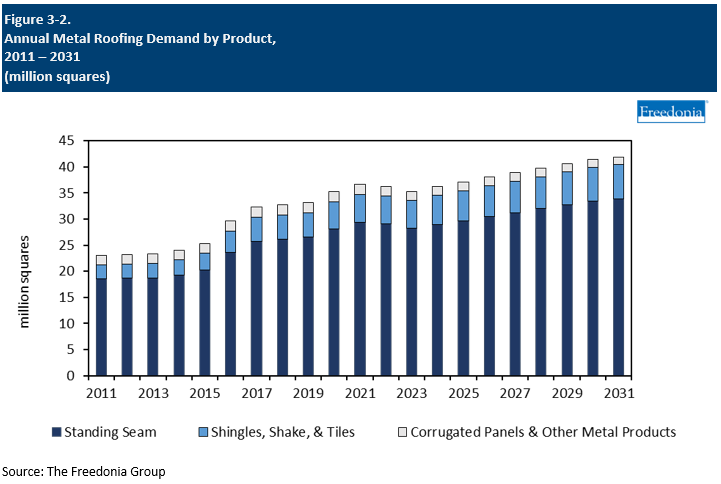
US demand for metal roofing is forecast to grow at an annual average rate of 0.7% to 38.07 million squares in 2026. Gains will be restrained by the high levels of metal roofing demand in 2020 and 2021 that were attributable to increased housing construction and home renovations and several severe weather events. Market value will have a more positive outlook because:
- metal prices will remain well above 2021 levels following a spike in 2022
- use of less expensive metal products – like corrugated panels – is either slowing or outright declining while metal roofing products with enhanced performance and aesthetics become increasingly popular
Standing Seam Will See Above Average Gains in the Residential Market
Standing seam roofing will continue to capture a growing share of metal roofing demand as more homeowners chose to replace their asphalt shingle roofs with metal. Standing seam metal roofing is becoming favored by homeowners due to its:
- resistance to uplift and leads, making it useful for homes located in storm-prone areas
- ability to improve energy efficiency either through its cool roofing properties or when attached to insulation
Metal Shingles, Shakes, & Tiles Will Grow at the Fastest Rate of Any Metal Roofing Product
In the commercial and residential markets alike, metal shingles, shakes, and tiles see the fastest rate of growth:
- In residential applications, growing demand for durable roofing products that are aesthetically pleasing and blend in with traditional home materials will be a driver.
- In the commercial market, the lower prices of metal shingles, shakes, and tiles (compared to slate) will drive gains, specifically among institutional buildings like religious and university facilities.
Severe Weather & Warm Climate Create Demand for Metal Roofing in the South
The South will offer the best opportunities for metal roofing of any region, due to:
- the frequency of severe weather, such as hurricanes, which produce strong winds in the region – homeowner demand for wind- and heavy rain-resistant roofing supports demand for metal roofing products, especially in coastal regions
- the region’s hot summer climate that creates demand for cool roofing products such as metal roofing, which reflects sun rays and lowers the amount of heat absorbed by the roof, thus reducing energy costs
Historical Market Trends
Demand shifts for metal roofing can vary from year to year and are determined by numerous factors, primarily those related to building construction activity. They include:
- levels of housing starts, particularly in the single-family housing segment
- the size and age of the US housing stock
- interest rates – low interest rates may encourage home and business owners to take out lines of credit often used to fund roof repair and replacement projects
- the number and types of commercial buildings erected or repaired in any given year
- the type of roof (e.g., steep-slope or low-slope) installed on a structure that will be repaired or replaced
- the types of roofing materials most often specified by contractors and other consumers in a particular region of the US
- the roofing materials originally installed on the structure
The US has a significant number of homes and businesses with roofs that are at or near the end of their life expectancies. Thus, age-related reroofing is the most significant driver of metal roofing demand in the US.
Metal roofing demand advanced at a healthy rate in 2020, a marked contrast to the weaker demand growth of 2018 and 2019. This growth was spurred by multiple outbreaks of severe weather across the US and an increase in residential roofing demand precipitated by the COVID-19 pandemic. Demand increased again in 2021 despite the continued restraint from supply chain issues and increased inflation.

Supply & Demand
Foreign Trade
Foreign trade plays a very minor role in the US metal roofing market; imports accounted for slightly more than 2% of US sales in 2021, and exports of metal roofing accounted for under 2% of US industry shipments that year.
Trade in metal roofing materials between the US and foreign countries is primarily limited the weight and bulk of metal roofing, which make shipment across long distances costly and impractical.
The US’ main trading partner in metal roofing is Canada, which accounts for about 65% of imports and exports in any given year because:
- Structures in the two countries share similar designs and are constructed in the same manner with similar materials.
- The weather and climate patterns in the two countries are similar in the northern half of the US and Canada – including harsh winters with heavy snowfalls, short but hot summers, and periodic instances of tornadoes, hailstorms, and other severe weather events.
- Roofing designed for use in the northern half of the US meets Canadian building code requirements, as do Canadian roofing materials marketed to US consumers.
- The proximity of the two countries means that it is sometimes a shorter distance to ship to Canada than to other parts of the US.
Other countries that supply metal roofing the US include China and South Korea.
Product Overview
Area Demand by Product
US demand for metal roofing is expected to rise at an average annual pace of 0.7% to 38.07 million squares in 2026, with growth restrained by:
- declining housing starts
- surging home repair and reroofing activity in 2020 and 2021, as these roofs will not need to be repaired or replaced over the next five years
However, metal roofing is one of the few major roofing materials that will increase in demand during the forecast period, supported by:
- continuing interest in the use of metal roofing as a weather-resistant alternative to such products as asphalt shingles and roofing membranes
- homeowner interest in installing metal roofing to create a more unique exterior appearance
- rising installations of prefabricated metal buildings in commercial construction applications
- the perception of metal roofing products as environmentally friendly materials:
- Metal roofing can serve as a cool roofing material that reduces a building’s energy consumption and lowers utility bills.
- Metal has a long product lifespan and can be recycled after its useful lifespan, diverting waste materials from landfills.
Standing seam roofing will continue accounting for the largest share of metal roofing demand, supported by its high performance in leak and wind protection and ability to be used as both low- and steep-slope roofing. However, metal shingles, shakes, and tiles will see faster growth going forward, boosted by their increasing residential use as homeowners seek more durable alternatives to asphalt shingles.

- Executive Summary
- Figure 1-1 Metal Roofing Market Outlook
- About This Report
- Report Details
- Study Scope & Product Description
- Impact of COVID-19 Pandemic
- Table | Annual Metal Roofing Demand by Product, 2019 – 2023
- Table | Annual Metal Roofing Demand by Market, 2019 – 2023
- Figure 2-1. Annual Metal Roofing Demand Volume & Value Growth, 2018 – 2024
- Overview
- Historical Market Trends
- Table | Metal Roofing Demand, 2011 – 2021
- Figure 3-1. Metal Roofing Demand, 2001 – 2021
- Supply & Demand
- Production
- Table | Metal Roofing Supply & Demand, 2011, 2016, 2021, 2026, &2031
- Table | Annual Metal Roofing Supply & Demand, 2018 – 2025
- Foreign Trade
- Production
- Product Overview
- Area Demand by Product
- Table | Metal Roofing Demand by Product, 2011, 2016, 2021, 2026, &2031
- Table | Annual Metal Roofing Demand by Product, 2018 – 2025
- Figure 3-2. Annual Metal Roofing Demand by Product, 2011 – 2031
- Market Value by Product
- Table | Metal Roofing Demand by Product, 2011, 2016, 2021, 2026, &2031
- Table | Annual Metal Roofing Demand by Product, 2018 – 2025
- Figure 3-3. Annual Metal Roofing Demand by Product, 2011 – 2031
- Area Demand by Product
- Markets Overview
- Demand by Market
- Table | Metal Roofing Demand by Market, 2011, 2016, 2021, 2026, &2031
- Table | Annual Metal Roofing Demand by Market, 2018 – 2025
- Figure 3-4. Annual Metal Roofing Demand by Market, 2011 – 2031
- Commercial Buildings
- Table | Commercial Metal Roofing Demand by Product, 2011, 2016, 2021, 2026, &2031
- Table | Annual Commercial Metal Roofing Demand by Product, 2018 – 2025
- Figure 3-5. Annual Commercial Metal Roofing Demand by Product, 2011 – 2031
- Residential Buildings
- Table | Residential Metal Roofing Demand by Product, 2011, 2016, 2021, 2026, &2031
- Table | Annual Residential Metal Roofing Demand by Product, 2018 – 2025
- Figure 3-6. Annual Residential Metal Roofing Demand by Product, 2011 – 2031
- Demand by Market
- Applications
- Demand by Application
- Table | Metal Roofing Demand by Application, 2011, 2016, 2021, 2026, &2031
- Table | Annual Metal Roofing Demand by Application, 2018 – 2025
- Reroofing
- Table | Metal Roofing Demand in Reroofing Applications, 2011, 2016, 2021, 2026, &2031
- Table | Annual Metal Roofing Demand in Reroofing Applications, 2018 – 2025
- New Roofing
- Table | Metal Roofing Demand in New Construction Applications, 2011, 2016, 2021, 2026, &2031
- Table | Annual Metal Roofing Demand in New Construction Applications, 2018 – 2025
- Demand by Application
- Pricing Trends
- Table | Metal Roofing Pricing by Product, 2011, 2016, 2021, 2026, &2031
- Table | Annual Metal Roofing Pricing by Product, 2018 – 2025
- Figure 3-7. Metal Roofing Pricing by Product, 2011 – 2031
- Competitive Products
- Figure 3-8. Comparative Growth: Metal Roofing & Competitive Products, 2021 – 2026
- Historical Market Trends
- Factors Impacting Roofing Demand
- Building Construction Activity
- Table | Building Construction Expenditures, 2011, 2016, 2021, 2026, &2031
- Table | Annual Building Construction Expenditures, 2018 – 2025
- Age of Building Stock
- Table | Residential & Commercial Roofing Stock by Building Type, 2011, 2016, 2021, 2026, &2031
- Table | Annual Residential & Commercial Roofing Stock by Building Type, 2018 – 2025
- Weather & Climate
- Figure 4-1. Shares of Weather-Related Reroofing Demand, 2007 – 2021
- Low-Slope vs. Steep-Slope
- Table | Metal Roofing Demand by Slope, 2011, 2016, 2021, 2026, &2031
- Table | Annual Metal Roofing Demand by Slope, 2018 – 2025
- Figure 4-2. Annual Metal Roofing Demand by Slope, 2011 – 2031
- Installation Issues
- Comparative Installation Costs
- Table | Selected Roofing Product Installation Costs, 2011, 2016, 2021, 2026, &2031
- Table | Annual Selected Roofing Product Installation Costs, 2018 – 2025
- Availability of Trained Labor
- Jobsite Safety
- Comparative Installation Costs
- Evolving Building Codes
- Adoption of Roof Maintenance Programs
- Insurer Requirements
- Sustainability Initiatives
- Recycling & Recycled Content
- Cool Roofing
- Energy Efficiency (LEED & Energy Star)
- Product Lifespans
- Building Construction Activity
- Standing Seam Metal Roofing
- Scope & Product Description
- Figure 5-1. Standing Seam Metal Roofing: Product Examples
- Product Trends
- Markets
- Table | Standing Seam Metal Roofing Demand by Market, 2011, 2016, 2021, 2026, &2031
- Table | Annual Standing Seam Metal Roofing Demand by Market, 2018 – 2025
- Figure 5-2. Annual Standing Seam Metal Roofing Demand by Market, 2011 – 2031
- Applications
- Table | Standing Seam Metal Roofing Demand by Application, 2011, 2016, 2021, 2026, &2031
- Table | Annual Standing Seam Metal Roofing Demand by Application, 2018 – 2025
- Figure 5-3. Annual Standing Seam Metal Roofing Demand by Application, 2011 – 2031
- Demand by US Region
- Table | Standing Seam Metal Roofing Demand by Region, 2011, 2016, 2021, 2026, &2031
- Table | Annual Standing Seam Metal Roofing Demand by Region, 2018 – 2025
- Scope & Product Description
- Metal Shingles, Shakes, &Tiles
- Scope & Product Description
- Figure 6-1. Metal Shingle, Shake, &Tile Roofing: Product Examples
- Product Trends
- Table | Metal Shingle, Shake, &Tile Roofing Demand by Product, 2011, 2016, 2021, 2026, &2031
- Table | Annual Metal Shingle, Shake, &Tile Roofing Demand by Product, 2018 – 2025
- Markets
- Table | Metal Shingle, Shake, &Tile Roofing Demand by Market, 2011, 2016, 2021, 2026, &2031
- Table | Annual Metal Shingle, Shake, &Tile Roofing Demand by Market, 2018 – 2025
- Figure 6-2. Annual Metal Shingle, Shake, &Tile Roofing Demand by Market, 2011 – 2031
- Applications
- Table | Metal Shingle, Shake, &Tile Roofing Demand by Application, 2011, 2016, 2021, 2026, &2031
- Table | Annual Metal Shingle, Shake, &Tile Roofing Demand by Application, 2018 – 2025
- Figure 6-3. Metal Shingle, Shake, &Tile Roofing Demand by Application, 2011 – 2031
- Demand by US Region
- Table | Metal Shingle, Shake, &Tile Roofing Demand by Region, 2011, 2016, 2021, 2026, &2031
- Table | Annual Metal Shingle, Shake, &Tile Roofing Demand by Region, 2018 – 2025
- Scope & Product Description
- Corrugated Panels & Other Metal Roofing
- Scope & Product Description
- Figure 7-1. Corrugated Panels & Other Metal Roofing: Product Examples
- Product Trends
- Markets
- Table | Corrugated Panel & Other Metal Roofing Demand by Market, 2011, 2016, 2021, 2026, &2031
- Table | Annual Corrugated Panel & Other Metal Roofing Demand by Market, 2018 – 2025
- Figure 7-2. Annual Corrugated Panel & Other Metal Roofing Demand by Market, 2011 – 2031
- Applications
- Table | Corrugated Panel & Other Metal Roofing Demand by Application,2011, 2016, 2021, 2026, &2031
- Table | Annual Corrugated Panel & Other Metal Roofing Demand by Application, 2018 – 2025
- Figure 7-3. Annual Corrugated Panel & Other Metal Roofing Demand by Application, 2011 – 2031
- Demand by US Region
- Table | Corrugated Panel & Other Metal Roofing Demand by Region, 2011, 2016, 2021, 2026, &2031
- Table | Annual Corrugated Panel & Other Metal Roofing Demand by Region 2018 – 2025
- Scope & Product Description
- Commercial Market
- Market Scope
- Applications
- Demand by Application
- Table | Commercial Metal Roofing Demand by Application, 2011, 2016, 2021, 2026, &2031
- Table | Annual Commercial Metal Roofing Demand by Application, 2018 – 2025
- Figure 8-1. Annual Commercial Metal Roofing Demand by Application, 2011 – 2031
- Reroofing
- Table | Commercial Metal Roofing Demand in Reroofing Applications by Product, 2011, 2016, 2021, 2026, &2031
- Table | Annual Commercial Metal Roofing Demand in Reroofing Applications by Product, 2018 – 2025
- New Construction
- Table | Commercial Metal Roofing Demand in New Construction Applications by Product, 2011, 2016, 2021, 2026,
- Table | Annual Commercial Metal Roofing Demand in New Construction Applications by Product, 2018 – 2025
- Demand by Application
- Building Type
- Demand by Building Type
- Table | Commercial Metal Roofing Demand by Building Type, 2011, 2016, 2021, 2026, &2031
- Table | Annual Commercial Metal Roofing Demand by Building Type, 2018 – 2025
- Office, Retail, &Lodging
- Table | Office, Retail, &Lodging Buildings Demand by Application, 2011, 2016, 2021, 2026, &2031
- Table | Annual Office, Retail, &Lodging Buildings Demand by Application, 2018 – 2025
- Institutional
- Table | Institutional Building Demand by Application, 2011, 2016, 2021, 2026, &2031
- Table | Annual Institutional Building Demand by Application, 2018 – 2025
- Industrial
- Table | Industrial Building Demand by Application, 2011, 2016, 2021, 2026, &2031
- Table | Annual Industrial Building Demand by Application, 2018 – 2025
- Other Commercial Buildings
- Table | Transportation & Other Commercial Building Demand by Application, 2011, 2016, 2021, 2026, &2031
- Table | Annual Transportation & Other Commercial Building Demand by Application, 2018 – 2025
- Demand by Building Type
- Product Trends
- Table | Commercial Metal Roofing Demand by Product, 2011, 2016, 2021, 2026, &2031
- Table | Annual Commercial Metal Roofing Demand by Product, 2018 – 2025
- Demand by US Region
- Table | Commercial Metal Roofing Demand by Region, 2011, 2016, 2021, 2026, &2031
- Table | Annual Commercial Metal Roofing Demand by Region, 2018 – 2025
- Residential Market
- Market Scope
- Applications
- Demand by Application
- Table | Residential Metal Roofing Demand by Application, 2011, 2016, 2021, 2026, &2031
- Table | Annual Residential Metal Roofing Demand by Application, 2018 – 2025
- Figure 9-1. Annual Residential Metal Roofing Demand by Application, 2011 – 2031
- Reroofing
- Table | Residential Metal Roofing Demand in Reroofing Applications by Product, 2011, 2016, 2021, 2026, &2031
- Table | Annual Residential Metal Roofing Demand in Reroofing Applications by Product, 2018 – 2025
- New Construction
- Table | Residential Metal Roofing Demand in New Construction Applications by Product, 2011, 2016, 2021, 2026
- Table | Annual Residential Metal Roofing Demand in New Construction Applications by Product, 2018 – 2025
- Demand by Application
- Housing Type
- Demand by Housing Type
- Table | Residential Metal Roofing Demand by Housing Type, 2011, 2016, 2021, 2026, &2031
- Table | Annual Residential Metal Roofing Demand by Housing Type, 2018 – 2025
- Single-Family Housing
- Multifamily Housing
- Manufactured Housing
- Demand by Housing Type
- Product Trends
- Table | Residential Metal Roofing Demand by Product, 2011, 2016, 2021, 2026, &2031
- Table | Annual Residential Metal Roofing Demand by Product, 2018 – 2025
- Demand by Region
- Table | Residential Metal Roofing Demand by Region, 2011, 2016, 2021, 2026, &2031
- Table | Annual Residential Metal Roofing Demand by Region, 2018 – 2025
- Regional Trends
- Demand by Region
- Table | Metal Roofing Demand by Region, 2011, 2016, 2021, 2026, &2031
- Table | Annual Metal Roofing Demand by Region, 2018 – 2025
- Northeast
- Demand by Subregion
- Table | Northeast: Metal Roofing Demand by Subregion, 2011, 2016, 2021, 2026, &2031
- Table | Northeast: Annual Metal Roofing Demand by Subregion, 2018 – 2025
- New England
- Table | New England: Metal Roofing Demand by Product, Market, &Application, 2011, 2016, 2021, 2026, &2031
- Table | New England: Annual Metal Roofing Demand by Product, Market, &Application, 2018 – 2025
- Middle Atlantic
- Table | Middle Atlantic: Metal Roofing Demand by Product, Market, &Application, 2011, 2016, 2021, 2026, &203
- Table | Middle Atlantic: Annual Metal Roofing Demand by Product, Market, &Application, 2018 – 2025
- Demand by Subregion
- Midwest
- Demand by Subregion
- Table | Midwest: Metal Roofing Demand by Subregion, 2011, 2016, 2021, 2026, &2031
- Table | Midwest: Annual Metal Roofing Demand by Subregion, 2018 – 2025
- East North Central
- Table | East North Central: Metal Roofing Demand by Product, Market, &Application, 2011, 2016, 2021, 2026, &
- Table | East North Central: Annual Metal Roofing Demand by Product, Market, &Application, 2018 – 2025
- West North Central
- Table | West North Central: Metal Roofing Demand by Product, Market, &Application, 2011, 2016, 2021, 2026, &
- Table | West North Central: Annual Metal Roofing Demand by Product, Market, &Application, 2018 – 2025
- Demand by Subregion
- South
- Demand by Subregion
- Table | South: Metal Roofing Demand by Subregion, 2011, 2016, 2021, 2026, &2031
- Table | South: Annual Metal Roofing Demand by Subregion, 2018 – 2025
- South Atlantic
- Table | South Atlantic: Metal Roofing Demand by Product, Market, &Application, 2011, 2016, 2021, 2026, &2031
- Table | South Atlantic: Annual Metal Roofing Demand by Product, Market, &Application, 2018 – 2025
- East South Central
- Table | East South Central: Metal Roofing Demand by Product, Market, &Application, 2011, 2016, 2021, 2026, &
- Table | East South Central: Annual Metal Roofing Demand by Product, Market, &Application, 2018 – 2025
- West South Central
- Table | West South Central: Metal Roofing Demand by Product, Market, &Application, 2011, 2016, 2021, 2026, &
- Table | West South Central: Annual Metal Roofing Demand by Product, Market, &Application, 2018 – 2025
- Demand by Subregion
- West
- Demand by Subregion
- Table | West: Metal Roofing Demand by Subregion, 2011, 2016, 2021, 2026, &2031
- Table | West: Annual Metal Roofing Demand by Subregion, 2018 – 2025
- Mountain
- Table | Mountain: Metal Roofing Demand by Product, Market, &Application, 2011, 2016, 2021, 2026, &2031
- Table | Mountain: Annual Metal Roofing Demand by Product, Market, &Application, 2018 – 2025
- Pacific
- Table | Pacific: Metal Roofing Demand by Product, Market, &Application, 2011, 2016, 2021, 2026, &2031
- Table | Pacific: Metal Roofing Demand by Product, Market, &Application, 2018 – 2025
- Demand by Subregion
- Demand by Region
- Key Suppliers & Market Share
- Industry Composition
- Market Share
- Figure 11-1. Metal Roofing Market Share by Company, 2021
- Mergers & Acquisitions
- Table | Selected Mergers & Acquisitions
- Appendix
- Scope
- Table | Study Scope: US Geographic Regions & Subregions
- Table | Relevant Industry Codes
- Table | Relevant HS Codes
- Definitions
- Freedonia Methodology
- Study-Specific Methodology
- Sources
- Associations & Agencies
- Related Studies & Reports
- Macroeconomic Assumptions
- Economic Environment
- Table | Macroeconomic Indicators, 2011, 2016, 2021, 2026, &2031
- Figure 12-1. Annual Growth in Real GDP, 2000 – 2019, Compared to 1980 – 2005 Average
- Demographic Trends
- Table | Population & Households, 2011, 2016, 2021, 2026, &2031
- Figure 12-2. Annual Population Growth, 2004 – 2019
- Consumer Spending
- Table | Personal Consumption Expenditures, 2011, 2016, 2021, 2026, &2031
- Consumer Financing
- Table | Consumer Financing Environment, 2011 – 2021
- Residential Building Construction
- Table | Residential Building Construction Expenditures, 2011, 2016, 2021, 2026, &2031
- Residential Improvements & Repairs
- Table | Residential Improvement & Repair Expenditures, 2011, 2016, 2021, 2026, &2031
- Commercial Building Construction
- Table | Commercial Building Construction Expenditures, 2011, 2016, 2021, 2026, &2031
- Commercial Building Stock
- Table | Commercial Building Stock, 2011, 2016, 2021, 2026, &2031
- Commercial Building Improvements & Repairs
- Table | Commercial Building Improvement & Repair Expenditures, 2011, 2016, 2021, 2026, &2031
- Economic Environment
- Scope
US demand for metal roofing is expected to rise at an average annual pace of 0.7% to 38.07 million squares in 2026.
The residential market for metal has grown faster than commercial over the last five years, and it is expected to continue gaining market share.
Metal roofing products compete with asphalt shingle roofing, bituminous roofing and plastic single-ply roofing.
Standing seam roofing will continue accounting for the largest share of metal roofing demand, supported by its high performance in leak and wind protection and ability to be used as both low- and steep-slope roofing.