US Paper Foodservice Packaging & Serviceware
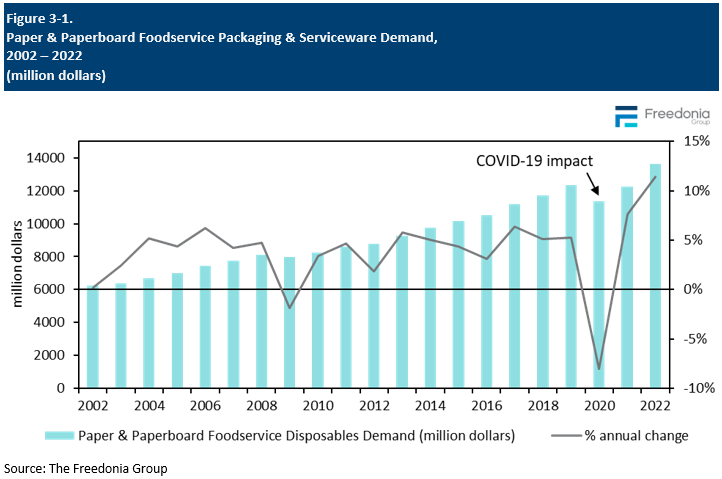
This Freedonia industry study analyzes the $13.6 billion US paper disposable packaging and serviceware market. It presents historical demand data (2012, 2017 and 2022) and forecasts (2027) by product and market.
Free Sample Report
Request a free sample of this report and our team will email it to you.
Report Overview
Understand market size and industry players
Understand the main types of packaging and demand trends
-
napkins
-
paper cups
-
paper plates
-
paper straws
 packaging and serviceware market. It presents historical demand data (2012, 2017 and 2022) and forecasts (2027) by product (beverage packaging, serviceware, food cups, boxes and folding cartons, clamshells and two-piece containers, packaging bags and wraps, carryout bags, trays, and other food packaging) and market (limited-service restaurants, full-service restaurants, retail foodservice and non-commercial foodservice).
Featuring 83 tables and 20 figures – available in Excel and Powerpoint! Learn More
This report includes data from 2012-2027 in 5 year intervals and tables featuring year-by-year data for 2019-2026.
Demand for paper and paperboard single-use foodservice products is forecast to grow 3.3% annually to $16.0 billion in 2027. Demand in unit terms will grow as sustainability concerns increase, leading restaurants to move away from materials such as conventional plastic and foam and adopt paper and other biodegradable materials as a replacement. Additionally, demand in value terms will be supported by a shift toward higher value packaging, as more sustainable products that also feature a high performance level are higher priced than conventional paper packaging. Further gains will result from elevated levels of foodservice delivery and carryout/drive-thru revenues elevating paper disposables usage.
Paper-based disposables account for nearly half of the overall foodservice disposables market due to the ubiquity of napkins, paper cups, and paper bags at foodservice establishments. Paper’s natural high biodegradability levels and low cost has made it the preferred material to replace plastics in suitable applications in past years. However, paper faces a number of challenges in keeping its market share.
Paper Faces Competition from New Materials to Replace Plastic
Restaurants have felt increasing pressure to address concerns of excessive waste and lack of biodegradability in their disposable packaging. As sustainability concerns increase, other materials such as molded fiber and bioplastics are entering the market and competing with paper in acquiring demand share from plastic. In response, paper foodservice disposables suppliers are improving product aesthetics and performance, as well as increasing paper products’ environmental profile through replacing product coatings that hinder the eco-friendliness of their products.Development of New Coatings to Increase Performance & Sustainability
An increased focus on biodegradability by end users has called into question the coatings used to improve paper performance in applications dealing with moisture and grease. Efforts from paper disposables suppliers to address this issue include the development of plant-based coatings as well as uncoated paper packaging that still offers high levels of grease resistance while maintaining high biodegradability levels.Elevated Interest in Carryout & Drive-Thru Will Support Demand for Paper Disposables
Although a shift from dining on premises to takeout orders and delivery via digital apps had been occurring prior to 2020, the pandemic significantly accelerated this trend. This has had a varied impact on paper disposables, with products such as carryout bags and takeout containers benefiting the most. However, offering disposables such as napkins and straws upon request to limit waste creation is a growing practice that could restrain further expansion of paper disposables demand.Historical Market Trends
At its broadest level, demand for single-use paper foodservice products is driven by trends in foodservice revenue, which is an indicator of the number of meals eaten away from home and the amount spent on those meals. Growth in foodservice activity in turn is dependent on a number of macroeconomic and demographic factors, including:
- trends in food consumption and the mix of food eaten at home versus away from home
- the health of the overall economy and levels of disposable income, which impact the ability of consumers to spend on more expensive restaurant meals (compared to home cooking)
- changes in the population mix, especially in terms of age cohorts (such as young adults) that are likely to eat out more often
- trends in consumer spending, including spending on travel and entertainment, which impact foodservice sales at hotels and sports and recreation venues
- student enrollment levels and trends in school lunch programs
- the mix of restaurants that are limited versus full-service, as limited service restaurants use a higher level and broader mix of disposables
- the share of total restaurant orders that are provided via drive-thru, curbside pickup, carryout, or delivery services
- the size and diversity of restaurant menus, as specific disposables are often used with specific menu items
- social factors such as health concerns, which not only influence the amount consumers eat out but the type of foods they purchase
- sustainability initiatives, which impact the overall level of disposables used as well as the types of products and materials used
- regulations, especially restrictions on specific materials or types of disposables
In addition, consumers are increasingly aware of the environmental impact of disposable packaging, and this has provided a distinct benefit for producers of paper products as major foodservice operations focus on improving their sustainability image.
Demand by Material (Paper & Paperboard)
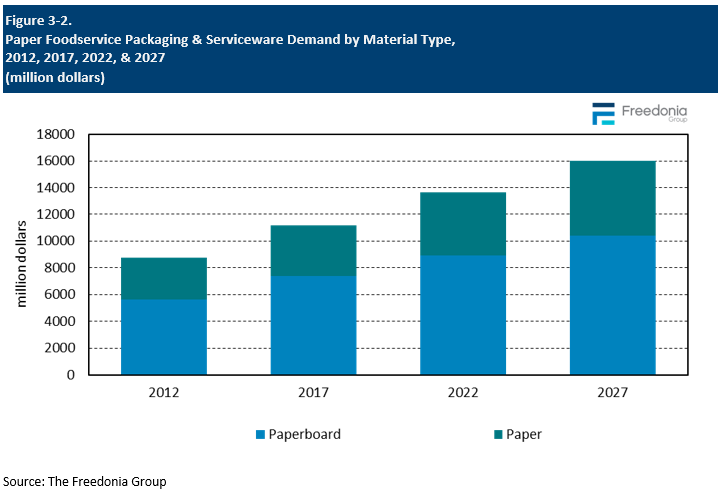
Paper and paperboard products account for nearly half of overall foodservice disposables demand and are gaining share from conventional plastic – their main competitor – due to growing preferences for materials that are perceived as environmentally friendly. However, in some applications paper products still need to address performance issues – particularly regarding high-moisture foods – and develop improved coatings that do not restrict recycling or product biodegradability.
Demand for paper and paperboard disposables is forecast to grow 3.3% annually to $16 billion in 2027. Products will lose demand share to other higher value materials increasingly penetrating the eco-friendly market – especially in applications where high quality is expected, as those are able to provide a better customer experience. However, new materials are still being implemented and have not yet reached economies of scale, meaning prices have yet to decline, allowing paper to compete as an inexpensive alternative.
Factors influencing overall demand include:
- Growth is expected due to a combination of convenience, cost-effectiveness, sustainability, and changing consumer behaviors.
- As more businesses look for ways to reduce their environmental impact and meet the demands of eco-conscious consumers, paper disposables are likely to become an increasingly popular option for the foodservice industry.
Pricing Trends
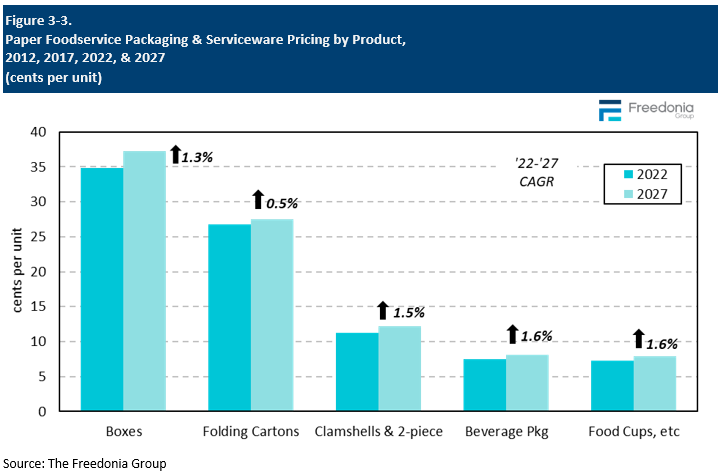
The foodservice disposables industry is competitive, and product pricing is a significant factor in customer purchasing decisions. Factors influencing prices for single-use foodservice products include:
- raw material and labor costs
- shipping and transportation costs
- supply and demand balances
- customization, design, and printing costs
- changes in the material mix for various products
- increasing participation in and corresponding competition from products made of newer and more innovative materials
- import competition
Despite the significance of raw material costs as a base influence on disposables prices, pricing for single-use foodservice products does not always track raw material costs, as manufacturers tend to absorb raw material price increases as much as possible to maintain competitiveness. In addition, foodservice establishments can switch from one type of disposable to another if cost becomes an issue, limiting the ability of disposables producers to pass on increasing materials costs as well.
Demand for paper and paperboard single-use foodservice products is forecast to grow 3.3% annually to $16.0 billion in 2027. Demand in unit terms will grow as sustainability concerns increase, leading restaurants to move away from materials such as conventional plastic and foam and adopt paper and other biodegradable materials as a replacement. Additionally, demand in value terms will be supported by a shift toward higher value packaging, as more sustainable products that also feature a high performance level are higher priced than conventional paper packaging. Further gains will result from elevated levels of foodservice delivery and carryout/drive-thru revenues elevating paper disposables usage.
Paper-based disposables account for nearly half of the overall foodservice disposables market due to the ubiquity of napkins, paper cups, and paper bags at foodservice establishments. Paper’s natural high biodegradability levels and low cost has made it the preferred material to replace plastics in suitable applications in past years. However, paper faces a number of challenges in keeping its market share.
Paper Faces Competition from New Materials to Replace Plastic
Restaurants have felt increasing pressure to address concerns of excessive waste and lack of biodegradability in their disposable packaging. As sustainability concerns increase, other materials such as molded fiber and bioplastics are entering the market and competing with paper in acquiring demand share from plastic. In response, paper foodservice disposables suppliers are improving product aesthetics and performance, as well as increasing paper products’ environmental profile through replacing product coatings that hinder the eco-friendliness of their products.Development of New Coatings to Increase Performance & Sustainability
An increased focus on biodegradability by end users has called into question the coatings used to improve paper performance in applications dealing with moisture and grease. Efforts from paper disposables suppliers to address this issue include the development of plant-based coatings as well as uncoated paper packaging that still offers high levels of grease resistance while maintaining high biodegradability levels.Elevated Interest in Carryout & Drive-Thru Will Support Demand for Paper Disposables
Although a shift from dining on premises to takeout orders and delivery via digital apps had been occurring prior to 2020, the pandemic significantly accelerated this trend. This has had a varied impact on paper disposables, with products such as carryout bags and takeout containers benefiting the most. However, offering disposables such as napkins and straws upon request to limit waste creation is a growing practice that could restrain further expansion of paper disposables demand.Historical Market Trends
At its broadest level, demand for single-use paper foodservice products is driven by trends in foodservice revenue, which is an indicator of the number of meals eaten away from home and the amount spent on those meals. Growth in foodservice activity in turn is dependent on a number of macroeconomic and demographic factors, including:
- trends in food consumption and the mix of food eaten at home versus away from home
- the health of the overall economy and levels of disposable income, which impact the ability of consumers to spend on more expensive restaurant meals (compared to home cooking)
- changes in the population mix, especially in terms of age cohorts (such as young adults) that are likely to eat out more often
- trends in consumer spending, including spending on travel and entertainment, which impact foodservice sales at hotels and sports and recreation venues
- student enrollment levels and trends in school lunch programs
- the mix of restaurants that are limited versus full-service, as limited service restaurants use a higher level and broader mix of disposables
- the share of total restaurant orders that are provided via drive-thru, curbside pickup, carryout, or delivery services
- the size and diversity of restaurant menus, as specific disposables are often used with specific menu items
- social factors such as health concerns, which not only influence the amount consumers eat out but the type of foods they purchase
- sustainability initiatives, which impact the overall level of disposables used as well as the types of products and materials used
- regulations, especially restrictions on specific materials or types of disposables
In addition, consumers are increasingly aware of the environmental impact of disposable packaging, and this has provided a distinct benefit for producers of paper products as major foodservice operations focus on improving their sustainability image.

Demand by Material (Paper & Paperboard)
Paper and paperboard products account for nearly half of overall foodservice disposables demand and are gaining share from conventional plastic – their main competitor – due to growing preferences for materials that are perceived as environmentally friendly. However, in some applications paper products still need to address performance issues – particularly regarding high-moisture foods – and develop improved coatings that do not restrict recycling or product biodegradability.
Demand for paper and paperboard disposables is forecast to grow 3.3% annually to $16 billion in 2027. Products will lose demand share to other higher value materials increasingly penetrating the eco-friendly market – especially in applications where high quality is expected, as those are able to provide a better customer experience. However, new materials are still being implemented and have not yet reached economies of scale, meaning prices have yet to decline, allowing paper to compete as an inexpensive alternative.
Factors influencing overall demand include:
- Growth is expected due to a combination of convenience, cost-effectiveness, sustainability, and changing consumer behaviors.
- As more businesses look for ways to reduce their environmental impact and meet the demands of eco-conscious consumers, paper disposables are likely to become an increasingly popular option for the foodservice industry.

Pricing Trends
The foodservice disposables industry is competitive, and product pricing is a significant factor in customer purchasing decisions. Factors influencing prices for single-use foodservice products include:
- raw material and labor costs
- shipping and transportation costs
- supply and demand balances
- customization, design, and printing costs
- changes in the material mix for various products
- increasing participation in and corresponding competition from products made of newer and more innovative materials
- import competition
Despite the significance of raw material costs as a base influence on disposables prices, pricing for single-use foodservice products does not always track raw material costs, as manufacturers tend to absorb raw material price increases as much as possible to maintain competitiveness. In addition, foodservice establishments can switch from one type of disposable to another if cost becomes an issue, limiting the ability of disposables producers to pass on increasing materials costs as well.

- Executive Summary
- Figure 1-1. Paper Foodservice Packaging & Serviceware Market
- About This Report
- Report Details
- Study Scope & Product Description
- Impact of COVID-19 Pandemic
- Table | Annual Paper & Paperboard Foodservice Disposable Packaging & Serviceware Demand by Material, 2020 –
- Table | Annual Paper & Paperboard Foodservice Disposable Packaging & Serviceware Demand by Market, 2020 – 20
- Figure 2-1. Paper Foodservice Packaging & Serviceware Demand, 2019 – 2024
- Overview
- Historical Market Trends
- Table | Paper & Paperboard Foodservice Packaging & Serviceware Demand, 2012 – 2022
- Figure 3-1. Paper & Paperboard Foodservice Packaging & Serviceware Demand, 2002 – 2022
- Demand by Material (Paper & Paperboard)
- Table | Paper & Paperboard Foodservice Packaging & Serviceware Demand by Material, 2012, 2017, 2022, &2027
- Table | Annual Paper Foodservice Packaging & Serviceware Demand by Material, 2019 – 2026
- Figure 3-2. Paper Foodservice Packaging & Serviceware Demand by Material Type, 2012, 2017, 2022, &20
- Pricing Trends
- Table | Paper & Paperboard Foodservice Disposable Packaging & Serviceware Pricing by Product, 2012, 2017, 20
- Table | Annual Paper & Paperboard Foodservice Disposable Packaging & Serviceware Pricing by Product, 2019 –
- Figure 3-3. Paper Foodservice Packaging & Serviceware Pricing by Product, 2012, 2017, 2022, &2027
- Competitive Products
- Figure 3-4. Comparative Value Growth: Paper Foodservice Packaging & Serviceware & Competitive Produc
- Global Perspective
- Figure 3-5. Global Paper Foodservice Disposable Demand Share, 2022
- Historical Market Trends
- Factors Impacting Paper Foodservice Disposables Demand
- Foodservice Industry Trends
- Foodservice Revenues by Establishment Type
- Table | Foodservice Revenue, 2012, 2017, 2022, &2027
- Trends in Eating Away from Home
- Figure 4-1. Food Expenditure Share: Away From Home vs. At Home, 2012 – 2021
- Growth in Fast Casual Restaurants
- Growth in Off-Premises Dining (Carry-Out, Curbside Pickup, &Delivery)
- Foodservice Revenues by Establishment Type
- Regulations
- State Regulations
- Federal Regulations
- PFAS (Perfluoroalkyl & Polyfluoroalkyl Substances)
- Sustainability Initiatives
- Consumer Preferences
- General Environmental Attitudes
- Table | Consumer Attitudes on Recycling & Environmental Responsibility by Age Group, 2022
- Table | Consumer Attitudes on Recycling & Environmental Responsibility by Gender, 2022
- Table | Consumer Attitudes on Recycling & Environmental Responsibility by Annual Household Income Bracket, 2
- Consumer Sentiment
- Table | Consumer Attitudes About Packaging & Serviceware Used in Foodservice, 2022
- Table | Consumer Attitudes About Hygiene of Disposables by Gender, Age Group, Urban vs. Rural Setting, Annua
- Table | Consumer Attitudes About Restaurant Use of Sustainable Disposables by Gender, Age Group, Urban vs. R
- Table | Willingness to Pay More for Sustainable Disposables by Gender, Age Group, Urban vs. Rural Setting, A
- Table | Consumer Awareness of Disposable Material by Gender, Age Group, Urban vs. Rural Setting, Annual Hous
- Table | Preference for Receiving Foodservice Disposables Upon Request by Gender, Age Group, Urban vs. Rural
- General Environmental Attitudes
- Foodservice Industry Trends
- Paper Foodservice Disposable Products
- Demand by Product Type
- Table | Paper & Paperboard Foodservice Disposable Packaging & Serviceware Demand by Product, 2012, 2017, 202
- Table | Annual Paper & Paperboard Foodservice Disposable Packaging & Serviceware Demand by Product, 2019 – 2
- Figure 5-1. Paper & Paperboard Foodservice Packaging & Serviceware Demand by Product Type, 2012, 201
- Boxes & Folding Cartons
- Demand Overview
- Table | Disposable Foodservice Paper Boxes & Folding Carton Demand by Product, 2012, 2017, 2022, &2027
- Table | Annual Disposable Foodservice Paper Boxes & Folding Carton Demand by Product, 2019 – 2026
- Figure 5-2. Paperboard Boxes & Folding Cartons: Examples
- Corrugated & Set-Up Boxes
- Table | Disposable Foodservice Corrugated & Set-Up Box Demand by Product & Market, 2012, 2017, 2022, &2027
- Table | Annual Disposable Foodservice Corrugated & Set-Up Boxes Demand by Product & Market, 2019 – 2026
- Folding Cartons
- Table | Disposable Foodservice Folding Carton Demand by Market, 2012, 2017, 2022, &2027
- Table | Annual Disposable Foodservice Folding Carton Demand by Market, 2019 – 2026
- Demand Overview
- Serviceware (Dinnerware, Napkins, Straws, Drink Carriers)
- Demand Overview
- Table | Disposable Foodservice Paper & Paperboard Serviceware Demand by Product, 2012, 2017, 2022, &2027
- Table | Annual Disposable Foodservice Paper Serviceware Demand by Product, 2019 – 2026
- Figure 5-3. Paper Serviceware: Examples
- Napkins
- Table | Disposable Foodservice Napkin Demand by Market, 2012, 2017, 2022, &2027
- Table | Annual Disposable Napkin Demand by Market, 2019 – 2026
- Dinnerware
- Table | Disposable Foodservice Paper Dinnerware Demand by Market, 2012, 2017, 2022, &2027
- Table | Annual Disposable Foodservice Paper Dinnerware Demand by Market, 2019 – 2026
- Other Serviceware
- Table | Other Disposable Foodservice Paper & Paperboard Serviceware Demand by Market, 2012, 2017, 2022, &202
- Table | Annual Other Disposable Foodservice Paper & Paperboard Serviceware Demand by Market, 2019 – 2026
- Demand Overview
- Food Cups, Scoops, Tubs & Buckets
- Demand Overview
- Table | Disposable Foodservice Paper & Paperboard Food Cup, Scoop, Tub, &Bucket Demand by Product, 2012, 201
- Table | Annual Disposable Foodservice Paper Food Cup, Scoop, Tub, &Bucket Demand by Product, 2019 – 2026
- Figure 5-4. Paperboard Food Cups, Scoops, Tubs, &Buckets: Examples
- Food Cups
- Table | Disposable Foodservice Paper Food Cup Demand by Market, 2012, 2017, 2022, &2027
- Table | Annual Disposable Foodservice Paper Food Cup Demand by Market, 2019 – 2026
- Scoop Cups
- Table | Disposable Foodservice Paper Scoop Cup Demand by Market, 2012, 2017, 2022, &2027
- Table | Annual Disposable Foodservice Paper Scoop Cup Demand by Market, 2019 – 2026
- Tubs & Buckets
- Table | Disposable Foodservice Paper Tub & Bucket Demand by Market, 2012, 2017, 2022, &2027
- Table | Annual Disposable Foodservice Paper Tub & Bucket Demand by Market, 2019 – 2026
- Demand Overview
- Beverage Packaging (Cups, Sleeves & Bag-in-Box)
- Table | Paper & Paperboard Disposable Foodservice Beverage Packaging Demand by Product & Market, 2012, 2017,
- Table | Annual Paper Disposable Foodservice Beverage Packaging Demand by Product & Market, 2019 – 2026
- Figure 5-5. Paper & Paperboard Beverage Packaging: Examples
- Packaging Bags, Wraps, &Liners
- Table | Paper Disposable Foodservice Packaging Bag, Wrap, &Liner Demand by Product & Market, 2012, 2017, 202
- Table | Annual Paper Disposable Foodservice Packaging Bag, Wrap, &Liner Demand by Product & Market, 2019 – 2
- Figure 5-6. Paper Packaging Bags & Wraps: Examples
- Carryout (Take-Out) Bags
- Table | Paper Disposable Foodservice Carryout (Take-Out) Bag Demand by Market, 2012, 2017, 2022, &2027
- Table | Annual Paper Disposable Foodservice Carryout (Take-Out) Bag Demand by Market, 2019 – 2026
- Figure 5-7. Paper Carryout Bags: Examples
- Clamshells & Two-Piece Containers
- Table | Paper Disposable Foodservice Clamshell & Two-Piece Container Demand by Product & Market, 2012, 2017,
- Table | Annual Paper Disposable Foodservice Clamshell & Two-Piece Container Demand by Product & Market, 2019
- Figure 5-8. Paperboard Clamshells & Two-Piece Containers: Examples
- Trays & Other Packaging
- Table | Paper & Paperboard Disposable Foodservice Tray & Other Packaging Demand by Product & Market, 2012, 2
- Table | Annual Disposable Foodservice Paper Tray & Other Packaging Demand by Product & Market, 2019 – 2026
- Figure 5-9. Paper & Paperboard Trays & Other Packaging: Examples
- Demand by Product Type
- Foodservice Markets
- Demand by Market
- Table | Paper & Paperboard Foodservice Disposables Demand by Market, 2012, 2017, 2022, &2027
- Table | Annual Paper & Paperboard Foodservice Disposables Demand by Market, 2019 – 2026
- Figure 6-1. Paper Foodservice Packaging & Serviceware Demand by Market, 2012, 2017, 2022, &2027
- Limited Service Restaurants
- Demand by Restaurant Type & Product
- Table | Limited Service Restaurant Market for Paper & Paperboard Foodservice Disposables by Establishment Ty
- Table | Annual Limited Service Restaurant Market for Paper & Paperboard Foodservice Disposables by Establish
- Table | Limited Service Restaurant Market for Paper & Paperboard Foodservice Disposables by Product, 2012, 2
- Table | Annual Limited Service Restaurant Market for Paper & Paperboard Foodservice Disposables by Product,
- Figure 6-2. Limited Restaurant Market for Paper Foodservice Packaging & Serviceware by Submarket & P
- Fast Food & Fast Casual Restaurants
- Table | Fast Food & Fast Casual Restaurant Market for Paper & Paperboard Foodservice Disposables by Product,
- Table | Annual Fast Food & Fast Casual Restaurant Market for Paper & Paperboard Foodservice Disposables by P
- Table | Fast Food & Fast Casual Restaurant Market for Paper & Paperboard Foodservice Disposables by Product,
- Table | Annual Fast Food & Fast Casual Restaurant Market for Paper & Paperboard Foodservice Disposables by P
- Coffee & Snack Shops
- Table | Coffee & Snack Shop Market for Paper & Paperboard Foodservice Disposables by Product, 2012, 2017, 20
- Table | Annual Coffee & Snack Shop Market for Paper & Paperboard Foodservice Disposables by Product, 2019 –
- Table | Coffee & Snack Shop Market for Paper & Paperboard Foodservice Disposables by Product, 2012, 2017, 20
- Table | Annual Coffee & Snack Shop Market for Paper & Paperboard Foodservice Disposables by Product, 2019 –
- Demand by Restaurant Type & Product
- Full-Service Restaurants, Cafeterias, &Bars
- Table | Full-Service Restaurant, Cafeteria, &Bar Market for Paper & Paperboard Foodservice Disposables by Pr
- Table | Annual Full-Service Restaurant, Cafeteria, &Bar Market for Paper & Paperboard Foodservice Disposable
- Table | Full-Service Restaurant, Cafeteria, &Bar Market for Paper & Paperboard Foodservice Disposables by Pr
- Table | Annual Full-Service Restaurant, Cafeteria, &Bar Market for Paper & Paperboard Foodservice Disposable
- Retail Foodservice (Grocery & Convenience Stores)
- Table | Retail Foodservice Market for Paper & Paperboard Foodservice Disposables by Product, 2012, 2017, 202
- Table | Annual Retail Foodservice Market for Paper & Paperboard Foodservice Disposables by Product, 2019 – 2
- Table | Retail Foodservice Market for Paper & Paperboard Foodservice Disposables by Product, 2012, 2017, 202
- Table | Annual Retail Foodservice Market for Paper & Paperboard Foodservice Disposables by Product, 2019 – 2
- Noncommercial Foodservice
- Table | Noncommercial Foodservice Market for Paper & Paperboard Foodservice Disposables by Product, 2012, 20
- Table | Annual Noncommercial Foodservice Market for Paper Foodservice Disposables by Product, 2019 – 2026
- Table | Noncommercial Foodservice Market for Paper & Paperboard Foodservice Disposables by Product, 2012, 20
- Table | Annual Noncommercial Foodservice Market for Paper Foodservice Disposables by Product,, 2019 – 2026
- Demand by Market
- Key Suppliers & Market Share
- Industry Composition
- Market Share
- Figure 7-1. Paper Packaging & Serviceware Market Share by Company, 2022
- Mergers & Acquisitions
- Table | Selected Mergers & Acquisitions
- Appendix
- Scope
- Table | Relevant Industry Codes
- Definitions
- Freedonia Methodology
- Study-Specific Methodology
- Sources
- Associations & Agencies
- Related Studies & Reports
- Macroeconomic Assumptions
- Economic Environment
- Table | Macroeconomic Indicators, 2012, 2017, 2022, &2027
- Demographic Trends
- Table | Population & Households, 2012, 2017, 2022, &2027
- Consumer Spending
- Table | Personal Consumption Expenditures & Retail Sales, 2012, 2017, 2022, &2027
- Retail Sales
- Table | Nondurable Goods Retail Sales, 2012, 2017, 2022, &2027
- Economic Environment
- Scope
Growth is driven by the continued replacement of plastic products due to paper’s strong environmental image and strong gains in products like paper carryout bags and other products used with carryout and delivery orders.
Paper and paperboard foodservice disposables face competition from a variety of other materials, including plastics, molded fiber, and aluminum.
Demand for single-use foodservice products made from paper and paperboard is forecast to grow 3.3% annually to $16.0 billion in 2027.
Paper and paperboard products account for nearly half of overall foodservice disposables demand and are gaining share from conventional plastic – their main competitor – due to growing preferences for materials that are perceived as environmentally friendly.