US Packaging Wrap
This study examines the US market for packaging wrap. Historical data are provided for 2011, 2016, and 2021, with forecasts through 2026. Also provided is an analysis of key industry players.
Free Sample Report
Request a free sample of this report and our team will email it to you.
Report Overview
Learn more with this accurate assessment of shifts and determine which aspects of the market will revert to pre-pandemic trends and which ones will remain in place.
-
How much sustainability is impacting the materials used for disposables
-
Use of disposables at restaurants and other establishments
 Historical data are provided for 2011, 2016, and 2021, with forecasts through 2026. Also provided is an analysis of key industry players.
Featuring 56 tables and 9 figures – available in Excel and Powerpoint! Learn More
This report includes data from 2011-2031 in 5 year intervals and tables featuring year-by-year data for 2018-2025.
Sustainability Efforts Have Strong Influence on Demand for Wrap
Both suppliers and end users of packaging wrap have sustainability goals, which have a complicated effect on demand for wrap. On one hand, the general shift favoring flexible packaging will be beneficial to wrap demand, as will food waste reduction efforts achieved by using wrap to package meat and other fresh foods in smaller portion-sized amounts. At the same time, efforts to reduce secondary and other inessential packaging – such as film overwrap of beverage containers or pharmaceutical products – will serve to curb packaging wrap demand in those applications.Performance Characteristics Ensures Plastic Retains Market Share
Plastic is expected to remain the dominant material used to produce packaging wrap. While paper wrap will retain much of its market presence (due in part to its image as an environmentally preferable material), it is not expected to take market share from plastic wrap as it has for pouches. Instead, plastic wrap will actually increase in popularity as it offers better barrier properties and moisture protection in food packaging and other applications where such attributes are required.Major Food Applications to Lead Growth
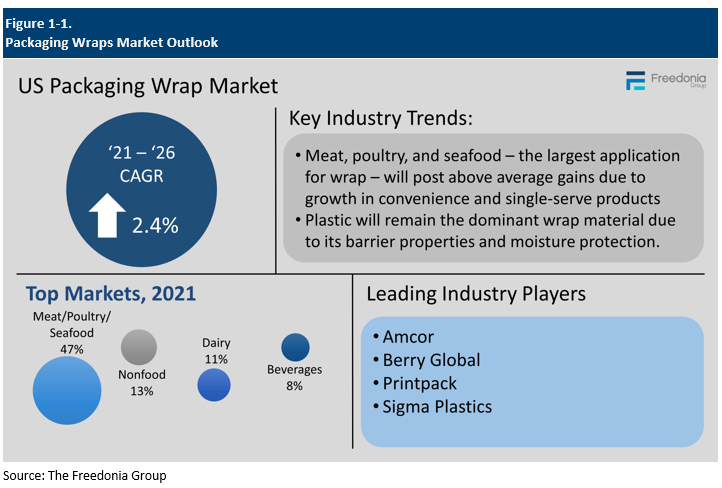
The market for packaging wrap is fairly mature, and the prospects for wrap demand are primarily determined by the outlook for the major markets in which they are used. Wrap markets that will have the biggest impact on wrap demand are meat, poultry, and seafood; and fresh produce:- Growth in the meat, poultry, and seafood market – by far the largest market for packaging wrap – will be driven by increased packaging of products into single portions, and the growing popularity of case-ready fresh meat and ready-to-cook meal items such as specialty ready-to-cook cheeseburgers.
- Gains in the produce market will result mainly from the increased share of fresh produce being packaged rather than being sold unpackaged in retail stores.
Demand by Market
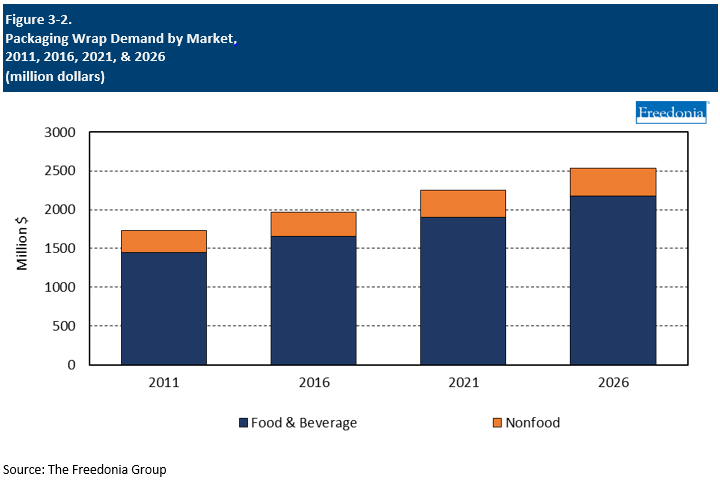
Demand for packaging wrap is expected to grow 2.4% per year to $2.5 billion in 2026. Though wrap faces strong competition from lidding and skin packaging, it will still benefit from a general shift away from rigid packaging. Wrap will also continue to benefit from light weight and low cost, which are especially important for meat products sold at big-box stores and discount grocers.Food and beverage applications represented 85% of the US wrap market in 2021, and they will remain dominant based on continued demand for product transparency and material use reductions; these trends favor all-film packaging:
- Meat, poultry, and seafood products will remain the most significant applications for wrap, due to wrap’s low cost and adequate barrier properties.
- Dairy products, beverages, and candy and confections also represent significant demand.
Competition from Rigid Packaging
Wrap is often used in tandem with other flexible and rigid packaging products to provide complete product protection, allow for easier dispensing of contents, and enhance the shelf appeal of products. However, source reduction efforts (by both packaging manufacturers and end users) are discouraging the use of extra product packaging,Overall, sustainability and performance continue to be the top drivers of change in the packaging industry. Continued market presence for wrap greatly depends on how consumers’ perceptions of plastic packaging, as well as the durability of trends focused on eliminating single-use plastics.
Plastic is the dominant material used to produce wrap, with paper, foil, and cellophane limited to differing extents by performance constraints. Therefore, improving recycling rates and recycled content usage are key competitive factors in wrap maintaining or increasing its share of the overall packaging market.
Sustainability Initiatives
Sustainability has become one of the top trends in the packaging industry. Customers and consumers increasingly demand packaging products that are better for the environment, and regulators continue to make single-use packaging the target of restrictions and bans. Key ways that packaging producers are becoming more sustainable include:- Increasing recycling rates and using more recycled content
- Source reduction, or reducing the volume of packaging waste through actions like downgauging or otherwise reducing packaging weight and eliminating secondary packaging
- Developing biodegradable and/or compostable products
Sustainability Efforts Have Strong Influence on Demand for Wrap
Both suppliers and end users of packaging wrap have sustainability goals, which have a complicated effect on demand for wrap. On one hand, the general shift favoring flexible packaging will be beneficial to wrap demand, as will food waste reduction efforts achieved by using wrap to package meat and other fresh foods in smaller portion-sized amounts. At the same time, efforts to reduce secondary and other inessential packaging – such as film overwrap of beverage containers or pharmaceutical products – will serve to curb packaging wrap demand in those applications.Performance Characteristics Ensures Plastic Retains Market Share
Plastic is expected to remain the dominant material used to produce packaging wrap. While paper wrap will retain much of its market presence (due in part to its image as an environmentally preferable material), it is not expected to take market share from plastic wrap as it has for pouches. Instead, plastic wrap will actually increase in popularity as it offers better barrier properties and moisture protection in food packaging and other applications where such attributes are required.Major Food Applications to Lead Growth
The market for packaging wrap is fairly mature, and the prospects for wrap demand are primarily determined by the outlook for the major markets in which they are used. Wrap markets that will have the biggest impact on wrap demand are meat, poultry, and seafood; and fresh produce:- Growth in the meat, poultry, and seafood market – by far the largest market for packaging wrap – will be driven by increased packaging of products into single portions, and the growing popularity of case-ready fresh meat and ready-to-cook meal items such as specialty ready-to-cook cheeseburgers.
- Gains in the produce market will result mainly from the increased share of fresh produce being packaged rather than being sold unpackaged in retail stores.

Demand by Market
Demand for packaging wrap is expected to grow 2.4% per year to $2.5 billion in 2026. Though wrap faces strong competition from lidding and skin packaging, it will still benefit from a general shift away from rigid packaging. Wrap will also continue to benefit from light weight and low cost, which are especially important for meat products sold at big-box stores and discount grocers.Food and beverage applications represented 85% of the US wrap market in 2021, and they will remain dominant based on continued demand for product transparency and material use reductions; these trends favor all-film packaging:
- Meat, poultry, and seafood products will remain the most significant applications for wrap, due to wrap’s low cost and adequate barrier properties.
- Dairy products, beverages, and candy and confections also represent significant demand.

Competition from Rigid Packaging
Wrap is often used in tandem with other flexible and rigid packaging products to provide complete product protection, allow for easier dispensing of contents, and enhance the shelf appeal of products. However, source reduction efforts (by both packaging manufacturers and end users) are discouraging the use of extra product packaging,Overall, sustainability and performance continue to be the top drivers of change in the packaging industry. Continued market presence for wrap greatly depends on how consumers’ perceptions of plastic packaging, as well as the durability of trends focused on eliminating single-use plastics.
Plastic is the dominant material used to produce wrap, with paper, foil, and cellophane limited to differing extents by performance constraints. Therefore, improving recycling rates and recycled content usage are key competitive factors in wrap maintaining or increasing its share of the overall packaging market.
Sustainability Initiatives
Sustainability has become one of the top trends in the packaging industry. Customers and consumers increasingly demand packaging products that are better for the environment, and regulators continue to make single-use packaging the target of restrictions and bans. Key ways that packaging producers are becoming more sustainable include:- Increasing recycling rates and using more recycled content
- Source reduction, or reducing the volume of packaging waste through actions like downgauging or otherwise reducing packaging weight and eliminating secondary packaging
- Developing biodegradable and/or compostable products
- Executive Summary
- Figure 1-1. Packaging Wraps Market Outlook
- About This Report
- Report Details
- Study Scope & Product Description
- Figure 2-1. Packaging Wrap Examples
- Impact of COVID-19 Pandemic
- Table | Packaging Wrap Demand by Market & Application, 2019 - 2022
- Table | Packaging Wrap Demand by Material, 2019 - 2022
- Figure 2-2. Packaging Wrap Demand, 2018 - 2024
- Overview
- Historical Market Trends
- Table | Packaging Wrap Demand, 2011 - 2021
- Figure 3-1. Packaging Wrap Demand, 2001 - 2021
- Demand by Market
- Table | Packaging Wrap Demand by Market, 2011, 2016, 2021, &2026
- Table | Annual Packaging Wrap Demand by Market, 2018 - 2025
- Figure 3-2. Packaging Wrap Demand by Market, 2011, 2016, 2021, &2026
- Demand by Material
- Table | Packaging Wrap Demand by Material, 2011, 2016, 2021, &2026
- Table | Annual Packaging Wrap Demand by Material, 2018 - 2025
- Figure 3-3. Packaging Wrap Demand by Material, 2011, 2016, 2021, &2026
- Plastic
- Table | Plastic Packaging Wrap Demand by Market, 2011, 2016, 2021, &2026
- Table | Annual Plastic Packaging Wrap Demand by Market, 2018 - 2025
- Paper
- Table | Paper Packaging Wrap Demand by Market, 2011, 2016, 2021, &2026
- Table | Annual Paper Packaging Wrap Demand by Market, 2018 - 2025
- Other Materials
- Table | Other Packaging Wrap Demand by Material, 2011, 2016, 2021, &2026
- Table | Annual Packaging Other Wrap Demand by Material, 2018 - 2025
- Pricing Trends
- Table | Packaging Wrap Material Price Deflators, 2011, 2016, 2021, &2026
- Table | Annual Packaging Wrap Material Price Deflators, 2018 - 2025
- Historical Market Trends
- Factors Impacting Flexible Packaging Demand
- Competition from Rigid Packaging
- Technology & Product Innovation
- Barrier Properties & Mixed Material Use
- Aqueous Barrier Solutions
- Convenience & Other Performance Features
- Customization & Industrial Internet of Things (IIoT) Automation
- Growth in E-Commerce
- Regulations
- Sustainability Initiatives
- Source Reduction
- Recycling & Recycled Content
- Biodegradable Packaging
- Compostable Packaging
- Consumer Preferences
- Importance of Packaging
- Table | "Packaging Is An Important Factor to Me When Making My Grocery Shopping Choices", by Gender & Age Gr
- Preferred Packaging Characteristics
- Table | Packaging Features: Consumer Opinions on Eco-Friendly Packaging by Gender & Age Group 2022
- Table | Packaging Features: Consumer Opinions on Priority of Eco-Friendly Packaging Features, 2022
- Table | Packaging Features: Microwaveability, "I Put Packaging in the Microwave If Use Instructions Say I Ca
- Recycling Attitudes & Environmental Responsibility
- Table | Consumer Insights: Attitudes on Environment & Responsibility by Gender & Age Group 2022
- Table | Consumer Insights: Attitudes on Recycling & Waste by Gender & Age Group 2022
- Sustainability Views by Material
- Table | Consumer Insights: Sustainability Views by Material, 2022
- Importance of Packaging
- Food & Beverage Markets
- Market Scope
- Demand by Application
- Table | Food & Beverage Markets for Packaging Wraps by Application, 2011, 2016, 2021, &2026
- Table | Annual Food & Beverage Markets for Packaging Wraps by Application, 2018 - 2025
- Figure 5-1. Food & Beverage Markets for Packaging Wraps by Application, 2011, 2016, 2021, &2026
- Meat, Poultry, &Seafood
- Market Scope
- Table | Industry Codes Related to Meat, Poultry, &Seafood
- Market Outlook
- Table | Meat, Poultry, &Seafood Market for Packaging Wrap by Material, 2011, 2016, 2021, &2026
- Table | Annual Meat, Poultry, &Seafood Market for Packaging Wrap by Material, 2018 - 2025
- Market Scope
- Dairy Products
- Market Scope
- Table | Industry Codes Related to Dairy Products
- Market Outlook
- Table | Dairy Product Market for Packaging Wrap by Material, 2011, 2016, 2021, &2026
- Table | Annual Dairy Product Market for Packaging Wrap by Material, 2018 - 2025
- Market Scope
- Beverages
- Market Scope
- Table | Industry Codes Related to Beverages
- Market Outlook
- Table | Beverage Market for Packaging Wrap, 2011, 2016, 2021, &2026
- Table | Annual Beverage Market for Packaging Wrap, 2018 - 2025
- Market Scope
- Candy & Confections
- Market Scope
- Table | Industry Codes Related to Candy & Confections
- Market Outlook
- Table | Candy & Confections Market for Packaging Wrap by Material, 2011, 2016, 2021, &2026
- Table | Annual Candy & Confections Market for Packaging Wrap by Material, 2018 - 2025
- Market Scope
- Fresh Produce
- Market Scope
- Market Outlook
- Table | Fresh Produce Market for Packaging Wrap, 2011, 2016, 2021, &2026
- Table | Annual Fresh Produce Market for Packaging Wrap, 2018 - 2025
- Frozen Prepared Foods
- Market Scope
- Table | Industry Codes Related to Frozen Prepared Foods
- Market Outlook
- Table | Frozen Prepared Foods Market for Packaging Wrap, 2011, 2016, 2021, &2026
- Table | Annual Frozen Prepared Foods Market for Packaging Wrap, 2018 - 2025
- Market Scope
- Other Foods
- Market Scope
- Table | Industry Codes Related to Other Food Products
- Market Outlook
- Table | Other Food Markets for Packaging Wrap by Material & Application, 2011, 2016, 2021, &2026
- Table | Annual Other Food Markets for Packaging Wrap by Material & Application, 2018 - 2025
- Market Scope
- Nonfood Markets
- Market Scope
- Demand by Application
- Table | Nonfood Markets for Packaging Wrap by Application, 2011, 2016, 2021, &2026
- Table | Annual Nonfood Markets for Packaging Wrap by Application, 2018 - 2025
- Figure 6-1. Nonfood Markets for Packaging Wrap by Application, 2011, 2016, 2021, &2026
- Paper & Textiles
- Market Scope
- Table | Industry Codes Related to Paper & Textile Products
- Market Outlook
- Table | Paper & Textile Market for Packaging Wrap by Material, 2011, 2016, 2021, &2026
- Table | Annual Paper & Textile Market for Packaging Wrap by Material, 2018 - 2025
- Market Scope
- Other Nonfood Markets
- Market Scope
- Market Outlook
- Table | Other Nonfood Markets for Packaging Wrap by Material, 2011, 2016, 2021, &2026
- Table | Annual Other Nonfood Markets for Packaging Wrap by Material, 2018 - 2025
- Key Suppliers & Market Share
- Industry Composition
- Market Share
- Figure 7-1. Packaging Wrap Market Share by Company, 2021
- Mergers & Acquisitions
- Table | Selected Mergers & Acquisitions
- Appendix
- Scope
- Table | Relevant Industry Codes
- Definitions
- Freedonia Methodology
- Study-Specific Methodology
- Sources
- Associations & Agencies
- Related Studies & Reports
- Macroeconomic Assumptions
- Economic Environment
- Table | Macroeconomic Indicators, 2011, 2016, 2021, &2026
- Demographic Trends
- Table | Population & Households, 2011, 2016, 2021, &2026
- Food & Beverage Industry Outlook
- Table | Food & Beverage Manufacturing, 2011, 2016, 2021, &2026
- Economic Environment
- Scope
Overall, 61% of consumers indicate that they prefer to buy products with packaging made from recycled materials.
Overall, sustainability and performance continue to be the top drivers of change in the packaging industry.
Packaging wrap (or wrappers) is generally defined as a flat sheet of packaging material, such as plastic film, paper, cellophane, or cloth, which is cut to size and wrapped around a product to contain, bundle, and/or protect its contents.
Packaging wrap generally consists of a single ply or multiple plies of flexible material that are laminated together by an adhesive system. Coextruded, oriented, and metalized plastic film is also included. Paper includes all grades and finishes of paper but excludes paperboard and molded pulp.